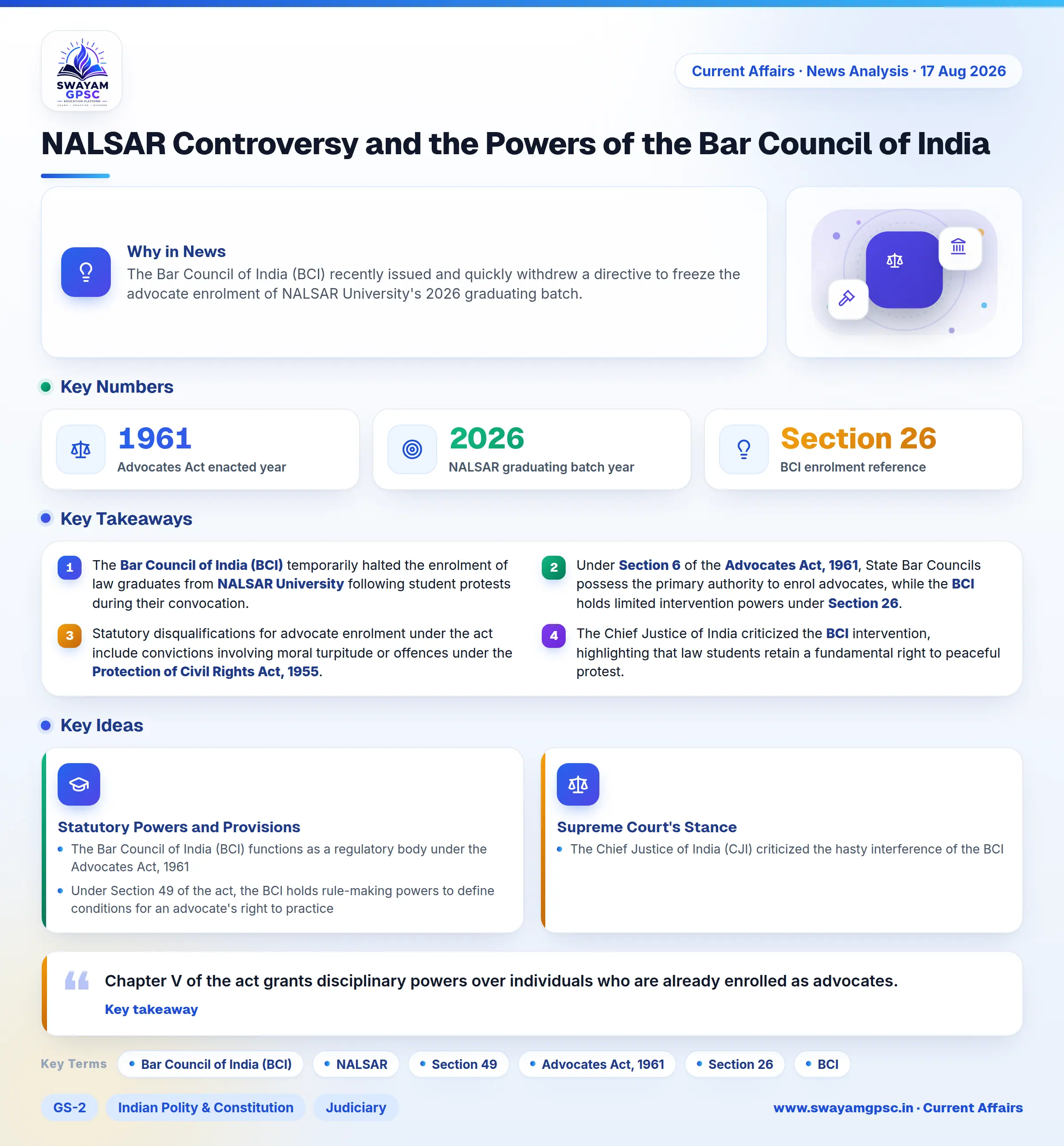
NALSAR Controversy and the Powers of the Bar Council of India
#GS-2 #Indian Polity & Constitution #Judiciary #Governance & Social Justice #Regulatory Bodies #Current Events #National
Key takeaways
- The Bar Council of India (BCI) temporarily halted the enrolment of law graduates from NALSAR University following student protests during their convocation.
- Under Section 6 of the Advocates Act, 1961, State Bar Councils possess the primary authority to enrol advocates, while the BCI holds limited intervention powers under Section 26.
- Statutory disqualifications for advocate enrolment under the act include convictions involving moral turpitude or offences under the Protection of Civil Rights Act, 1955.
- The Chief Justice of India criticized the BCI intervention, highlighting that law students retain a fundamental right to peaceful protest.
Why in News
- The Bar Council of India (BCI) recently issued and quickly withdrew a directive to freeze the advocate enrolment of NALSAR University's 2026 graduating batch. This action triggered a legal debate on the scope of BCI powers and the statutory authority of State Bar Councils under the Advocates Act, 1961.
- Students at NALSAR opposed inviting the Chief Justice of India (CJI) to their convocation ceremony. They raised concerns about the Supreme Court declining to hear petitions regarding police action on students protesting the NEET-UG paper leak.
Statutory Powers and Provisions under Advocates Act, 1961
- The Bar Council of India (BCI) functions as a regulatory body under the Advocates Act, 1961, overseeing legal education, professional standards, and State Bar Councils.
- Under Section 49 of the act, the BCI holds rule-making powers to define conditions for an advocate's right to practice law in India.
- The Advocates Act, 1961 sets up State Bar Councils under Section 3 and the BCI under Section 4, where Section 6 grants State Bar Councils the specific power to enrol advocates.
- According to Section 26, if a State Bar Council's enrolment committee wants to reject an individual application, it must send the reasons to the BCI. However, this provision gives no explicit power to impose a blanket ban on an entire batch.
- Legal grounds for disqualification from enrolment include convictions for moral turpitude, violations of the Protection of Civil Rights Act, 1955, or removal from government service under specified conditions.
- Chapter V of the act grants disciplinary powers over individuals who are already enrolled as advocates. Unenrolled law graduates fall outside this disciplinary framework, although the BCI continues to oversee overall standards of legal education.
Supreme Court's Stance
- The Chief Justice of India (CJI) criticized the hasty interference of the BCI, stating that students have a legitimate right to protest and that the situation was simply an ongoing communication between him and the students.