MSCARO 2026 and ICAI Audit Standards for Multi-State Cooperatives
#GS-3 #Economy #Banking #Cooperatives #Governance & Social Justice #Regulatory Bodies #Rapid Fire CA
Key takeaways
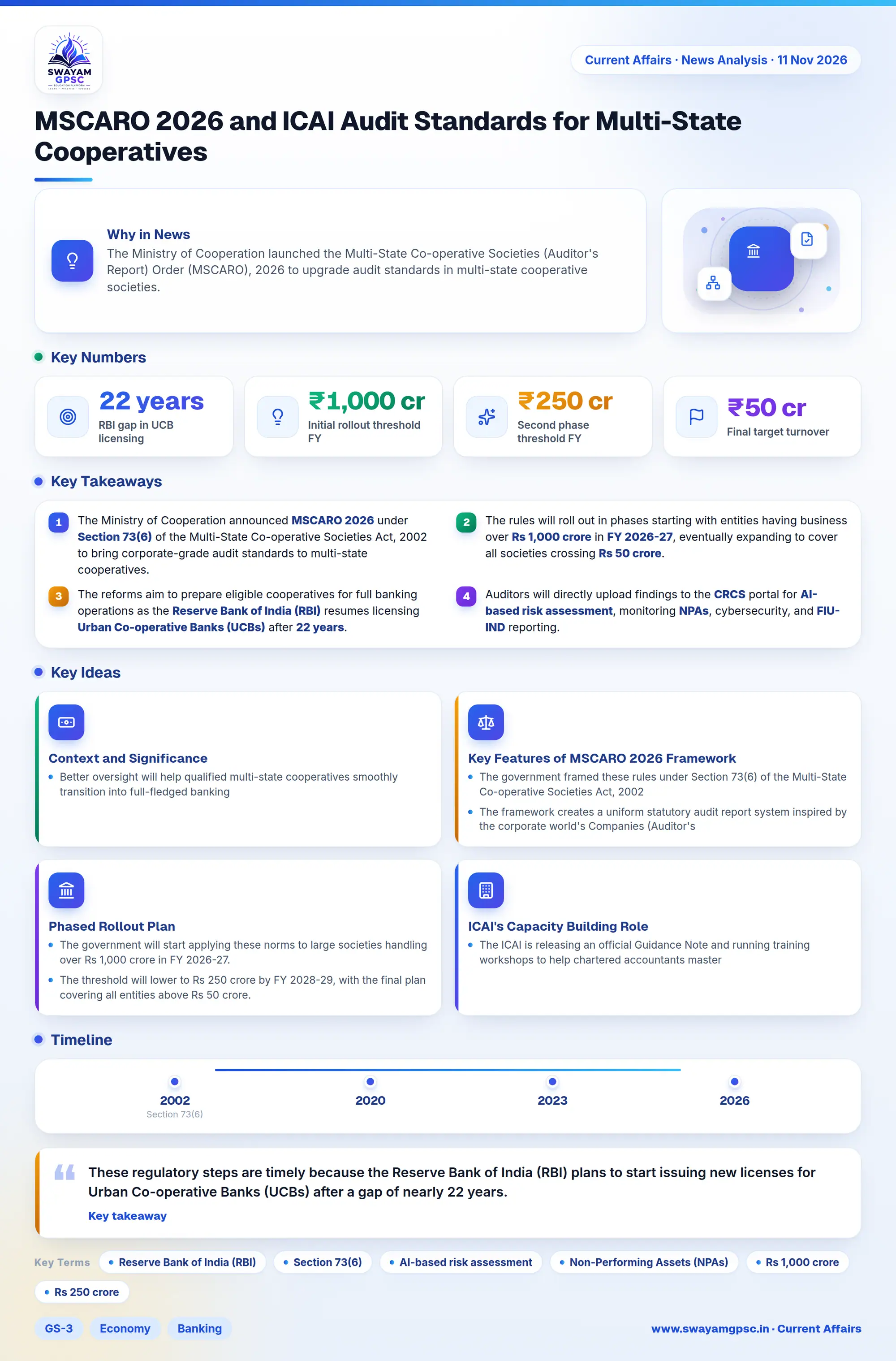
- The Ministry of Cooperation announced MSCARO 2026 under Section 73(6) of the Multi-State Co-operative Societies Act, 2002 to bring corporate-grade audit standards to multi-state cooperatives.
- The rules will roll out in phases starting with entities having business over Rs 1,000 crore in FY 2026-27, eventually expanding to cover all societies crossing Rs 50 crore.
- The reforms aim to prepare eligible cooperatives for full banking operations as the Reserve Bank of India (RBI) resumes licensing Urban Co-operative Banks (UCBs) after 22 years.
- Auditors will directly upload findings to the CRCS portal for AI-based risk assessment, monitoring NPAs, cybersecurity, and FIU-IND reporting.
Why in News
- The Ministry of Cooperation launched the Multi-State Co-operative Societies (Auditor's Report) Order (MSCARO), 2026 to upgrade audit standards in multi-state cooperative societies.
- The Institute of Chartered Accountants of India (ICAI) is creating a detailed Guidance Note to help auditors implement these new rules effectively.
Context and Significance
- These regulatory steps are timely because the Reserve Bank of India (RBI) plans to start issuing new licenses for Urban Co-operative Banks (UCBs) after a gap of nearly 22 years.
- Better oversight will help qualified multi-state cooperatives smoothly transition into full-fledged banking institutions.
Key Features of MSCARO 2026 Framework
- The government framed these rules under Section 73(6) of the Multi-State Co-operative Societies Act, 2002, which received updates through the 2023 amendment.
- The framework creates a uniform statutory audit report system inspired by the corporate world's Companies (Auditor's Report) Order (CARO), 2020.
- Auditors will send their reports straight to the Central Registrar of Cooperative Societies (CRCS) portal for automated checking and AI-based risk assessment to spot financial trouble early.
- Audit teams must carefully review Non-Performing Assets (NPAs), usage of funds, digital security measures, and compliance with anti-money laundering (AML) guidelines including submitting Suspicious Transaction Reports (STRs) to FIU-IND.
- The regulations require checking the composition of board members to confirm proper inclusion of SC/ST members and women as mandated by the Multi-State Co-operative Societies (Amendment) Act, 2023.
Phased Rollout Plan
- The government will start applying these norms to large societies handling over Rs 1,000 crore in FY 2026-27.
- The threshold will lower to Rs 250 crore by FY 2028-29, with the final plan covering all entities above Rs 50 crore.
ICAI's Capacity Building Role
- The ICAI is releasing an official Guidance Note and running training workshops to help chartered accountants master these strict reporting requirements.
Challenges Addressed and Statutory Reforms
- These rules target past issues like poor management, political pressure, risky loans to single borrowers, and hidden losses that led to the collapse of Punjab and Maharashtra Co-operative Bank (PMC Bank) and Madhavpura Mercantile Co-operative Bank (MMCB).
- This framework builds upon the structural reform introduced by the Multi-State Co-operative Societies (Amendment) Act, 2023, which created the Cooperative Ombudsman and Cooperative Election Authority while mandating real-time concurrent audits.