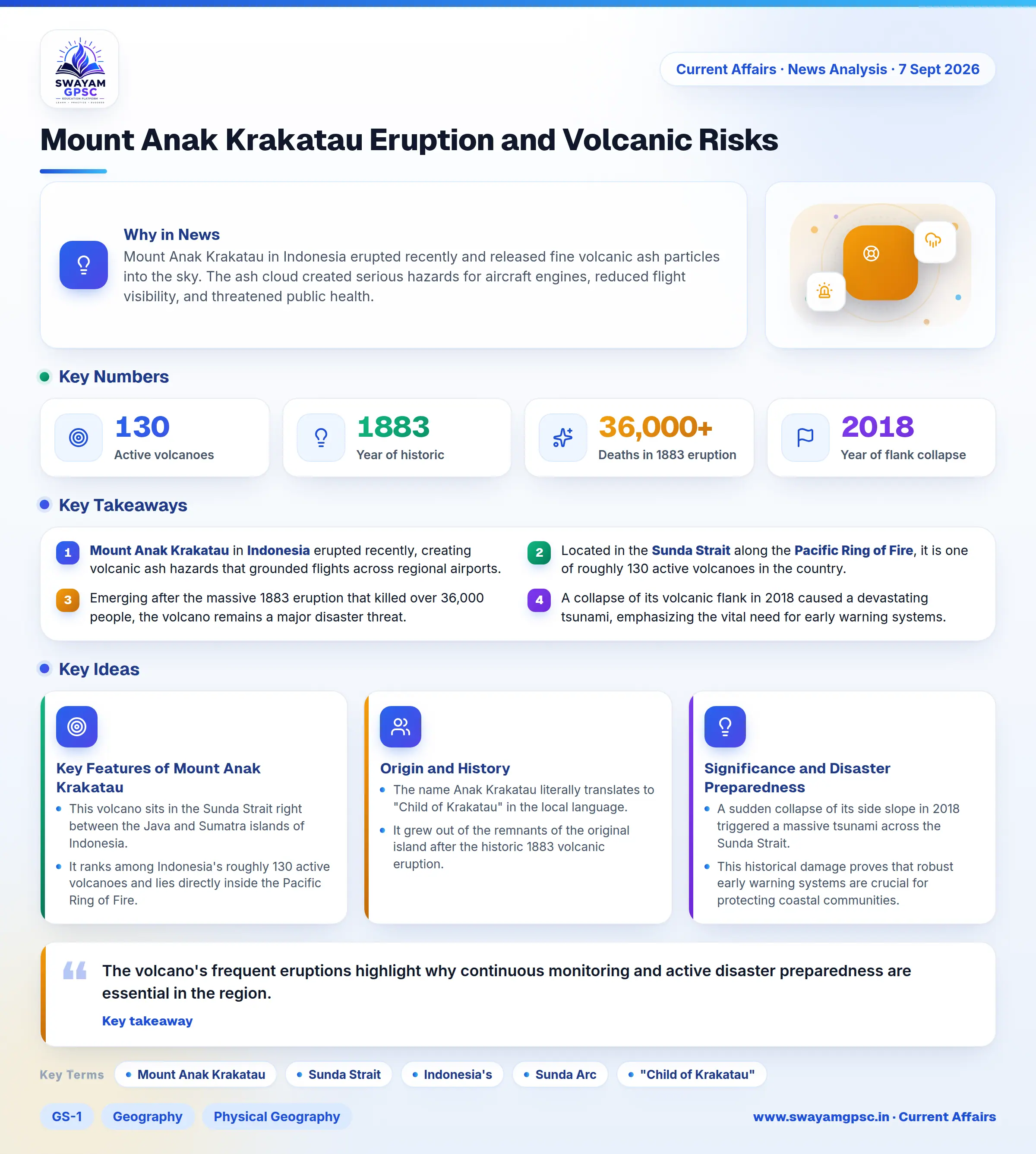
Mount Anak Krakatau Eruption and Volcanic Risks
#GS-1 #Geography #Physical Geography #GS-3 #Disaster Management #Disaster Preparedness #Current Events #International #Volcanology
Key takeaways
- Mount Anak Krakatau in Indonesia erupted recently, creating volcanic ash hazards that grounded flights across regional airports.
- Located in the Sunda Strait along the Pacific Ring of Fire, it is one of roughly 130 active volcanoes in the country.
- Emerging after the massive 1883 eruption that killed over 36,000 people, the volcano remains a major disaster threat.
- A collapse of its volcanic flank in 2018 caused a devastating tsunami, emphasizing the vital need for early warning systems.
Why in News
- Mount Anak Krakatau in Indonesia erupted recently and released fine volcanic ash particles into the sky.
- The ash cloud created serious hazards for aircraft engines, reduced flight visibility, and threatened public health.
- Authorities suspended operations at several regional airports, which disrupted normal air travel and passenger transport.
Key Features of Mount Anak Krakatau
- This volcano sits in the Sunda Strait right between the Java and Sumatra islands of Indonesia.
- It ranks among Indonesia's roughly 130 active volcanoes and lies directly inside the Pacific Ring of Fire.
- It forms part of the Sunda Arc, created as the Indo-Australian Plate slides beneath the Eurasian Plate.
Origin and History
- The name Anak Krakatau literally translates to "Child of Krakatau" in the local language.
- It grew out of the remnants of the original island after the historic 1883 volcanic eruption.
- That catastrophic 1883 event destroyed most of the island, generated giant tsunamis, and killed over 36,000 people.
Significance and Disaster Preparedness
- The volcano's frequent eruptions highlight why continuous monitoring and active disaster preparedness are essential in the region.
- A sudden collapse of its side slope in 2018 triggered a massive tsunami across the Sunda Strait.
- This historical damage proves that robust early warning systems are crucial for protecting coastal communities.