Modernising India's Nuclear Energy Sector for Future Power Needs
#GS-3 #Science & Technology #Energy #Nuclear Technology #Infrastructure #Current Events #National
Key takeaways
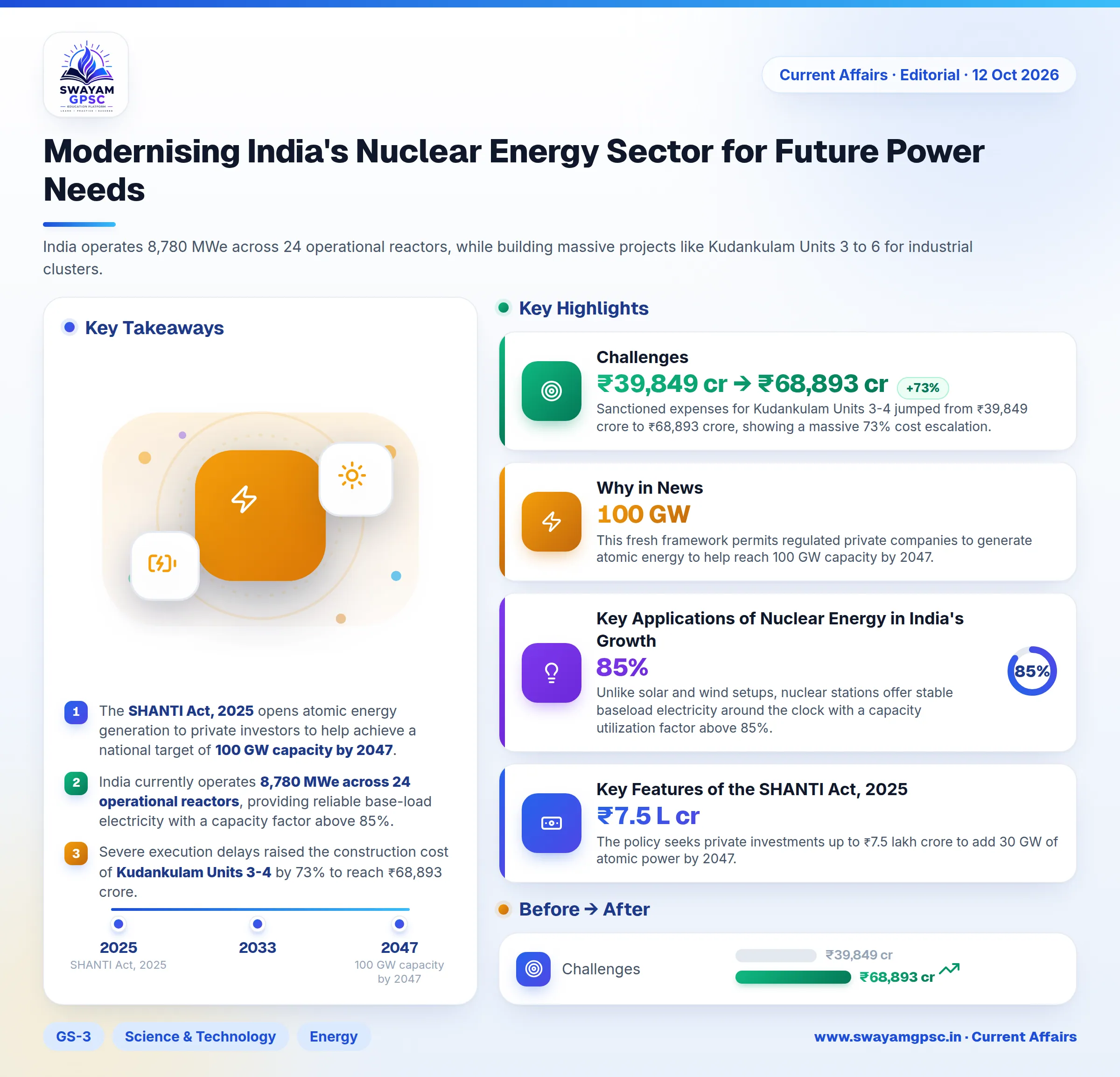
- The SHANTI Act, 2025 opens atomic energy generation to private investors to help achieve a national target of 100 GW capacity by 2047.
- India currently operates 8,780 MWe across 24 operational reactors, providing reliable base-load electricity with a capacity factor above 85%.
- Severe execution delays raised the construction cost of Kudankulam Units 3-4 by 73% to reach ₹68,893 crore.
- Domestic deposits have low uranium grades, which forced India to import 18,842 metric tonnes of uranium between 2008-09 to 2024-25.
- To cut carbon emissions, the nation plans to mass-produce factory-built 220 MWe Bharat Small Modular Reactor (BSMR-200) units for industrial zones.
Why in News
- The government published draft rules under the SHANTI Act, 2025 to reform India's nuclear landscape completely.
- This fresh framework permits regulated private companies to generate atomic energy to help reach 100 GW capacity by 2047.
- Achieving this massive expansion needs bold solutions for severe structural, financial, and technological hurdles.
Key Applications of Nuclear Energy in India's Growth
- Unlike solar and wind setups, nuclear stations offer stable baseload electricity around the clock with a capacity utilization factor above 85%.
- Indigenous 700 MWe Pressurized Heavy Water Reactors (PHWRs) at Kakrapar and Rawatbhata supply reliable electricity to core industrial zones.
- India operates 8,780 MWe across 24 operational reactors, while building massive projects like Kudankulam Units 3 to 6 for industrial clusters.
- Nuclear heat gives energy-intensive sectors like steel, cement, and chemical plants a clean way to cut carbon footprints.
- Planners at the Department of Atomic Energy and NITI Aayog back 220 MWe SMRs and Bharat Small Reactors (BSRs) to replace old coal plants.
- Using Cogeneration technology, reactors produce electricity and high-pressure steam together, lowering running expenses for big industrial units.
- Scientists at the Bhabha Atomic Research Centre (BARC) create high-yield Trombay seeds using radiation breeding across pulses, oilseeds, and groundnuts.
- Commercial farming uses 72 improved crop varieties developed by BARC, offering drought resistance, disease tolerance, and better farm output.
- A mutant banana called Kaveri Vaaman grows shorter to avoid falling over and ripens 1.5 months earlier than regular plants.
- Radiation techniques control dangerous farm pests without chemical sprays, keeping commercial fruit and vegetable exports safe.
- Gamma rays preserve fresh harvest by eliminating pests, killing microbes, and delaying decay in stored agricultural commodities.
- India runs 42 commissioned food-irradiation facilities, using Cobalt-60 irradiation to meet global export standards and extend storage life.
- Irradiation stops onions and potatoes from sprouting early, while protecting stored grains and lentils from insect damage.
- The KRUSHAK at Lasalgaon, Maharashtra facility shows how post-harvest treatment avoids economic losses without altering farm routines.
- BARC built the affordable Bhabhatron teletherapy unit, which treats cancer patients across the Tata Memorial Centre (TMC) network.
- The Dhruva research reactor produces vital medical isotopes like Technetium-99m and Iodine-131, reducing dependency on costly foreign medical shipments.
- The Board of Radiation and Isotope Technology sends items like Lu-177-PSMA-617 for prostate cancer, Lu-177-DOTATATE for neuroendocrine cancer, and Bhabhaspheres for liver cancer treatment to over 400 centers.
- Coastal atomic plants produce clean drinking water using leftover thermal heat and modern filtration membranes.
- The Hybrid Nuclear Desalination Plant operating at Kalpakkam combines two distinct methods to purify millions of liters of seawater daily.
- These desalination setups produce ultra-pure water for cooling reactors while supplying clean drinking water to nearby dry coastal villages.
- Scientists use Isotope hydrology to map hidden underground aquifers, watch groundwater flow, trace pollution lines, and spot dam leakages.
- Very hot reactors split water molecules efficiently through chemical cycles to make Green Hydrogen without polluting the atmosphere.
- Electrolysers powered by reactors supply a steady stream of clean hydrogen to make fertilizer and run petroleum refining complexes.
- Nuclear-based hydrogen avoids the changing nature of solar power, providing steady green fuel for heavy transport vehicles.
- Scientists build compact atomic power packs called Radioisotope Thermoelectric Generators using Plutonium-238 to run deep space vehicles.
- Miniature reactors drive nuclear submarines like INS Arihant, protecting crucial open ocean shipping routes for India.
- Through NPCIL, India markets its proven 220 MWe and 540 MWe reactor designs to emerging countries seeking small atomic units.
Key Features of the SHANTI Act, 2025
- The law allows private firms to Build, Own, Operate, or Decommission (BOOD) atomic plants and manufacture low-grade fuel under government supervision.
- The policy seeks private investments up to ₹7.5 lakh crore to add 30 GW of atomic power by 2047.
- Crucial tasks like high-grade fuel enrichment, spent fuel processing, heavy water production, and dangerous waste disposal stay with the Union government.
- The law gives independent statutory authority to the Atomic Energy Regulatory Board (AERB), separating safety rules from operating businesses.
- The board can conduct strict safety audits and inspect component production factories located in India or abroad.
- A modernized legal framework fixes absolute operator compensation caps, including ₹3,000 crore for reactors exceeding 3,600 MWth capacity.
- Section 16 permits lawsuits through written commercial agreements or deliberate harm, removing equipment supplier fault as a separate automatic ground.
- The statute speeds up research, innovation, and development work for peaceful uses by simplifying formal approvals.
- A distinct regulatory system fast-tracks small setups like the 220 MWe Bharat Small Modular Reactor (BSMR-200) and SMR-55 for factory use.
- The Union government can build a national policy linked with power grid planning to coordinate electricity prices, fuel supplies, and transmission.
- The law creates firm administrative channels to expand radiation uses across cancer clinics, farming, factories, and water purification.
- Inventors can patent safe, peaceful nuclear innovations under the Patents Act, 1970, while state security technologies remain protected from patenting.
- The system sets up the Atomic Energy Redressal Advisory Council alongside electricity appellate courts to resolve industrial disputes.
- Special Claims Commissioners and a Nuclear Damage Claims Commission evaluate and award payments for atomic accident damages.
Challenges
- Atomic plants demand massive upfront money, which creates long repayment cycles and raises future consumer electricity charges.
- Sanctioned expenses for Kudankulam Units 3-4 jumped from ₹39,849 crore to ₹68,893 crore, showing a massive 73% cost escalation.
- The IAEA's 2025 assessment stressed that massive nuclear stations require highly stable income structures and predictable financial backing.
- Atomic construction requires specialized machinery, skilled engineering teams, and strict procedures that often encounter severe execution delays.
- Authorities pushed back completion deadlines for Kaiga Unit 5 and Unit 6 by 5 year postponement periods due to execution challenges.
- Suppliers struggle with slow component delivery, tight contractor cash reserves, scarce technical talent, post-Fukushima safety revisions, and poor ground conditions.
- Local uranium ore from Jharkhand and Andhra Pradesh holds very low mineral concentrations, making extraction expensive and difficult.
- Between 2008-09 to 2024-25, India purchased 18,842 metric tonnes of uranium supplies abroad to feed its growing atomic network.
- Depending on foreign atomic fuel exposes power plants outside international inspection regimes to sudden geopolitical shifts and trade embargoes.
- The SHANTI Act, 2025 requires non-state operators to obtain two clearances: a central permit and a strict safety clearance.
- Private builders face a variable operator liability of ₹100-₹3,000 crore, requiring large insurance policies that lack market clarity.
- Atomic watchdogs must expand their technical teams and auditing processes to avoid safety lapses during sudden commercial expansions.
- A closed fuel cycle requires long-term handling, chemical separation, and safe isolation of highly dangerous radioactive waste.
- India stores used atomic rods in temporary pools near plants because it lacks a deep underground geological repository.
- Plans to build subterranean waste storage sites meet harsh local public resistance due to the Not-In-My-Backyard attitude.
- Stage-2 Fast Breeder Reactors (FBRs) face delays, slowing down the planned conversion of Thorium-232 into usable Uranium-233 fuel.
- Handling liquid sodium coolant inside breeder reactors presents complex technical hurdles that slow down commercial scale deployment.
- Even though India holds 25% of global thorium reserves, extracting commercial energy from beach sands remains decades away from practical use.
- Acquiring vast coastal or rural land tracts faces stiff opposition from villagers fearing loss of homes and fragile ecosystems.
- Public demonstrations stalled progress on the Chutka's two 700 MW reactors in Madhya Pradesh, keeping them stuck at planning stages.
- Past popular protests at Kudankulam (Tamil Nadu) and Jaitapur (Maharashtra) show public panic over earth tremors, sea heating, and radiation.
- Atomic stations need vast, uninterrupted freshwater flows for cooling, making them vulnerable to shifting climate patterns.
- The planned Gorakhpur Haryana Anu Vidyut Pariyojana requires drawing 180 cusecs of withdrawal and leaves 128 cusecs of net consumption.
- A 2025 assessment by the IAEA warned that droughts, floods, extreme heat, and severe storms threaten reactor cooling systems.
- Being outside the Nuclear Suppliers Group (NSG) limits India's access to high-end global atomic engineering, advanced materials, and sensitive equipment.
- Multilateral export control regimes restrict Indian laboratories from importing advanced dual-use alloys and precise scientific gear easily.
- India remains reliant on separate government-to-government pacts, like Russian assistance for Kudankulam, rather than tapping competitive open markets.
- Deploying 5 indigenous Small Modular Reactors by 2033, including the BSMR-200 and SMR-55, demands heavy initial manufacturing commitments.
- Building small reactors does not guarantee cheaper electricity unless companies achieve massive factory assembly lines to lower costs.
Way Forward
- India should test a Regulated Asset Base (RAB) financing system to let investors earn steady returns during long construction stages.
- Adopting Finland's Mankala model can let heavy industrial electricity buyers invest jointly in atomic reactors and buy low-cost power directly.
- The nation must build bigger uranium stockpiles with partner nations and use the IAEA Low Enriched Uranium (LEU) Bank for emergencies.
- Mining engineers should deploy alkaline leaching methods at deposits like Tummalapalle and Gogi to extract domestic uranium more efficiently.
- Cutting import duties on critical nuclear machinery will help domestic companies manufacture specialized forged metal pieces and heavy alloys.
- The government must implement the SHANTI Act, 2025 rules quickly to balance legal liabilities between plant operators and equipment makers.
- Officials should clear established power corporations to construct and run licensed commercial atomic reactors under strict government safety guidelines.
- Setting up the Atomic Energy Redressal Advisory Council quickly will settle administrative disagreements and manage accident claims fairly.
- Engineers should mass-produce factory-made 220 MWe Bharat Small Modular Reactor (BSMR-200) and 55 MWe SMR-55 units for factories.
- Implementing updated government safety rules can shrink safety buffer zones around small modular reactors by nearly two-thirds.
- Exporting standardized 220 MWe reactors under Make in India can help developing nations acquire affordable, low-carbon electricity.
- Giving complete legal independence to the Atomic Energy Regulatory Board (AERB) ensures safety rules remain completely separate from plant management.
- Indian regulators should align licensing criteria and facility inspections with IAEA international safety evaluation benchmarks.
- Creating a quick online clearance window within the AERB will help private factory owners install pre-approved small reactors quickly.
- India must select a stable granite rock site to construct its first deep underground storage repository for permanent nuclear waste.
- BARC should expand modern chemical processing to extract valuable radioisotopes from high-level waste before burying the remaining materials.
- Establishing statutory Host Community Benefit Funds will direct project revenues into local schools, clinics, and roads around atomic sites.
- Combining high-temperature gas-cooled reactors with water-splitting systems can manufacture green hydrogen at a large commercial scale.
- Coastal atomic plants should include desalination plants to supply fresh water to neighboring dry communities.
- Planners should run steam pipes from small atomic units directly into nearby chemical plants to replace fossil fuel boilers.
- Companies must build formal partnership compacts with local populations to offer steady jobs, healthcare services, and clear grievance mechanisms.
- Setting up a local development trust fund with project contributions ensures villagers control funding for regional public works.
- Engineers must review proposed reactor locations against extreme climate threats like heatwaves, earthquakes, floods, and water shortages.