Mission for Aatmanirbharta in Pulses
#GS-2 #Governance & Social Justice #GS-3 #Economy #Agriculture #Food Security #Infrastructure #Government Policies & Interventions #Agricultural Marketing #Buffer Stocks & Food Security
Key takeaways
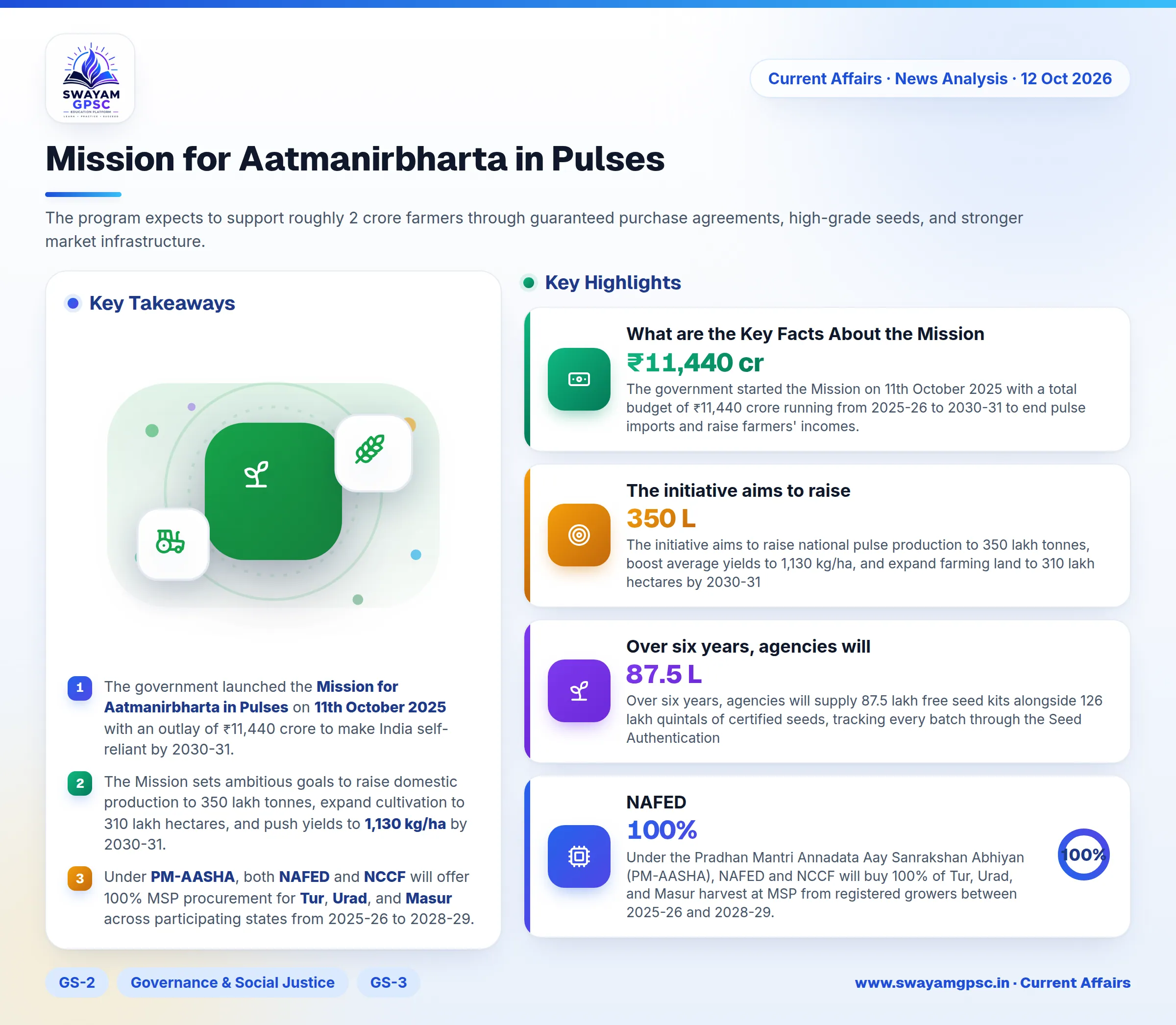
- The government launched the Mission for Aatmanirbharta in Pulses on 11th October 2025 with an outlay of ₹11,440 crore to make India self-reliant by 2030-31.
- The Mission sets ambitious goals to raise domestic production to 350 lakh tonnes, expand cultivation to 310 lakh hectares, and push yields to 1,130 kg/ha by 2030-31.
- Under PM-AASHA, both NAFED and NCCF will offer 100% MSP procurement for Tur, Urad, and Masur across participating states from 2025-26 to 2028-29.
- Due to rising domestic output reaching 274.09 lakh tonnes in 2025-26, India's pulse import bill fell sharply by 31.52% while export values grew by 13.40%.
Why in News
- The Mission for Aatmanirbharta in Pulses has completed its first operational year. This milestone shows clear progress toward achieving complete domestic self-reliance in pulses by 2030-31 through higher output, lower import dependence, and better farmer incomes.
What are the Key Facts About the Mission
- The government started the Mission on 11th October 2025 with a total budget of ₹11,440 crore running from 2025-26 to 2030-31 to end pulse imports and raise farmers' incomes.
- The initiative aims to raise national pulse production to 350 lakh tonnes, boost average yields to 1,130 kg/ha, and expand farming land to 310 lakh hectares by 2030-31, including 35 lakh hectares of new area.
- Authorities selected Tur, Urad, and Masur as primary crops, emphasizing improved seeds that offer higher yields and resist climate shocks and pests.
- Over six years, agencies will supply 87.5 lakh free seed kits alongside 126 lakh quintals of certified seeds, tracking every batch through the Seed Authentication, Traceability and Holistic Inventory (SATHI) portal.
- Under the Pradhan Mantri Annadata Aay Sanrakshan Abhiyan (PM-AASHA), NAFED and NCCF will buy 100% of Tur, Urad, and Masur harvest at MSP from registered growers between 2025-26 and 2028-29.
- The plan deploys targeted crop programs across 489 districts, expanding cultivation into rice-fallow acreage, promoting intercropping, and encouraging farmers to rotate crops.
- To build local supply chains and create village jobs, the government will support 1,000 primary processing and packaging facilities with grants reaching ₹25 lakh per unit.
- Through the Creation and Expansion of Food Processing and Preservation Capacities (CEFPPC) part of PMKSY, authorities approved 23 pulse processing projects, and 18 units are already finished.
- The program expects to support roughly 2 crore farmers through guaranteed purchase agreements, high-grade seeds, and stronger market infrastructure.
- Institutions like ICAR, local Krishi Vigyan Kendras, and state farm departments will guide growers on advanced farm equipment, soil nourishment, and modern agronomic practices.
Digital Monitoring and Seed Traceability
- A structured three-level Steering Committee oversees work at the national, state, and district tiers to ensure timely progress across all targets.
- Field officers use the Krishi Mapper application for geo-fencing, plot tagging, and monitoring seed demonstration trials and actual farm yields.
- The SATHI Portal completely digitizes seed management by recording production batches, testing certifications, and retail sales across the entire life cycle.
- The initiative links AgriStack and the Digital Crop Survey with unique Farmer IDs and Soil Health Card data, improving fertilizer advice and output estimates.
- Digital tools like E-Samriddhi and Vistaar handle direct financial transfers, show live mandi prices, and track market trends to maintain domestic price stability.
India's Pulses Sector
- National pulse production climbed to 274.09 lakh tonnes in 2025-26 according to third advance estimates, improving from 256.83 lakh tonnes in 2024-25.
- Total land under pulse cultivation grew from 277.20 lakh hectares to 286.46 lakh hectares in 2025-26.
- Crop productivity rose from 926 kg/ha to 957 kg/ha, which helped lower pulse import spending by 31.52% while lifting export earnings by 13.40% in 2025-26.
- The primary pulse-producing states include Madhya Pradesh, Maharashtra, Rajasthan, Uttar Pradesh, Gujarat, Andhra Pradesh, Karnataka, Jharkhand, Odisha, and West Bengal.
- India exported significant shipments of pulses to destination markets like China, the UAE, Bangladesh, the USA, and Sri Lanka.
Conclusion
- The Mission for Aatmanirbharta in Pulses represents a major leap forward for national nutritional security, food self-sufficiency, and rural prosperity. Sustained success requires closing yield gaps across regions, expanding processing links, and promoting climate-resilient farming techniques.