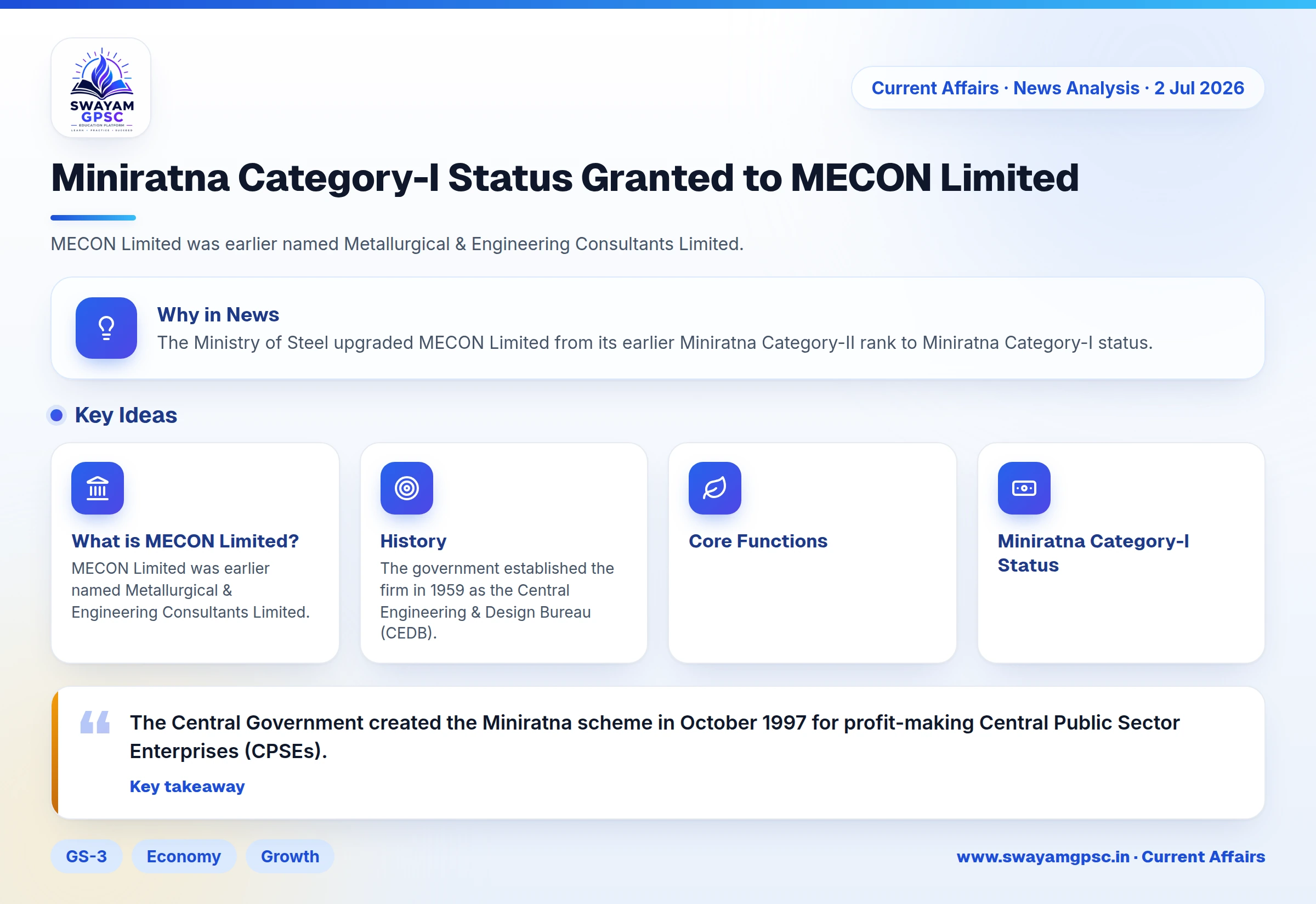
Miniratna Category-I Status Granted to MECON Limited
#GS-3 #Economy #Growth #Infrastructure #GS-2 #Governance & Social Justice #Regulatory Bodies #Current Events #National
Why in News
- The Ministry of Steel upgraded MECON Limited from its earlier Miniratna Category-II rank to Miniratna Category-I status.
What is MECON Limited?
- MECON Limited was earlier named Metallurgical & Engineering Consultants Limited. It operates as India's leading engineering, consultancy, and contracting enterprise under the administrative authority of the Ministry of Steel.
History
- The government established the firm in 1959 as the Central Engineering & Design Bureau (CEDB). It initially served as the internal design department for Hindustan Steel Limited (HSL).
- Government authorities later converted it into an independent consultancy company. This step aimed to decrease reliance on foreign engineering knowledge for large national projects.
Core Functions
- The company offers end-to-end consultancy services from feasibility reports to environmental design and project execution.
- It manages complete EPC contracts for building brand new Greenfield sites and upgrading existing Brownfield industrial plants.
- It supports India's steel and metallurgy sector while expanding into power, defense, oil, gas, and space infrastructure projects.
Miniratna Category-I Status
- The Central Government created the Miniratna scheme in October 1997 for profit-making Central Public Sector Enterprises (CPSEs). It grants higher financial powers and administrative freedom to companies operating without direct budget support.
Objectives
- The status frees profitable public enterprises from daily government red tape so they can compete in international markets.
- It allows enterprise management to make rapid decisions regarding investment, joint ventures, and technology partnerships.
Mandatory Eligibility Criteria
- The enterprise must generate continuous net profit for 3 consecutive years.
- Its pre-tax profit must reach ₹30 crore or higher in at least one of those three years.
- The company must maintain a strictly positive net worth buffer.
- The company must not default on repaying any loan principal or interest owed to the Central Government.
- The business cannot depend on direct government budgetary support or official financial guarantees.
- The enterprise must appoint at least 3 independent directors to restructure its board before exercising elevated powers.
Key Features
- The board can sanction capital expenditure up to ₹500 crore or its net worth without seeking prior government clearance.
- The company can form joint ventures or overseas subsidiaries and invest up to ₹500 crore, provided it informs the CCEA for foreign projects.
- The board can sign strategic partnerships, establish technology JVs, and purchase patents or technical licenses within official guidelines.
- The board gains authority to shape human resource policies, design voluntary retirement programs, and handle employee transfers.
- The CEO can approve foreign official travel for directors for up to 5 days with simple post-visit notification to the ministry.