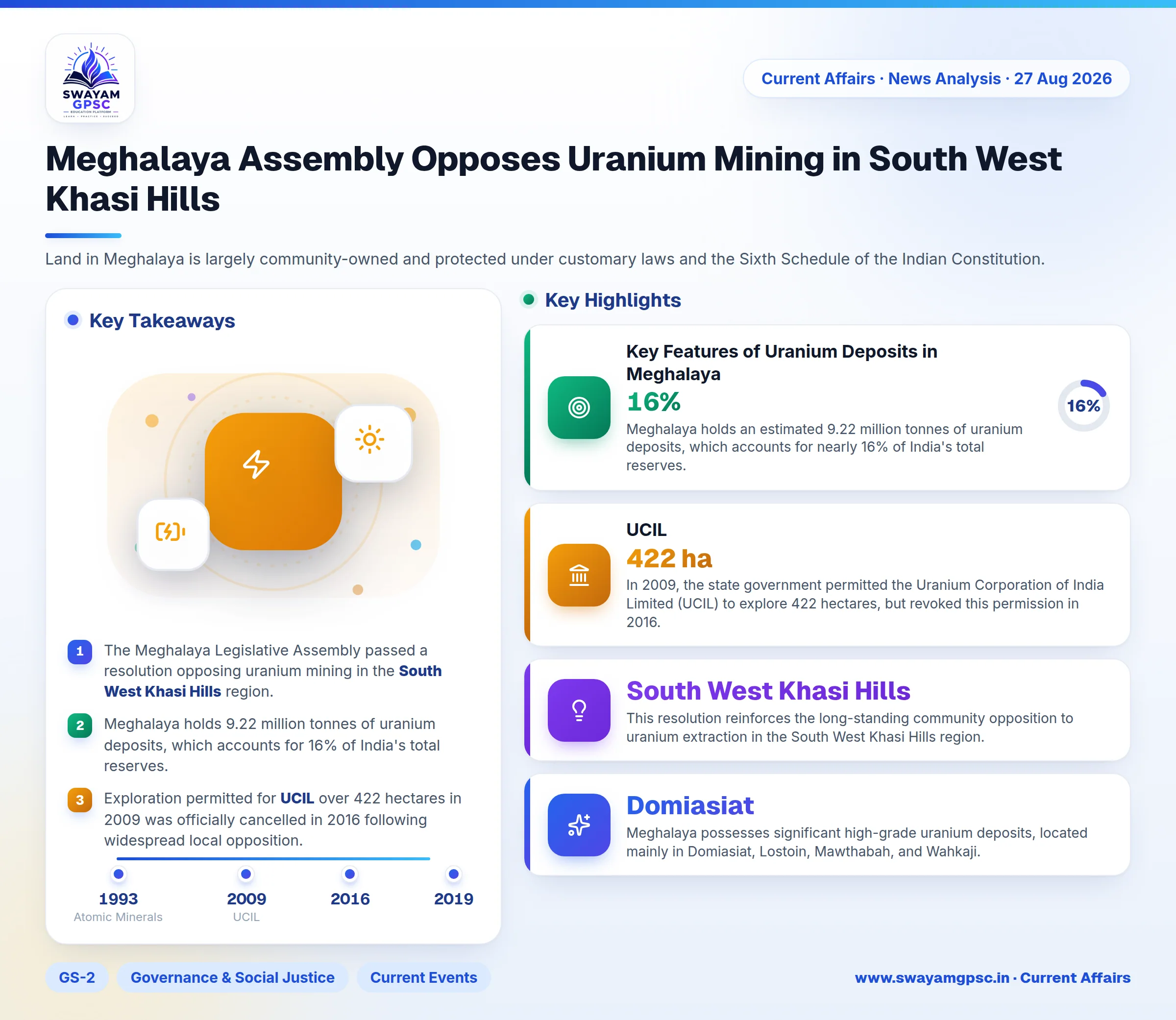
Meghalaya Assembly Opposes Uranium Mining in South West Khasi Hills
#GS-2 #Governance & Social Justice #Current Events #National #GS-3 #Economy #Infrastructure #Science & Technology #Energy #Environment #Uranium Mining
Key takeaways
- The Meghalaya Legislative Assembly passed a resolution opposing uranium mining in the South West Khasi Hills region.
- Meghalaya holds 9.22 million tonnes of uranium deposits, which accounts for 16% of India's total reserves.
- Exploration permitted for UCIL over 422 hectares in 2009 was officially cancelled in 2016 following widespread local opposition.
- The state assembly highlighted the Supreme Court's 2019 ruling in State of Meghalaya vs. All Dimasa Students' Union affirming customary mineral rights.
Why in News
- The Meghalaya Legislative Assembly recently passed a resolution opposing uranium mining and processing facilities in the state.
- This resolution reinforces the long-standing community opposition to uranium extraction in the South West Khasi Hills region.
Overview of Uranium Mining and Processing
- Uranium mining involves extracting uranium ores, which are then crushed and chemically treated to produce uranium concentrate for nuclear fuel.
- Meghalaya possesses significant high-grade uranium deposits, located mainly in Domiasiat, Lostoin, Mawthabah, and Wahkaji.
Key Features of Uranium Deposits in Meghalaya
- Meghalaya holds an estimated 9.22 million tonnes of uranium deposits, which accounts for nearly 16% of India's total reserves.
- Exploration began in 1993 by the Atomic Minerals Directorate, but continuous local protests forced the authorities to suspend operations.
- In 2009, the state government permitted the Uranium Corporation of India Limited (UCIL) to explore 422 hectares, but revoked this permission in 2016.
- Land in Meghalaya is largely community-owned and protected under customary laws and the Sixth Schedule of the Indian Constitution.
- The state assembly cited the 2019 Supreme Court judgment in State of Meghalaya vs. All Dimasa Students' Union, which recognized landowner rights over sub-surface minerals.
Major Implications and Concerns
- Halting domestic extraction in Meghalaya may impact India's efforts to boost indigenous uranium supplies for nuclear power generation.
- Local communities fear radioactive contamination and toxic waste, which could severely damage water resources, soil, and human health.
- The dispute reflects a deep conflict between national mineral extraction needs and constitutionally protected indigenous land rights.
- Balancing federal energy goals with constitutional tribal autonomy and local community consent remains a critical policy challenge.