Measures and Legislation Against Public Examination Paper Leaks in India
#GS-2 #Indian Polity & Constitution #Judiciary #Governance & Social Justice #Good Governance #Education #Current Events #National
Why in News
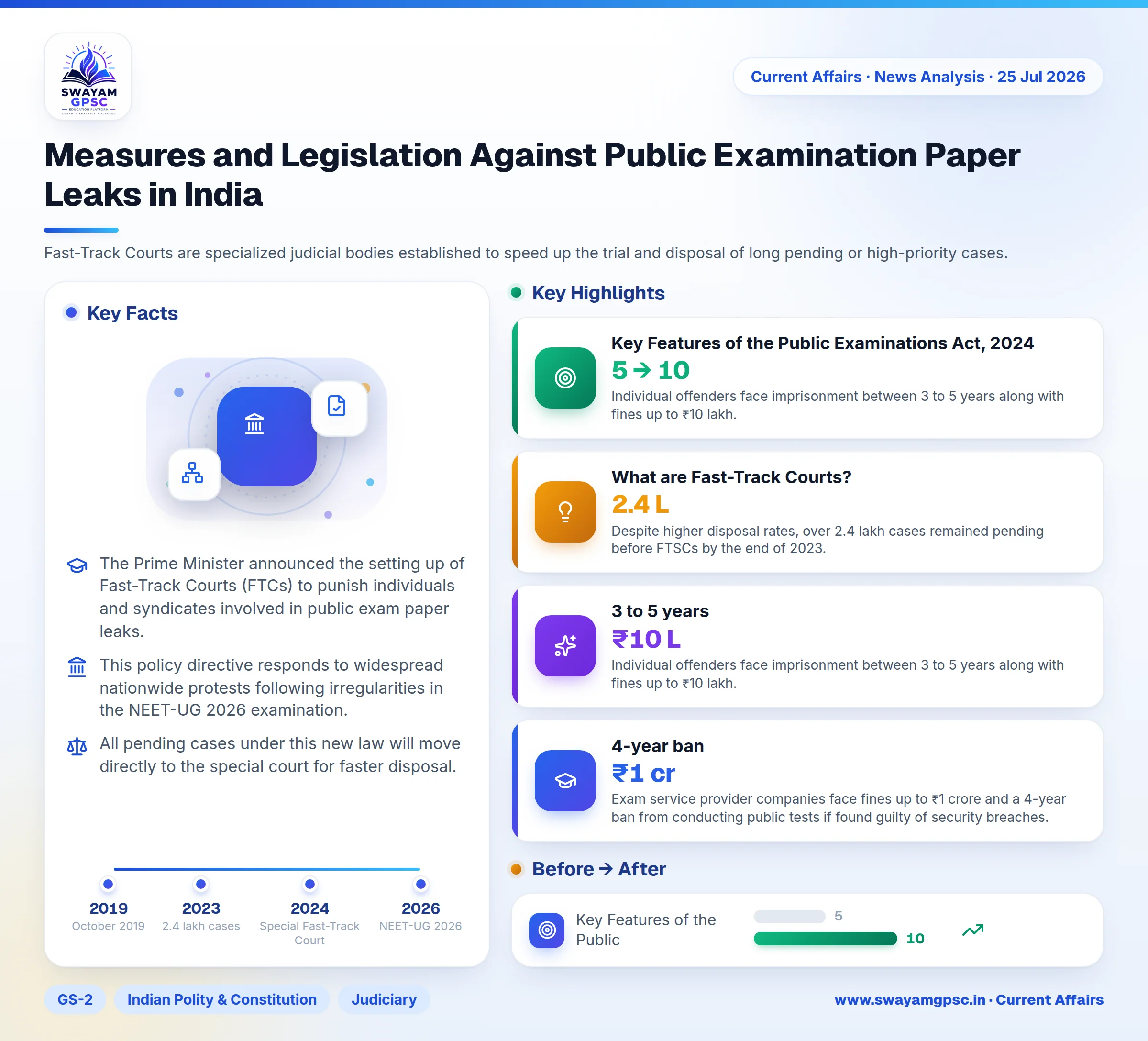
- The Prime Minister announced the setting up of Fast-Track Courts (FTCs) to punish individuals and syndicates involved in public exam paper leaks.
- This policy directive responds to widespread nationwide protests following irregularities in the NEET-UG 2026 examination.
- Following this announcement, the Delhi High Court constituted a Special Fast-Track Court to exclusively try offences under the Public Examinations (Prevention of Unfair Means) Act, 2024.
- All pending cases under this new law will move directly to the special court for faster disposal.
What are Fast-Track Courts?
- Fast-Track Courts are specialized judicial bodies established to speed up the trial and disposal of long pending or high-priority cases.
- The Supreme Court linked the right to a speedy trial to fundamental rights under Article 21 in the landmark Hussainara Khatoon v. Home Secretary, State of Bihar (1979) ruling.
- India lacks a single central statute that universally governs or establishes all fast-track courts across states.
- Instead, state governments set up these courts through Finance Commission recommendations, specific central schemes, or High Court notifications.
- The Eleventh Finance Commission (2000-2005) first suggested setting up FTCs to clear long-pending sessions criminal cases.
- Later, the Fourteenth Finance Commission (2015-2020) expanded their scope to cover heinous crimes like murder, kidnapping, civil property disputes pending over five years, and cases involving vulnerable groups.
- FTCs prioritize cases concerning women, children, senior citizens, disabled individuals, and terminally ill patients.
- The central government launched Fast-Track Special Courts (FTSCs) under a central scheme in October 2019 for rape and Protection of Children from Sexual Offences (POCSO) Act, 2012 cases.
- This scheme started after the Criminal Law (Amendment) Act, 2018 and receives partial funding through the Nirbhaya Fund.
- In 2017, the Supreme Court directed the government to set up special fast-track courts to expedite criminal trials against sitting MPs and MLAs.
- In State of West Bengal vs Anwar Ali Sarkar (1952), the Supreme Court ruled under Article 14 that trial speed alone cannot serve as an arbitrary classification factor without a rational objective basis.
- While regular trial courts dispose of roughly 3.3 cases per month, FTSCs operate faster by clearing nearly 9.5 cases monthly.
- Despite higher disposal rates, over 2.4 lakh cases remained pending before FTSCs by the end of 2023.
- In Brij Mohan Lal v. Union of India (2012), the court held that states carry primary responsibility for FTCs and temporary ad-hoc appointments cannot replace permanent judicial infrastructure.
- In Anita Kushwaha v. Pushap Sudan (2016), the Supreme Court recognized access to speedy justice as a fundamental right under Article 14 and Article 21.
- In P. Ramachandra Rao v. State of Karnataka (2002), the court held that no fixed deadline can be legally prescribed to conclude criminal trials.
Significance of FTCs in Paper Leak Cases
- Speedy disposal of paper leak cases restores public trust in competitive examinations and safeguards candidate merit.
- Swift punishment creates strong deterrence against organized examination mafias and fraud networks.
- Prompt judicial resolution prevents repeated exam cancellations, protecting the career prospects, financial resources, and mental health of young aspirants.
Limitations of Fast-Track Courts
- Fast-Track Courts act only after a paper leak takes place, meaning they cannot prevent the leak from occurring in the first place.
- Because education lies on the Concurrent List (Entry 25), localized FTCs face severe difficulties investigating inter-state paper leak syndicates.
- Delays in receiving digital forensic reports from the Forensic Science Laboratory (FSL) frequently stall fast-track court proceedings.
- Multi-agency investigations by bodies like the CBI and ED often fail to file charge sheets within 90 days, resulting in default bail for key accused.
- Rushed trials often result in convicting lower-level intermediaries while main ringleaders evade prosecution due to weak digital evidence.
- As noted in Brij Mohan Lal v. Union of India (2012), FTCs suffer from shortage of judges, dedicated prosecutors, and proper judicial infrastructure.
- The end of central grants shifted funding burdens onto state governments, creating wide disparities in FTC performance across states.
- Inadequate witness protection allows organized exam mafias to intimidate witnesses and weaken the prosecution case.
Key Features of the Public Examinations Act, 2024
- Parliament enacted the Public Examinations (Prevention of Unfair Means) Act, 2024 as a central law to curb paper leaks, cheating, and organized malpractices.
- The law directly covers exams held by scheduled central testing bodies including UPSC, SSC, RRBs, NTA, and IBPS.
- It explicitly penalizes unauthorized access, question paper leaks, computer network tampering, falsified merit lists, and fake admit card websites.
- Individual offenders face imprisonment between 3 to 5 years along with fines up to ₹10 lakh.
- Exam service provider companies face fines up to ₹1 crore and a 4-year ban from conducting public tests if found guilty of security breaches.
- Company directors and senior managers who consent to cheating schemes face 3 to 10 years in prison and a ₹1 crore fine.
- Organized paper leak syndicates face severe penalties ranging from 5 to 10 years imprisonment and a minimum fine of ₹1 crore.
- Courts can attach the property of guilty coaching institutes and recover the full costs of re-conducting cancelled exams.
- All offences under this statute are cognizable, non-bailable, and non-compoundable.
- Investigations must be conducted by senior police officers not below the rank of DSP or ACP, or transferred directly to the CBI.
Dr. K. Radhakrishnan Committee Reforms
- The government established the Dr. K. Radhakrishnan High-Level Committee (2024) to suggest systemic reforms for secure examination systems.
- The committee recommended shifting from single-day OMR paper tests to multi-shift Computer-Based Tests to limit the damage of potential leaks.
- It advised minimizing or eliminating third-party private vendors for printing and transporting question papers.
- It proposed implementing DIGI-EXAM, a biometric authentication system inspired by DigiYatra, to verify candidate identity from application to admission.
Way Forward
- Parliament should transform the National Testing Agency (NTA) into an autonomous statutory body with funding independence similar to the UPSC.
- High-stakes national examinations should take place exclusively in government-controlled, high-security test centres.
- Investigating agencies need a Supreme Court-monitored SOP to submit charge sheets directly to FTCs within a 90 days window.
- Testing authorities must adopt Quantum Key Distribution (QKD) technology to encrypt and transmit digital question papers securely.
- Exam rules should mandate a strict command liability clause to hold supervisory officers personally accountable for security lapses.
Conclusion
- Fast-Track Courts deliver essential post-crime punishment, but ensuring complete exam security requires preventive administrative reforms.
- Restoring integrity to public examinations protects equal opportunities for candidates and safeguards India's young talent pool.