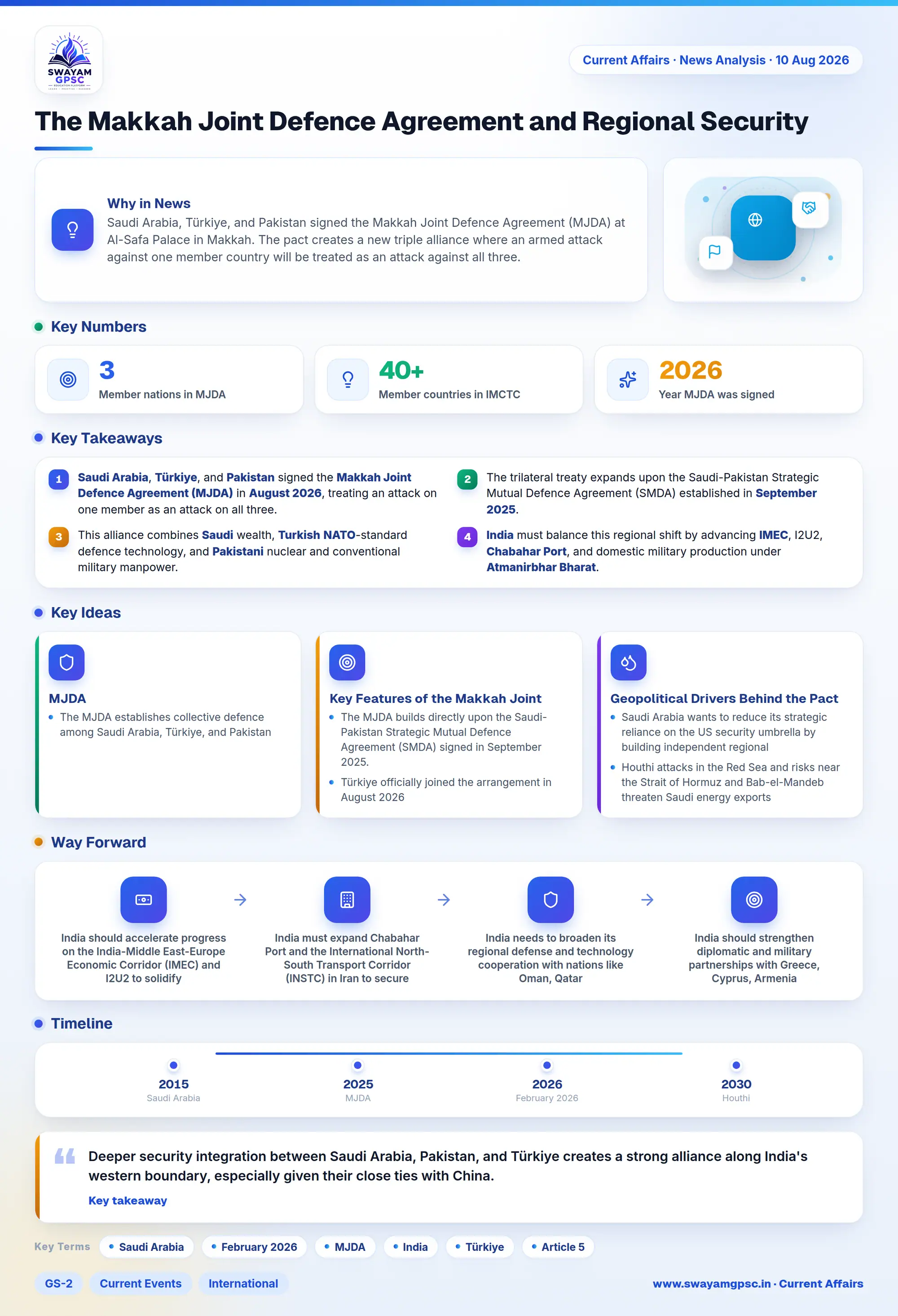
The Makkah Joint Defence Agreement and Regional Security
#GS-2 #Current Events #International #GS-3 #Science & Technology #Defence #Bilateral Groupings & Agreements #International Treaties & Agreements
Key takeaways
- Saudi Arabia, Türkiye, and Pakistan signed the Makkah Joint Defence Agreement (MJDA) in August 2026, treating an attack on one member as an attack on all three.
- The trilateral treaty expands upon the Saudi-Pakistan Strategic Mutual Defence Agreement (SMDA) established in September 2025.
- This alliance combines Saudi wealth, Turkish NATO-standard defence technology, and Pakistani nuclear and conventional military manpower.
- India must balance this regional shift by advancing IMEC, I2U2, Chabahar Port, and domestic military production under Atmanirbhar Bharat.
Why in News
- Saudi Arabia, Türkiye, and Pakistan signed the Makkah Joint Defence Agreement (MJDA) at Al-Safa Palace in Makkah.
- The pact creates a new triple alliance where an armed attack against one member country will be treated as an attack against all three.
- The three nations signed this agreement during the February 2026 West Asia escalation involving the US, Israel, and Iran as middle powers seek security alternatives.
Summary
- The MJDA establishes collective defence among Saudi Arabia, Türkiye, and Pakistan, highlighting a shift toward a multipolar security order in West Asia.
- To balance this new alliance, India must strengthen Gulf partnerships, advance IMEC, I2U2, Chabahar, INSTC, domestic defence manufacturing, and Indian Ocean security.
Key Features of the Makkah Joint Defence Agreement
- The MJDA builds directly upon the Saudi-Pakistan Strategic Mutual Defence Agreement (SMDA) signed in September 2025.
- Türkiye officially joined the arrangement in August 2026, transforming the bilateral agreement into a trilateral defense alliance during heightened regional conflict.
- The pact creates a collective deterrence commitment by stipulating that an attack on one signatory nation is considered an attack on all three.
- While this mutual defence concept resembles Article 5 of NATO, the MJDA currently lacks defined enforcement mechanisms and structural guarantees.
- The agreement mandates regular combined military exercises and joint training programs for the armed forces of Saudi Arabia, Pakistan, and Türkiye.
- The treaty establishes official communication pathways to share intelligence, threat assessments, and strategic security data among the three partners.
Geopolitical Drivers Behind the Pact
- Saudi Arabia wants to reduce its strategic reliance on the US security umbrella by building independent regional defence capabilities.
- Houthi attacks in the Red Sea and risks near the Strait of Hormuz and Bab-el-Mandeb threaten Saudi energy exports, investment, tourism, and Vision 2030 goals.
- Threats from Iranian drones, missiles, and regional proxy groups have exposed Saudi security vulnerabilities, creating a need for stronger regional deterrence.
- Türkiye seeks greater strategic influence in West Asia while viewing Israel's growing military operations in Gaza and Syria as a direct security concern.
- Pakistan expands its strategic footprint in West Asia while securing stronger economic, energy, and military ties with Saudi Arabia.
- Saudi Arabia contributes significant financial capital and energy resources while securing access to Pakistani manpower and Turkish defence technology.
- Türkiye offers NATO-standard defence manufacturing, advanced drones, and aerospace capabilities in exchange for access to Saudi capital and export markets.
- Pakistan provides nuclear capabilities, a large military force, and deep strategic experience while receiving critical economic and energy support.
- Together, Saudi financial resources, Turkish defence tech, and Pakistani military forces form a potent collective defence framework.
History of Pan-Islamic and Pan-Arab Defence Pacts
- The 1950 Arab League Treaty of Joint Defense and Economic Cooperation established a collective security framework, but political disagreements limited its practical success.
- The 1955 Baghdad Pact, later renamed CENTO after Iraq withdrew in 1958, aimed to contain Soviet expansion before dissolving after the 1979 Iranian Revolution.
- The Gulf Cooperation Council created the Peninsula Shield Force in 1984 during the Iran-Iraq War, later deploying troops during the 2011 Bahrain unrest.
- Saudi Arabia established the Islamic Military Counter Terrorism Coalition (IMCTC) in 2015 with over 40 member states to coordinate counter-terrorism operations.
Potential Implications on India
- Deeper security integration between Saudi Arabia, Pakistan, and Türkiye creates a strong alliance along India's western boundary, especially given their close ties with China.
- Turkish defence sales to Gulf nations could create severe competition for India's defence export goals involving systems like BrahMos and Akash.
- Both Pakistan and Türkiye regularly oppose India on the Kashmir issue at international forums like the UN and the Organisation of Islamic Cooperation (OIC).
- Increased Saudi reliance on Pakistan's military could give Islamabad extra diplomatic leverage, testing Riyadh's balanced relationship with New Delhi.
- Saudi Arabia continues to maintain strong economic, energy, and strategic ties with India through the India-Saudi Strategic Partnership Council.
- Combined naval cooperation among the three member states could extend their military presence into the Western Indian Ocean, challenging India's regional role.
- The collective defence clause introduces strategic ambiguity, which might give Pakistan perceived cover during potential conflicts with India.
- Saudi funding combined with Turkish technology could help Pakistan acquire advanced fighters, drones, and air defence systems, threatening India's military edge.
- Closer security relations between Saudi Arabia and Pakistan could complicate India's diplomatic attempts to build global consensus against cross-border terrorism.
- Pakistan's nuclear status adds nuclear ambiguity to the pact, raising strategic questions for India even without a formal nuclear protection guarantee.
Way Forward
- India should accelerate progress on the India-Middle East-Europe Economic Corridor (IMEC) and I2U2 to solidify ties with Saudi Arabia and the UAE.
- India must expand Chabahar Port and the International North-South Transport Corridor (INSTC) in Iran to secure alternative trade access to Central Asia.
- India needs to broaden its regional defense and technology cooperation with nations like Oman, Qatar, and the UAE to avoid reliance on any single country.
- India should strengthen diplomatic and military partnerships with Greece, Cyprus, Armenia, and Israel across the Eastern Mediterranean.
- Expanding the India-UAE Strategic Defence Partnership without mutual defence obligations allows India to work closely in the Gulf without getting drawn into conflicts.
- Under Atmanirbhar Bharat, India must rapidly develop AI, drones, electronic warfare, hypersonic weapons, and counter-drone technology to offset regional military upgrades.
- As chair of the Indian Ocean Rim Association (IORA), India should promote open maritime safety across the Indian Ocean rather than alliance-based power blocs.
- India should implement its Defence Forces Vision 2047 plan to achieve true strategic autonomy through technological and economic growth.
Conclusion
- The Makkah Joint Defence Agreement marks a shift toward regional military self-reliance and collective deterrence in West Asia.
- India must respond through active diplomacy in the Gulf, strategic transport routes through Iran, and continuous domestic military modernization.