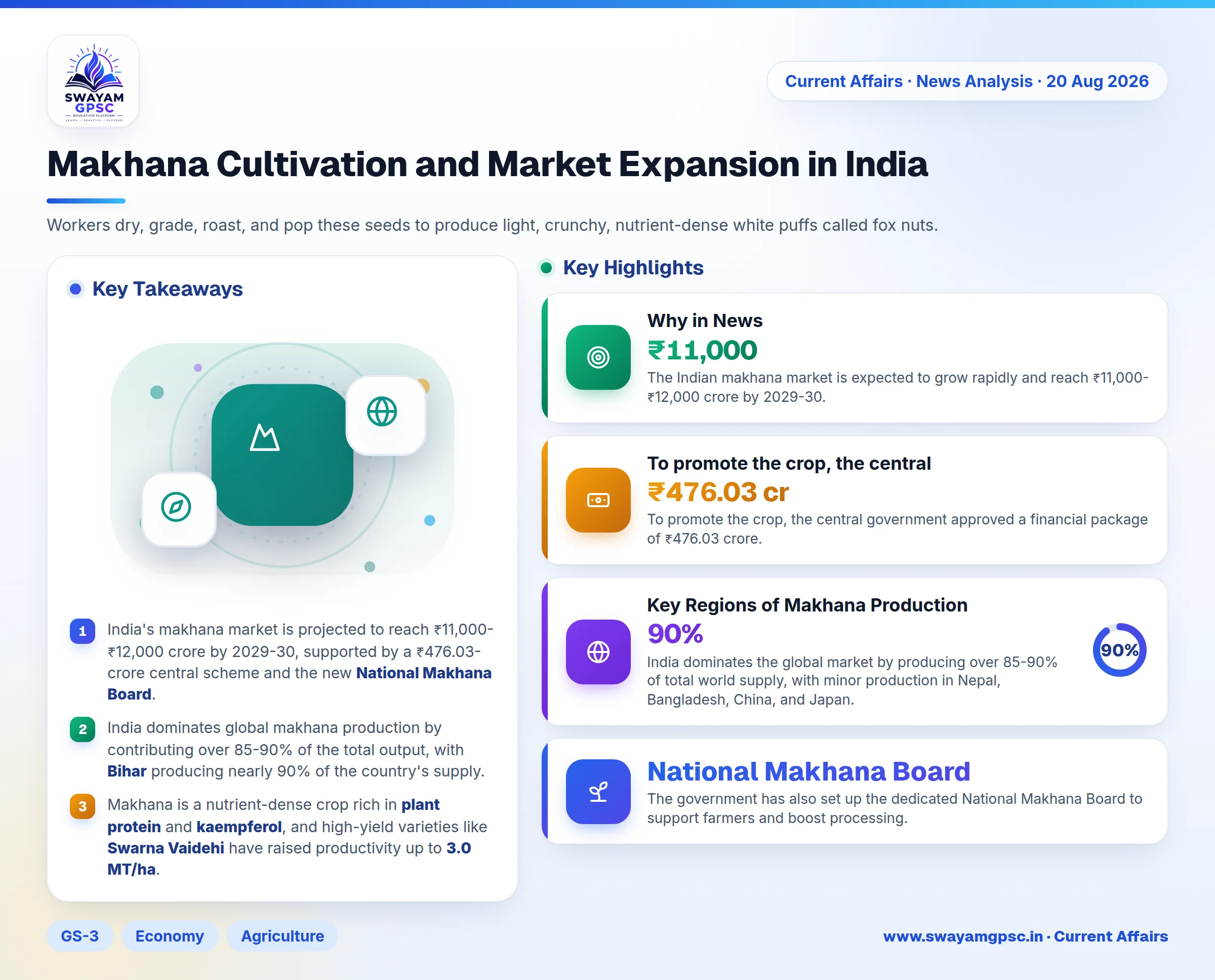
Makhana Cultivation and Market Expansion in India
#GS-3 #Economy #Agriculture #Geography #Resources #Current Events #National #Makhana Cultivation #GI Tag
Key takeaways
- India's makhana market is projected to reach ₹11,000-₹12,000 crore by 2029-30, supported by a ₹476.03-crore central scheme and the new National Makhana Board.
- India dominates global makhana production by contributing over 85-90% of the total output, with Bihar producing nearly 90% of the country's supply.
- Makhana is a nutrient-dense crop rich in plant protein and kaempferol, and high-yield varieties like Swarna Vaidehi have raised productivity up to 3.0 MT/ha.
- Mithila Makhana received the prestigious Geographical Indication (GI) tag in 2022, boosting its global market identity.
Why in News
- The Indian makhana market is expected to grow rapidly and reach ₹11,000-₹12,000 crore by 2029-30.
- Rising global demand and modern farming techniques are driving this massive growth in the sector.
- To promote the crop, the central government approved a financial package of ₹476.03 crore.
- The government has also set up the dedicated National Makhana Board to support farmers and boost processing.
What is Makhana?
- Makhana (Euryale ferox) is a high-value aquatic crop that belongs to the water lily family (Nymphaeaceae).
- Farmers extract the starchy seeds from the plant to prepare the edible component.
- Workers dry, grade, roast, and pop these seeds to produce light, crunchy, nutrient-dense white puffs called fox nuts.
Natural Habitat and Agro-Climatic Conditions
- Makhana grows best in shallow freshwater wetlands, stagnant ponds, oxbow lakes, ditches, and flood plains with slow water flow.
- The crop requires a warm, humid tropical to sub-tropical climate with water levels ranging between 1 and 1.5 metres.
- It thrives in pond beds containing clayey or alluvial soil rich in organic material.
Key Characteristics of Makhana
- The plant features large round floating leaves up to 1-2 metres wide with sharp spines, and produces prickly fruits with 20-40 hard black seeds.
- Makhana is low in calories and fat, but contains high levels of plant protein, dietary fiber, magnesium, potassium, iron, and calcium.
- It contains powerful antioxidants like kaempferol, which reduce cell damage, slow down aging, and protect heart health.
- The seeds have a low Glycemic Index (GI) and are naturally gluten-free, making them safe for individuals with diabetes.
- Modern high-yield varieties like Swarna Vaidehi and Sabour Makhana-1 have increased crop productivity from 1.5 MT/ha to 2.5-3.0 MT/ha.
Key Regions of Makhana Production
- India dominates the global market by producing over 85-90% of total world supply, with minor production in Nepal, Bangladesh, China, and Japan.
- The state of Bihar leads national production by contributing almost 90% of India's total makhana output from districts like Darbhanga, Madhubani, Purnia, and Katihar.
- The region's specialized product received official recognition when Mithila Makhana earned the Geographical Indication (GI) tag in 2022.
- Farmers also cultivate makhana on a smaller scale across the wetland regions of West Bengal, Assam, Odisha, and Manipur.