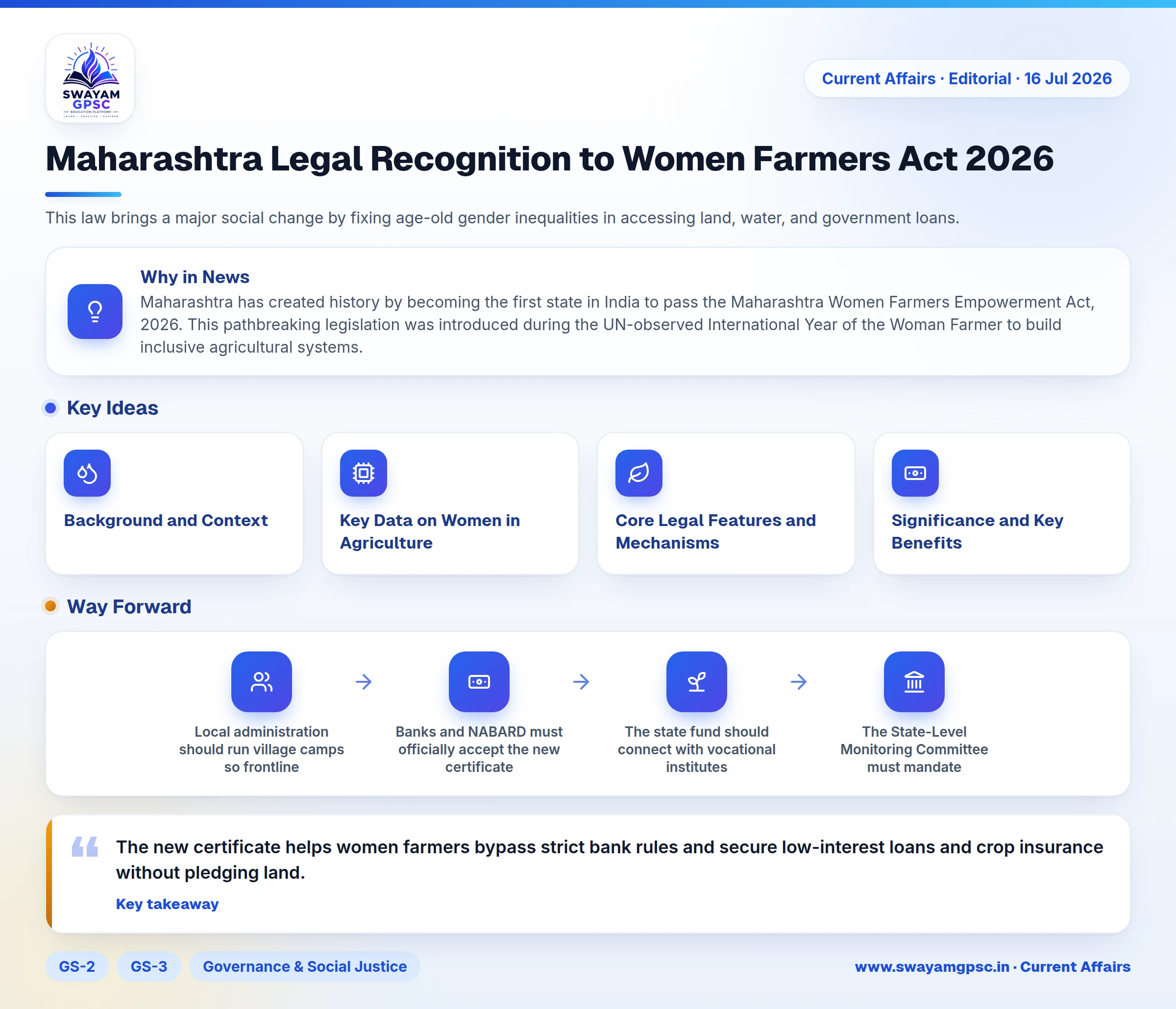
Maharashtra Legal Recognition to Women Farmers Act 2026
#GS-2 #GS-3 #Governance & Social Justice #Indian Society #Economy #Women #Social Justice #Agriculture #Empowerment
Why in News
- Maharashtra has created history by becoming the first state in India to pass the Maharashtra Women Farmers Empowerment Act, 2026.
- This pathbreaking legislation was introduced during the UN-observed International Year of the Woman Farmer to build inclusive agricultural systems.
Background and Context
- This law brings a major social change by fixing age-old gender inequalities in accessing land, water, and government loans.
- In the past, government agricultural benefits and bank loans required official land ownership, which mostly remained in the names of men.
Key Data on Women in Agriculture
- Data shows that 73% of the rural female workforce in India depends on farming, compared to only 47% of rural men.
- This new law fulfills the targets of Maharashtra's Fourth Policy for Women (2024), which focused on increasing female ownership of farm assets.
- The legislative framework covers a wide range of agricultural activities, aligning directly with the National Policy for Farmers (2007).
Core Legal Features and Mechanisms
- Following the National Policy for Farmers (2007), the law defines any woman working in crops, livestock, fisheries, or agro-forestry as a farmer.
- Eligible women can apply for a Woman Farmer Certificate (WFC) at their local Gram Sabha or Nagar Panchayat to prove their farming status without owning land.
- The government will set up a central digital registry to track certified women farmers, supported by a dedicated state welfare fund.
- A State-Level Monitoring Committee headed by the Chief Secretary will manage daily implementation, while a Governing Council led by the Chief Minister will guide overall policy.
Significance and Key Benefits
- The new certificate helps women farmers bypass strict bank rules and secure low-interest loans and crop insurance without pledging land.
- Using the digital registry, the state can design training programs specifically for single, widowed, and landless female farmers.
- Giving women legal identity boosts eco-friendly farming practices like vermiculture, as research shows women lead climate adaptation efforts.
- This reform honors the vision of legendary reformers like Jyotirao Phule and Savitribai Phule, who fought for women's equality in Maharashtra.
- When women gain direct control over farm income, rural families spend more money on healthcare, nutrition, and child education.
Challenges in Implementation
- Deeply rooted male-dominated social structures around land rights make village-level awareness campaigns essential.
- Administrative delays in local bodies like Gram Sabhas or Nagar Panchayats could slow down the issuance of certificates.
- Many rural women lack smartphones and digital skills, creating difficulty in registering on the state's digital portal.
- Tracking and helping landless migrant female workers who move frequently across districts remains a tough task.
- Effective implementation requires smooth coordination across distinct government departments like Agriculture, Finance, and Women Development.
Way Forward
- Local administration should run village camps so frontline workers can help illiterate women fill out certificate forms easily.
- Banks and NABARD must officially accept the new certificate as a valid document for giving collateral-free farm loans.
- The state fund should connect with vocational institutes to train women in modern agri-tech, post-harvest processing, and micro-irrigation.
- The State-Level Monitoring Committee must mandate that at least 30% of state agricultural subsidies go directly to certificate holders.
- The government should launch community radio shows and village plays to teach rural families about equal economic rights for women.
Conclusion
- By separating agricultural rights from land ownership, this law offers a strong model to recognize the work of women farmers.
- Proper execution of this legislation is vital to secure food production and ensure economic equity as male migration from villages continues.