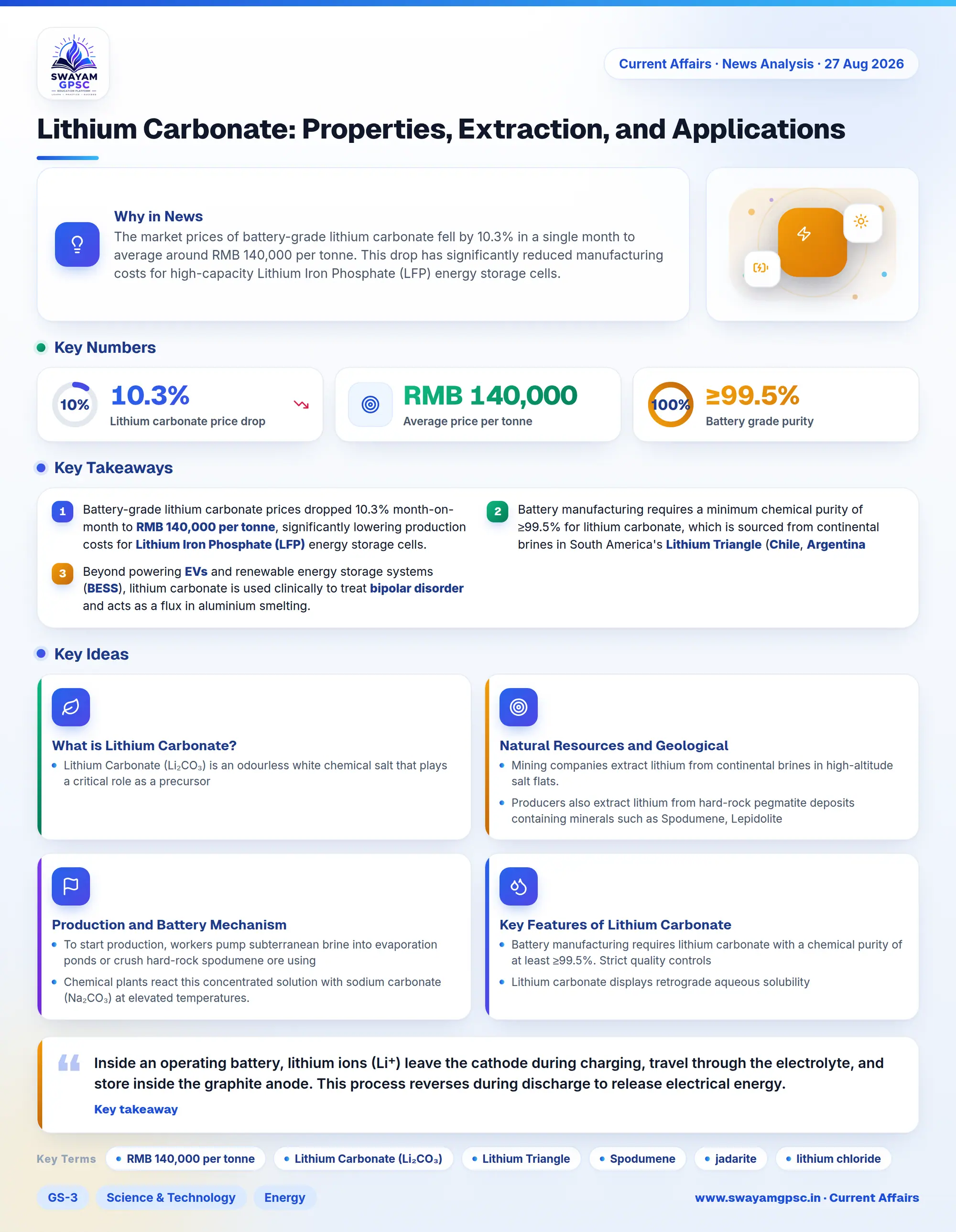
Lithium Carbonate: Properties, Extraction, and Applications
#GS-3 #Science & Technology #Energy #Economy #Infrastructure #Current Events #International #Lithium Carbonate #Energy Storage #Critical Minerals
Key takeaways
- Battery-grade lithium carbonate prices dropped 10.3% month-on-month to RMB 140,000 per tonne, significantly lowering production costs for Lithium Iron Phosphate (LFP) energy storage cells.
- Battery manufacturing requires a minimum chemical purity of ≥99.5% for lithium carbonate, which is sourced from continental brines in South America's Lithium Triangle (Chile, Argentina, and Bolivia) as well as hard-rock ores.
- Beyond powering EVs and renewable energy storage systems (BESS), lithium carbonate is used clinically to treat bipolar disorder and acts as a flux in aluminium smelting.
Why in News
- The market prices of battery-grade lithium carbonate fell by 10.3% in a single month to average around RMB 140,000 per tonne. This drop has significantly reduced manufacturing costs for high-capacity Lithium Iron Phosphate (LFP) energy storage cells.
What is Lithium Carbonate?
- Lithium Carbonate (Li₂CO₃) is an odourless white chemical salt that plays a critical role as a precursor in the lithium-ion battery supply chain. Manufacturers use this refined compound to produce cathode active materials for Lithium Iron Phosphate (LFP) and Lithium Cobalt Oxide (LCO) batteries, as well as specialized glass and ceramics.
Natural Resources and Geological Sources
- Mining companies extract lithium from continental brines in high-altitude salt flats. Major brine reserves lie within South America's Lithium Triangle covering Chile, Argentina, and Bolivia, as well as parts of China and the US.
- Producers also extract lithium from hard-rock pegmatite deposits containing minerals such as Spodumene, Lepidolite, and Petalite. Australia, China, Canada, and several African nations hold significant hard-rock deposits.
- Sedimentary clay formations provide another geological source of lithium, found in jadarite and hectorite clay deposits like the Thacker Pass deposit in the US.
Production and Battery Mechanism
- To start production, workers pump subterranean brine into evaporation ponds or crush hard-rock spodumene ore using acid leaching. This stage creates concentrated lithium chloride or lithium sulphate solutions.
- Chemical plants react this concentrated solution with sodium carbonate (Na₂CO₃) at elevated temperatures. Because lithium carbonate is sparingly soluble, solid Li₂CO₃ precipitates out of the liquid solution.
- Refining facilities mix battery-grade Li₂CO₃ with iron, phosphate, or cobalt compounds and heat them at high temperatures. This calcination process produces essential cathode powders like LiFePO₄.
- Inside an operating battery, lithium ions (Li⁺) leave the cathode during charging, travel through the electrolyte, and store inside the graphite anode. This process reverses during discharge to release electrical energy.
Key Features of Lithium Carbonate
- Battery manufacturing requires lithium carbonate with a chemical purity of at least ≥99.5%. Strict quality controls limit magnetic contaminants, calcium, and sodium to prevent internal damage and thermal runaway fires.
- Lithium carbonate displays retrograde aqueous solubility, which means it dissolves less in water as temperature increases. Engineers use this property to precipitate and crystallize the compound from hot solutions.
- This chemical serves as an economical raw material for Lithium Iron Phosphate (LFP) batteries. Industry relies heavily on LFP chemistry for commercial grid energy storage systems and standard electric vehicles.
- Compared to lithium hydroxide, lithium carbonate decomposes at lower calcination temperatures. This makes it ideal for synthesizing solid-state cathode crystals efficiently.
Applications of Lithium Carbonate
- Lithium carbonate acts as a foundational component for producing LFP and LCO cathodes. These cathodes power renewable energy storage systems (BESS), commercial solar projects, and electric vehicles.
- In glass and ceramic manufacturing, adding lithium carbonate lowers melting points and thermal expansion rates. This improves thermal shock resistance in cookware, ceramic stovetops, and telescope mirrors.
- Medical professionals prescribe lithium carbonate under strict clinical guidance as a mood stabilizer. It serves as an effective pharmaceutical treatment for bipolar disorder and severe depression.
- In aluminium smelting, operators add lithium carbonate to reduction cells. This additive lowers bath operating temperatures, boosts electrical conductivity, and cuts harmful fluorine emissions.