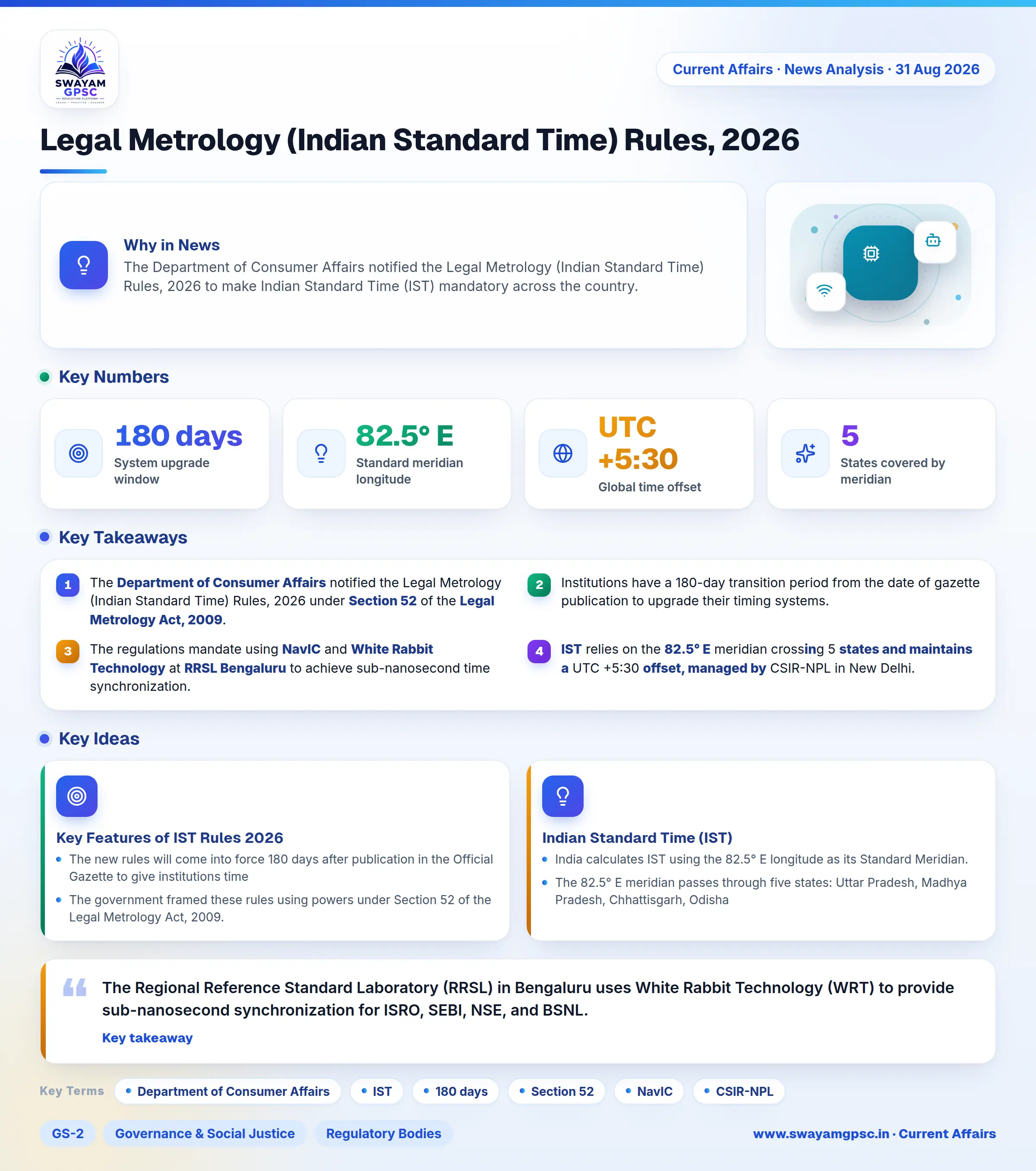
Legal Metrology (Indian Standard Time) Rules, 2026
#GS-2 #Governance & Social Justice #Regulatory Bodies #GS-3 #Science & Technology #ICT #Current Events #National #Government Policies
Key takeaways
- The Department of Consumer Affairs notified the Legal Metrology (Indian Standard Time) Rules, 2026 under Section 52 of the Legal Metrology Act, 2009.
- Institutions have a 180-day transition period from the date of gazette publication to upgrade their timing systems.
- The regulations mandate using NavIC and White Rabbit Technology at RRSL Bengaluru to achieve sub-nanosecond time synchronization.
- IST relies on the 82.5° E meridian crossing 5 states and maintains a UTC +5:30 offset, managed by CSIR-NPL in New Delhi.
Why in News
- The Department of Consumer Affairs notified the Legal Metrology (Indian Standard Time) Rules, 2026 to make Indian Standard Time (IST) mandatory across the country.
- This notification establishes IST as the single time standard for all legal, official, administrative, and commercial activities in India.
Key Features of IST Rules 2026
- The new rules will come into force 180 days after publication in the Official Gazette to give institutions time to update their systems.
- The government framed these rules using powers under Section 52 of the Legal Metrology Act, 2009.
- Uniform time stamping in banking and digital payments will stop settlement errors and reduce financial fraud.
- Transport networks like railways, airlines, and emergency services will operate on a single synchronized schedule.
- Telecom networks, internet systems, and smart power grids require microsecond time accuracy to avoid service disruptions.
- Standardized time logs ensure that administrative entries and legal filings remain valid evidence in court.
- The framework mandates using NavIC and domestic timing systems to reduce reliance on foreign satellite networks like GPS.
- Time signals will reach organizations through laboratories run by CSIR-NPL and Legal Metrology laboratories.
- These regulations support the broader 'One Nation, One Time' initiative to unify time measurement across critical infrastructure.
- The Regional Reference Standard Laboratory (RRSL) in Bengaluru uses White Rabbit Technology (WRT) to provide sub-nanosecond synchronization for ISRO, SEBI, NSE, and BSNL.
Indian Standard Time (IST)
- India calculates IST using the 82.5° E longitude as its Standard Meridian.
- The 82.5° E meridian passes through five states: Uttar Pradesh, Madhya Pradesh, Chhattisgarh, Odisha, and Andhra Pradesh.
- IST stays exactly 5 hours and 30 minutes ahead of Coordinated Universal Time (UTC +5:30).
- The CSIR-National Physical Laboratory (CSIR-NPL) in New Delhi keeps the primary time standard using atomic clocks linked with BIPM in France.