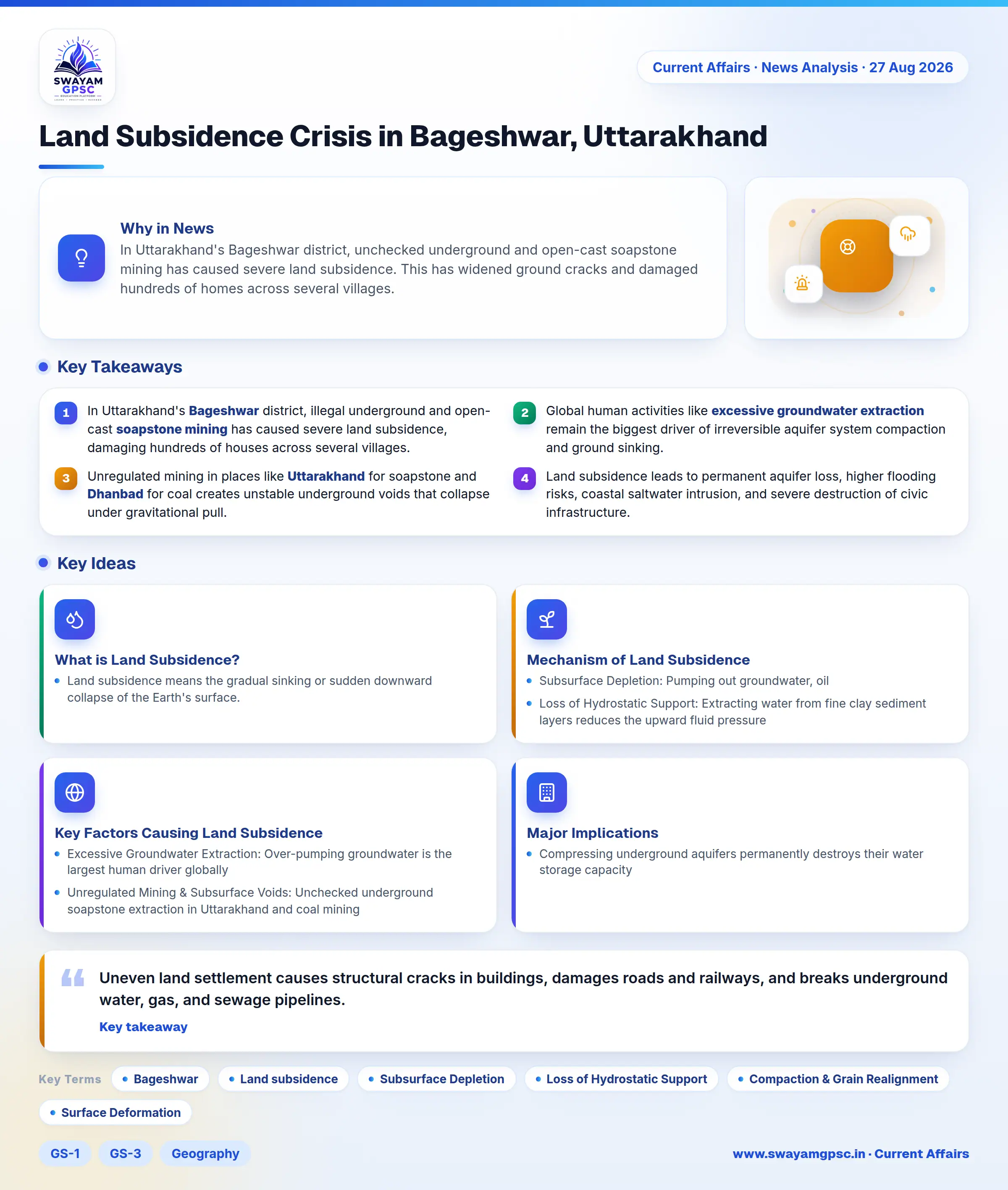
Land Subsidence Crisis in Bageshwar, Uttarakhand
#GS-1 #GS-3 #Geography #Disaster Geography #Environment #Disaster Management #Current Events #National #Land Subsidence
Key takeaways
- In Uttarakhand's Bageshwar district, illegal underground and open-cast soapstone mining has caused severe land subsidence, damaging hundreds of houses across several villages.
- Global human activities like excessive groundwater extraction remain the biggest driver of irreversible aquifer system compaction and ground sinking.
- Unregulated mining in places like Uttarakhand for soapstone and Dhanbad for coal creates unstable underground voids that collapse under gravitational pull.
- Land subsidence leads to permanent aquifer loss, higher flooding risks, coastal saltwater intrusion, and severe destruction of civic infrastructure.
Why in News
- In Uttarakhand's Bageshwar district, unchecked underground and open-cast soapstone mining has caused severe land subsidence. This has widened ground cracks and damaged hundreds of homes across several villages.
What is Land Subsidence?
- Land subsidence means the gradual sinking or sudden downward collapse of the Earth's surface. It happens when underground materials like groundwater, minerals, oil, or soluble rocks are removed or compacted.
Mechanism of Land Subsidence
- Subsurface Depletion: Pumping out groundwater, oil, or conducting physical mining creates empty underground voids and causes pressure drops deep inside the soil.
- Loss of Hydrostatic Support: Extracting water from fine clay sediment layers reduces the upward fluid pressure that previously supported the heavy weight of the soil above.
- Compaction & Grain Realignment: The full weight of the upper ground shifts onto fine soil sediment layers. This forces them to compress permanently and lose all pore spaces.
- Surface Deformation: The ongoing subterranean compaction manifests on the ground surface as regional sinking, uneven ground settling, or deep structural cracks.
Key Factors Causing Land Subsidence
- Excessive Groundwater Extraction: Over-pumping groundwater is the largest human driver globally, leading to permanent collapse of underground aquifer systems.
- Unregulated Mining & Subsurface Voids: Unchecked underground soapstone extraction in Uttarakhand and coal mining in Dhanbad leave huge subterranean voids that collapse under gravity.
- Disrupted Drainage & Slope Hydro-Pressure: Dumping mining waste blocks natural drainage channels. This traps water, increases pore pressure inside hill slopes, and triggers severe landslides.
- Natural & Geotechnical Causes: Dissolution of soluble rocks like limestone, drainage of organic wetland soils, thawing permafrost, and natural tectonic movements also cause ground sinking.
Major Implications
- Uneven land settlement causes structural cracks in buildings, damages roads and railways, and breaks underground water, gas, and sewage pipelines.
- Compressing underground aquifers permanently destroys their water storage capacity, while lower ground surface levels increase local flooding risks and coastal saltwater intrusion.