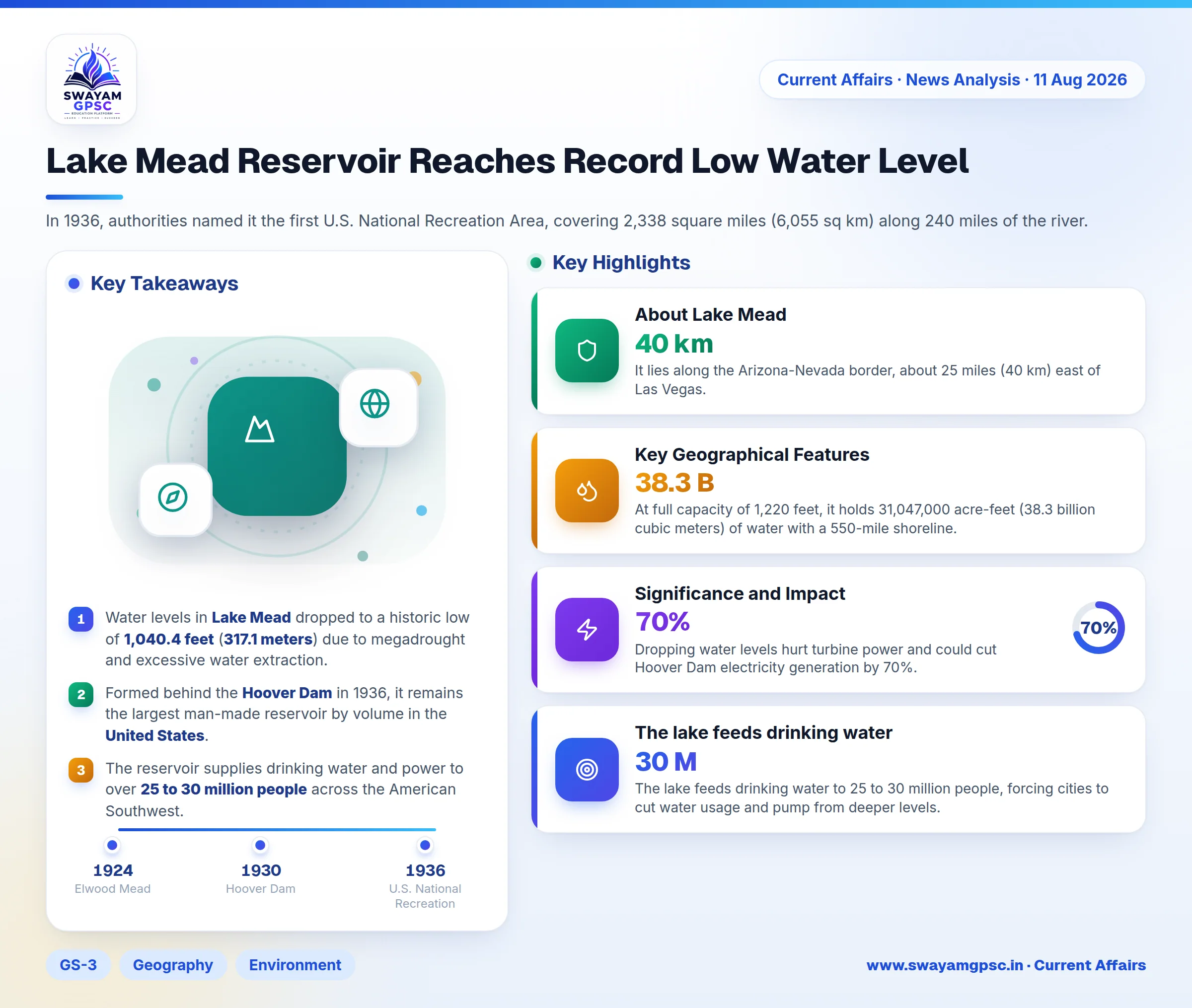
Lake Mead Reservoir Reaches Record Low Water Level
#GS-3 #Geography #Environment #Resources #Climate Change #Current Events #International #Lake Mead #Colorado River
Key takeaways
- Water levels in Lake Mead dropped to a historic low of 1,040.4 feet (317.1 meters) due to megadrought and excessive water extraction.
- Formed behind the Hoover Dam in 1936, it remains the largest man-made reservoir by volume in the United States.
- The reservoir supplies drinking water and power to over 25 to 30 million people across the American Southwest.
- Decreasing water availability directly threatens energy security by reducing Hoover Dam hydroelectric output by up to 70%.
Why in News
- Water levels at Lake Mead dropped to an all-time low of 1,040.4 feet (317.1 meters) above sea level.
About Lake Mead
- It is the largest man-made reservoir by volume in the United States, formed by damming the Colorado River.
- The reservoir acts as a main source of drinking water, farming water, and electricity across the American Southwest.
- It lies along the Arizona-Nevada border, about 25 miles (40 km) east of Las Vegas.
- In 1936, authorities named it the first U.S. National Recreation Area, covering 2,338 square miles (6,055 sq km) along 240 miles of the river.
Origin and History
- The reservoir formed during the 1930s after workers finished building the Hoover Dam in 1936.
- It was named after Elwood Mead, who served as Commissioner of the U.S. Bureau of Reclamation from 1924 to 1936.
Key Geographical Features
- At full capacity of 1,220 feet, it holds 31,047,000 acre-feet (38.3 billion cubic meters) of water with a 550-mile shoreline.
- A noticeable white mineral band on nearby cliffs marks the high-water level from past decades.
- It works alongside Lake Powell behind Glen Canyon Dam to control the storage and flow of the Colorado River.
Causes for the Decline
- Winter snowpack in the Rocky Mountains fell to record low levels, drastically reducing river inflows.
- High temperatures and fast evaporation caused a multi-decade megadrought across the region.
- Legal water allocations given to 7 states and Mexico continuously exceed the natural water supply of the river.
Significance and Impact
- Dropping water levels hurt turbine power and could cut Hoover Dam electricity generation by 70%.
- The lake feeds drinking water to 25 to 30 million people, forcing cities to cut water usage and pump from deeper levels.