Kufri Jamunia: India's Biofortified Purple Potato
#GS-3 #Science & Technology #Biotechnology #Economy #Agriculture #Food Security #Current Events #National #Prelims #Biofortification
Key takeaways
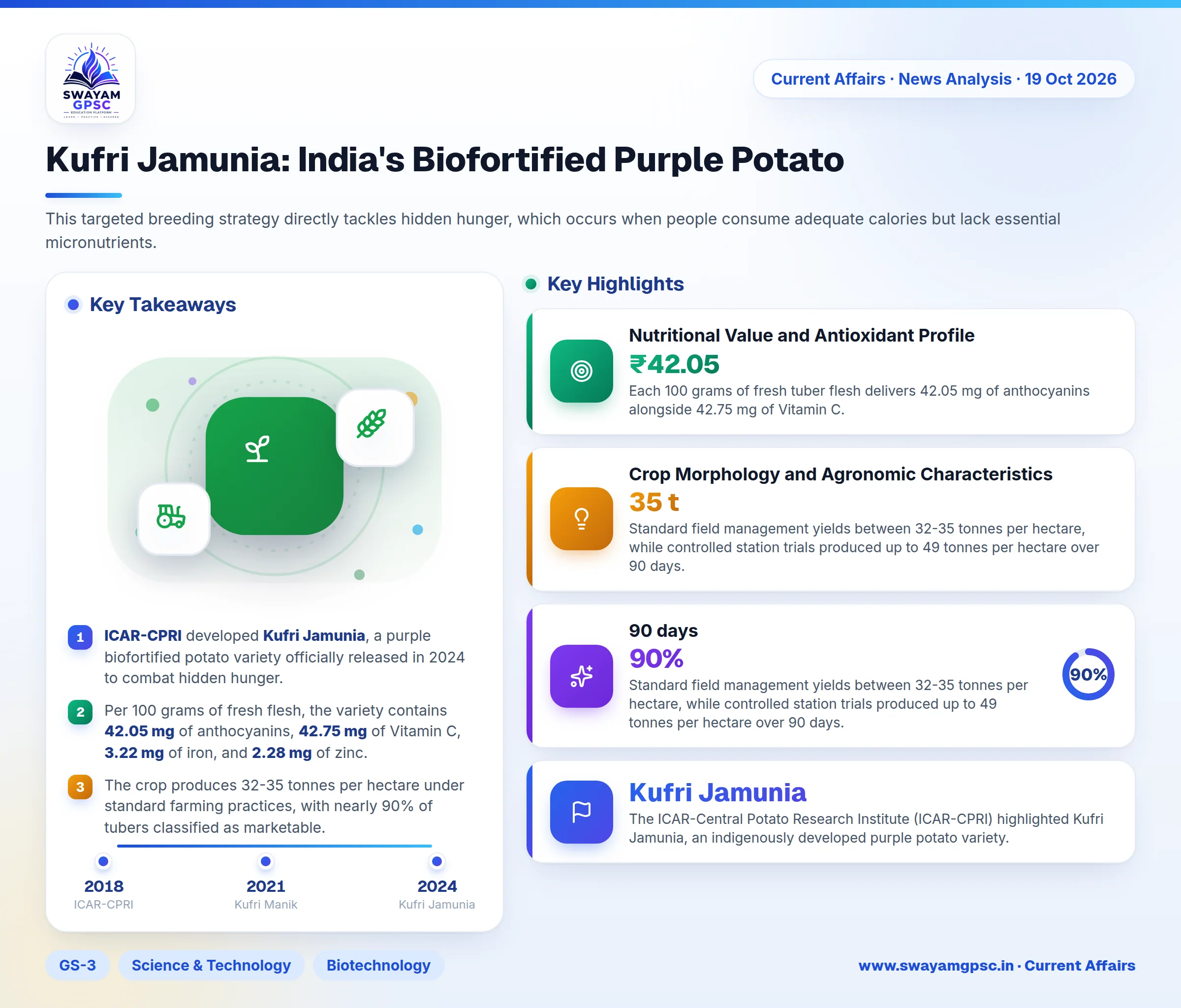
- ICAR-CPRI developed Kufri Jamunia, a purple biofortified potato variety officially released in 2024 to combat hidden hunger.
- Per 100 grams of fresh flesh, the variety contains 42.05 mg of anthocyanins, 42.75 mg of Vitamin C, 3.22 mg of iron, and 2.28 mg of zinc.
- The crop produces 32-35 tonnes per hectare under standard farming practices, with nearly 90% of tubers classified as marketable.
- Harvested tubers feature a natural dormancy period of 6-8 weeks, which significantly curbs premature sprouting and reduces storage decay.
Why in News
- The ICAR-Central Potato Research Institute (ICAR-CPRI) highlighted Kufri Jamunia, an indigenously developed purple potato variety.
- Scientists presented this biofortified crop as an effective solution to fight hidden hunger and improve nutritional security across Indian households.
Background and Scientific Biofortification
- The ICAR-Central Potato Research Institute (ICAR-CPRI), located in Shimla, officially released Kufri Jamunia in 2024.
- Biofortification relies on standard plant breeding methods to enrich the inherent nutritional value of staple food crops.
- This targeted breeding strategy directly tackles hidden hunger, which occurs when people consume adequate calories but lack essential micronutrients.
- The development of Kufri Jamunia builds upon earlier breeding milestones achieved by ICAR-CPRI with coloured specialty tubers.
Nutritional Value and Antioxidant Profile
- This specialty variety features dark purple skin combined with vivid purple flesh throughout its interior.
- The distinctive coloration comes from anthocyanins, which are natural plant pigments functioning as powerful health-promoting antioxidants.
- Each 100 grams of fresh tuber flesh delivers 42.05 mg of anthocyanins alongside 42.75 mg of Vitamin C.
- The tuber also supplies vital trace minerals, providing 3.22 mg of iron and 2.28 mg of zinc per 100 grams.
- These concentration levels of Vitamin C, carotenoids, and anthocyanins substantially surpass conventional potatoes and previous coloured selections.
Crop Morphology and Agronomic Characteristics
- The plant exhibits a medium-maturing lifecycle with semi-compact vegetative growth.
- Individual plants reliably generate 10-12 oblong tubers featuring shallow eyes and a floury, mealy internal texture.
- Standard field management yields between 32-35 tonnes per hectare, while controlled station trials produced up to 49 tonnes per hectare over 90 days.
- Field evaluations confirmed high commercial viability, noting that nearly 90% of total harvested volume meets standard marketable quality.
- Harvested tubers show natural dormancy lasting 6-8 weeks, which prevents premature sprouting and keeps post-harvest storage losses low.
Geographical Distribution and Agro-Climatic Suitability
- The crop is well adapted to the subtropical climate of the vast North Indian plains.
- The variety produces the best yields in well-drained alluvial and sandy-loam soils during cool winter months.
- Multi-location performance trials demonstrated consistent agricultural stability across Punjab, Haryana, Uttar Pradesh, and Uttarakhand.
- Field trials in central and eastern India, including Bihar, Madhya Pradesh, and Chhattisgarh, also showed dependable crop performance.
Culinary Applications and Commercial Significance
- Its firm flesh and mealy texture work well in traditional home-cooked recipes, such as curries, parathas, and puris.
- Food processors can mill the dried tubers into nutrient-dense flour, suji, and daliya for healthy bakery items and breakfast cereals.
- Widespread adoption of this biofortified staple supports dietary diversity and provides critical micronutrients to vulnerable populations.
- Farmers benefit financially from high field productivity and access to premium retail markets interested in vibrant, antioxidant-rich foods.
Earlier Specialty Varieties by ICAR-CPRI
- ICAR-CPRI released Kufri Neelkanth in 2018 as India's first specialty potato variety sporting purple skin.
- Agricultural authorities recommended Kufri Neelkanth for cultivation across Punjab, Haryana, Uttar Pradesh, Uttarakhand, Bihar, Madhya Pradesh, and Chhattisgarh due to its rich antioxidant content.
- The institute subsequently introduced Kufri Manik in 2021, a specialty variety bearing deep red, round tubers with yellow flesh containing anthocyanins, iron, and zinc.