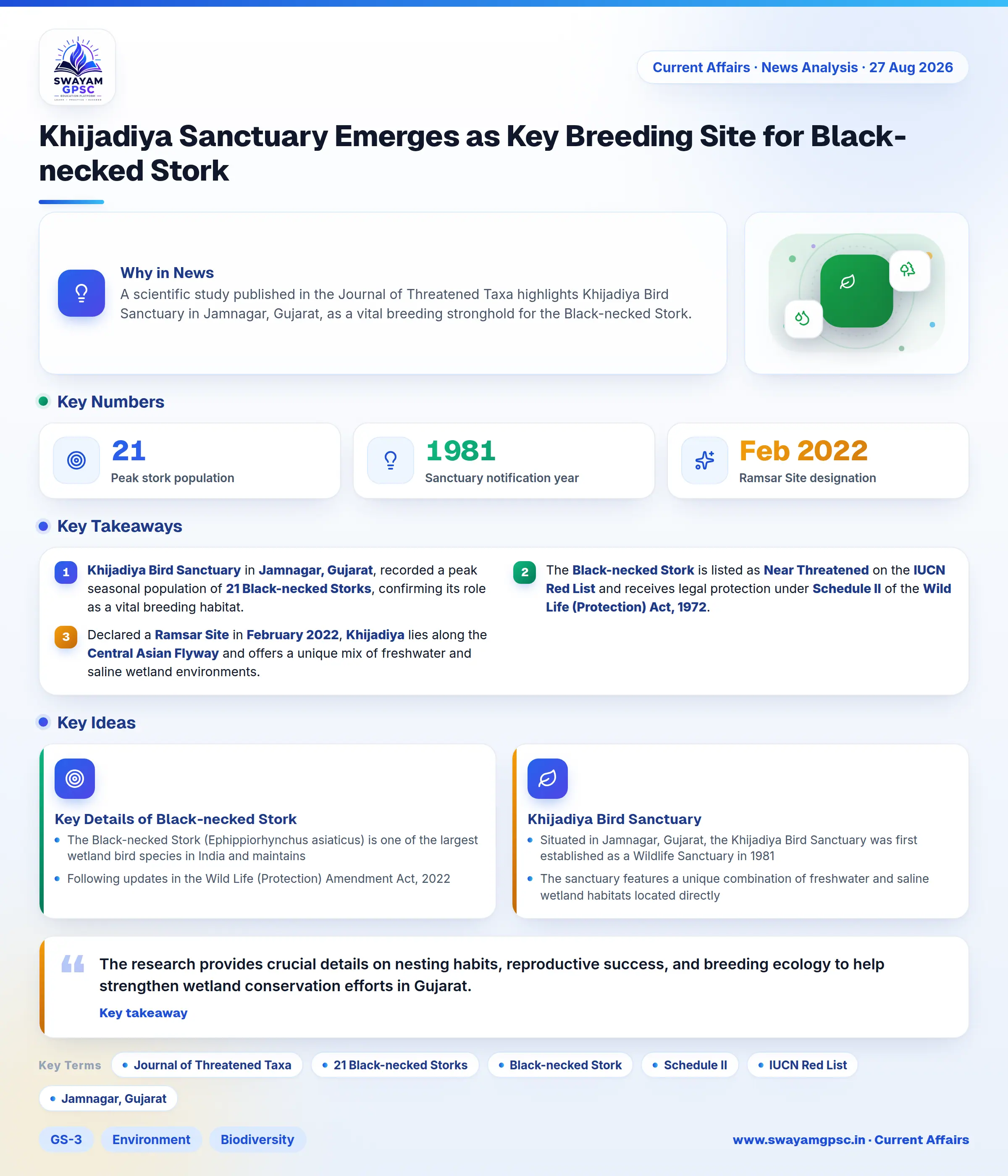
Khijadiya Sanctuary Emerges as Key Breeding Site for Black-necked Stork
#GS-3 #Environment #Biodiversity #Wildlife #GS-2 #Current Events #Gujarat #Ramsar Sites #Khijadiya Bird Sanctuary
Key takeaways
- Khijadiya Bird Sanctuary in Jamnagar, Gujarat, recorded a peak seasonal population of 21 Black-necked Storks, confirming its role as a vital breeding habitat.
- The Black-necked Stork is listed as Near Threatened on the IUCN Red List and receives legal protection under Schedule II of the Wild Life (Protection) Act, 1972.
- Declared a Ramsar Site in February 2022, Khijadiya lies along the Central Asian Flyway and offers a unique mix of freshwater and saline wetland environments.
Why in News
- A scientific study published in the Journal of Threatened Taxa highlights Khijadiya Bird Sanctuary in Jamnagar, Gujarat, as a vital breeding stronghold for the Black-necked Stork.
- The survey recorded a peak seasonal population of 21 Black-necked Storks, which includes both active breeding pairs and non-breeding adults.
Key Details of Black-necked Stork
- The Black-necked Stork (Ephippiorhynchus asiaticus) is one of the largest wetland bird species in India and maintains scattered breeding populations across the country.
- Following updates in the Wild Life (Protection) Amendment Act, 2022, this bird species receives legal protection under Schedule II of the Wild Life (Protection) Act, 1972.
- The IUCN Red List classifies the species as Near Threatened, mainly due to ongoing habitat destruction and declining population numbers.
Khijadiya Bird Sanctuary
- Situated in Jamnagar, Gujarat, the Khijadiya Bird Sanctuary was first established as a Wildlife Sanctuary in 1981 and later named a Ramsar Site in February 2022.
- The sanctuary features a unique combination of freshwater and saline wetland habitats located directly along the Central Asian Flyway.
Conservation Significance
- The research provides crucial details on nesting habits, reproductive success, and breeding ecology to help strengthen wetland conservation efforts in Gujarat.