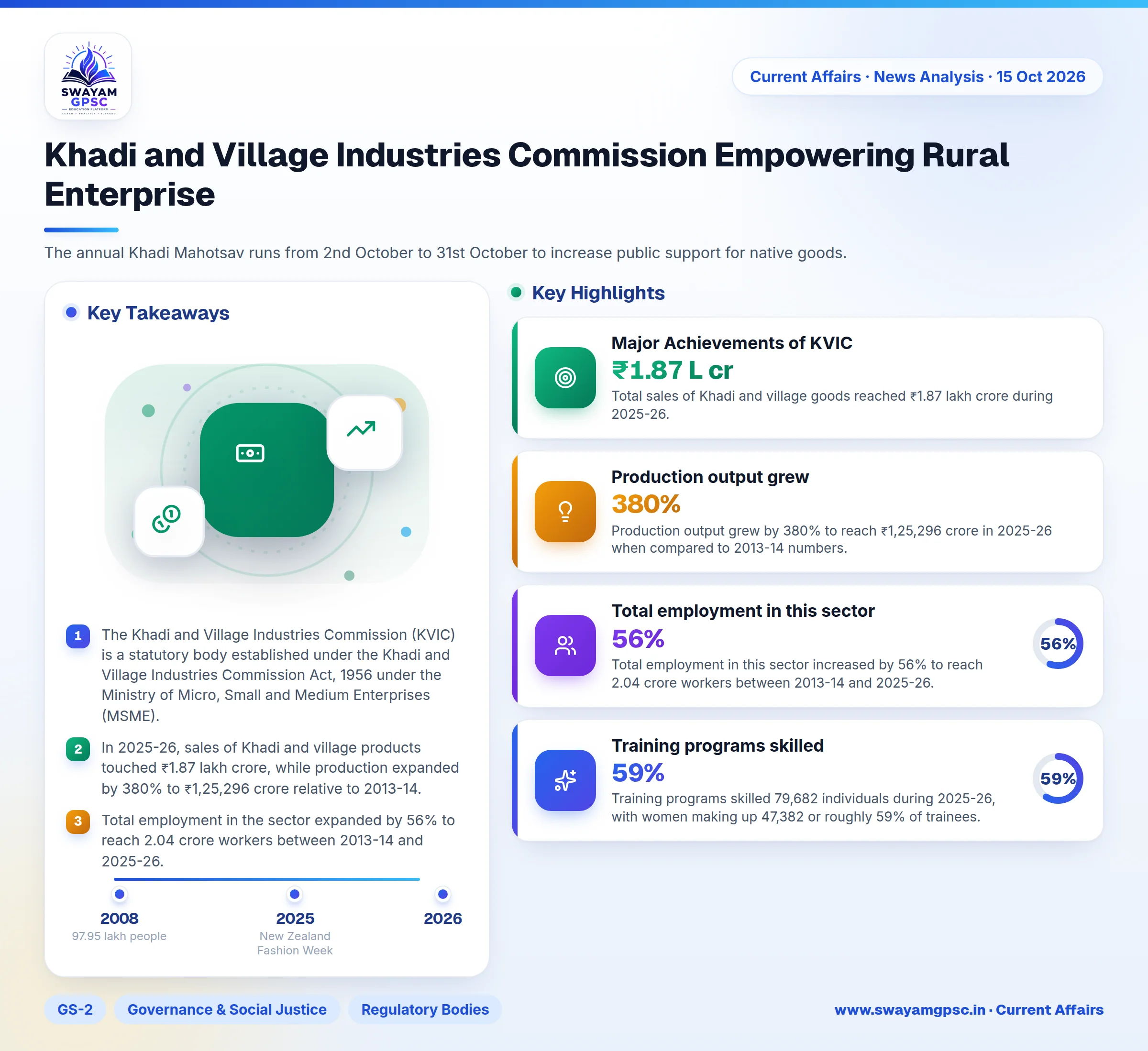
Khadi and Village Industries Commission Empowering Rural Enterprise
#GS-2 #Governance & Social Justice #Regulatory Bodies #Poverty #GS-3 #Economy #Employment #Infrastructure #Government Policies & Interventions
Key takeaways
- The Khadi and Village Industries Commission (KVIC) is a statutory body established under the Khadi and Village Industries Commission Act, 1956 under the Ministry of Micro, Small and Medium Enterprises (MSME).
- In 2025-26, sales of Khadi and village products touched ₹1.87 lakh crore, while production expanded by 380% to ₹1,25,296 crore relative to 2013-14.
- Total employment in the sector expanded by 56% to reach 2.04 crore workers between 2013-14 and 2025-26.
- Women account for over 80% of the 5 lakh artisans engaged in the Khadi sector, demonstrating its key role in boosting female workforce participation.
- The Prime Minister's Employment Generation Programme (PMEGP) has generated job opportunities for 97.95 lakh people via KVIC since March 2008.
Why in News
- The Ministry of Micro, Small and Medium Enterprises (MSME) recently highlighted how rural industries convert local skills and resources into modern enterprises.
- The Khadi and Village Industries Commission (KVIC) acts as the central agency driving this rural transformation.
- The government supports these village enterprises through affordable loans, modern technology, and technical training.
- The annual Khadi Mahotsav runs from 2nd October to 31st October to increase public support for native goods.
- This national campaign builds awareness among young people and aligns with the Vocal for Local and Atmanirbhar Bharat visions.
Key Facts About Khadi and Village Industries Commission
- The KVIC functions as a statutory body under the Ministry of Micro, Small and Medium Enterprises (MSME).
- Parliament established this central agency by passing the Khadi and Village Industries Commission Act, 1956.
- The core objective of the body involves driving industrial growth across rural areas and creating local jobs.
- It strengthens village enterprises by offering financial grants, technical tools, and marketing assistance to traditional artisans.
Initiatives for Market Promotion
- The agency assists rural entrepreneurs in participating in foreign trade fairs to connect directly with foreign buyers.
- It manages the official Khadi India digital store to sell clothing, groceries, cosmetics, essential oils, and incense online.
- The physical sales network comprises 8 departmental outlets, 15 KVIC branches, and 8,035 sales outlets run by certified institutions.
- Promoters display traditional fabrics at major events like New Zealand Fashion Week 2026 and Lakmé Fashion Week 2025 to target modern buyers.
Major Achievements of KVIC
- Total sales of Khadi and village goods reached ₹1.87 lakh crore during 2025-26.
- Production output grew by 380% to reach ₹1,25,296 crore in 2025-26 when compared to 2013-14 numbers.
- Total employment in this sector increased by 56% to reach 2.04 crore workers between 2013-14 and 2025-26.
- The commission manages 35 training centers that teach food processing, baking, beekeeping, agarbatti making, and vehicle repair.
- Training programs skilled 79,682 individuals during 2025-26, with women making up 47,382 or roughly 59% of trainees.
- Women represent over 80% of the 5 lakh artisans working in the Khadi sector, showing its strong support for female income generation.
Major Schemes Associated with KVIC
- The Prime Minister's Employment Generation Programme (PMEGP) helped create jobs for 97.95 lakh people through KVIC since March 2008.
- The Gramodyog Vikas Yojana (GVY) provides artisans with modern equipment, distributing 37,769 toolkits in 2025-26 and over 3.23 lakh toolkits by May 2026.
- The Khadi Vikas Yojana aids institutions with product design, quality improvements, and marketing support.
- The Modified Market Development Assistance (MMDA) component under this scheme gave ₹245 crore to 1,097 Khadi institutions and helped 1,45,484 artisans in 2024-25.
- The Interest Subsidy Eligibility Certificate Scheme enables eligible institutions to secure bank loans at a reduced interest rate of 4% per annum.
- The Workshed Scheme grants financial assistance to build better, safer, and larger production spaces for local workers.
Way Forward
- Upgrading traditional village production into market-ready businesses requires combining traditional craftsmanship with modern tools.
- Expanding financial support and digital market linkages will secure sustainable income sources for rural families.
- Strengthening this local industrial system supports gender equality, empowers rural women, and advances the Atmanirbhar Bharat mission.
Frequently Asked Questions
- Khadi refers to hand-spun and hand-woven cloth deeply linked to India's rural heritage and self-reliance history.
- The Khadi and Village Industries Commission operates as a statutory body created under the Khadi and Village Industries Commission Act, 1956.
- Main responsibilities of KVIC include providing worker training, supplying raw materials, backing marketing efforts, conducting research, and modernizing machinery.
- The Khadi Mahotsav is an annual awareness campaign running from 2nd October to 31st October to encourage citizens to buy local goods.
- Village industries generate rural jobs across sectors like textiles, food processing, honey collection, agarbatti creation, and handicraft making.