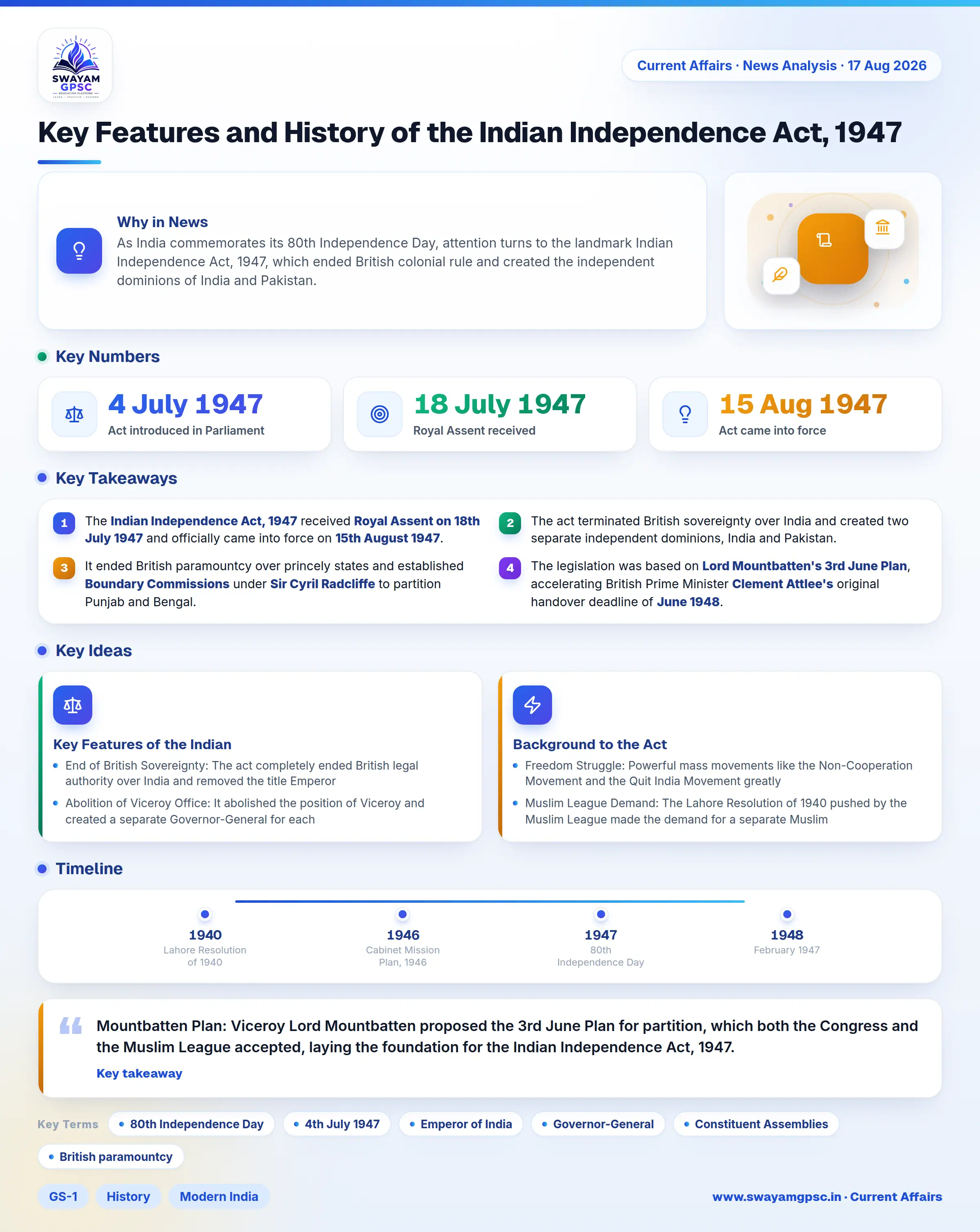
Key Features and History of the Indian Independence Act, 1947
#GS-1 #History #Modern India #Freedom Struggle #GS-2 #Current Events #National #Indian Independence Act 1947
Key takeaways
- The Indian Independence Act, 1947 received Royal Assent on 18th July 1947 and officially came into force on 15th August 1947.
- The act terminated British sovereignty over India and created two separate independent dominions, India and Pakistan.
- It ended British paramountcy over princely states and established Boundary Commissions under Sir Cyril Radcliffe to partition Punjab and Bengal.
- The legislation was based on Lord Mountbatten's 3rd June Plan, accelerating British Prime Minister Clement Attlee's original handover deadline of June 1948.
Why in News
- As India commemorates its 80th Independence Day, attention turns to the landmark Indian Independence Act, 1947, which ended British colonial rule and created the independent dominions of India and Pakistan.
- The British Parliament passed this historical legislation on 4th July 1947, received Royal Assent on 18th July 1947, and officially enforced it on 15th August 1947.
Key Features of the Indian Independence Act, 1947
- End of British Sovereignty: The act completely ended British legal authority over India and removed the title Emperor of India from the British monarch.
- Abolition of Viceroy Office: It abolished the position of Viceroy and created a separate Governor-General for each of the two new dominions.
- Constituent Assemblies: The law empowered the Constituent Assemblies of both nations to frame their constitutions and alter or cancel any existing British legislation.
- Princely States: It terminated British paramountcy over princely states, giving them the choice to join India, join Pakistan, or stay independent.
- Interim Constitutional Framework: Both nations could use the Government of India Act, 1935 as a temporary constitution until they framed their own, with necessary modifications.
- Boundary Demarcation: The legislation established Boundary Commissions headed by Sir Cyril Radcliffe to decide the final borders of Punjab and Bengal.
- Secretary of State for India: It formally abolished the post of the Secretary of State for India and transferred its duties to the Commonwealth Office.
Background to the Act
- Freedom Struggle: Powerful mass movements like the Non-Cooperation Movement and the Quit India Movement greatly strengthened the public demand for total independence.
- Muslim League Demand: The Lahore Resolution of 1940 pushed by the Muslim League made the demand for a separate Muslim state much stronger.
- Failure of Cabinet Mission Plan: The Cabinet Mission Plan, 1946 tried to keep India united with regional autonomy, but political disagreement and communal riots caused it to fail.
- Attlee Announcement: In February 1947, British Prime Minister Clement Attlee declared that Britain would hand over full power by June 1948 at the latest.
- Mountbatten Plan: Viceroy Lord Mountbatten proposed the 3rd June Plan for partition, which both the Congress and the Muslim League accepted, laying the foundation for the Indian Independence Act, 1947.