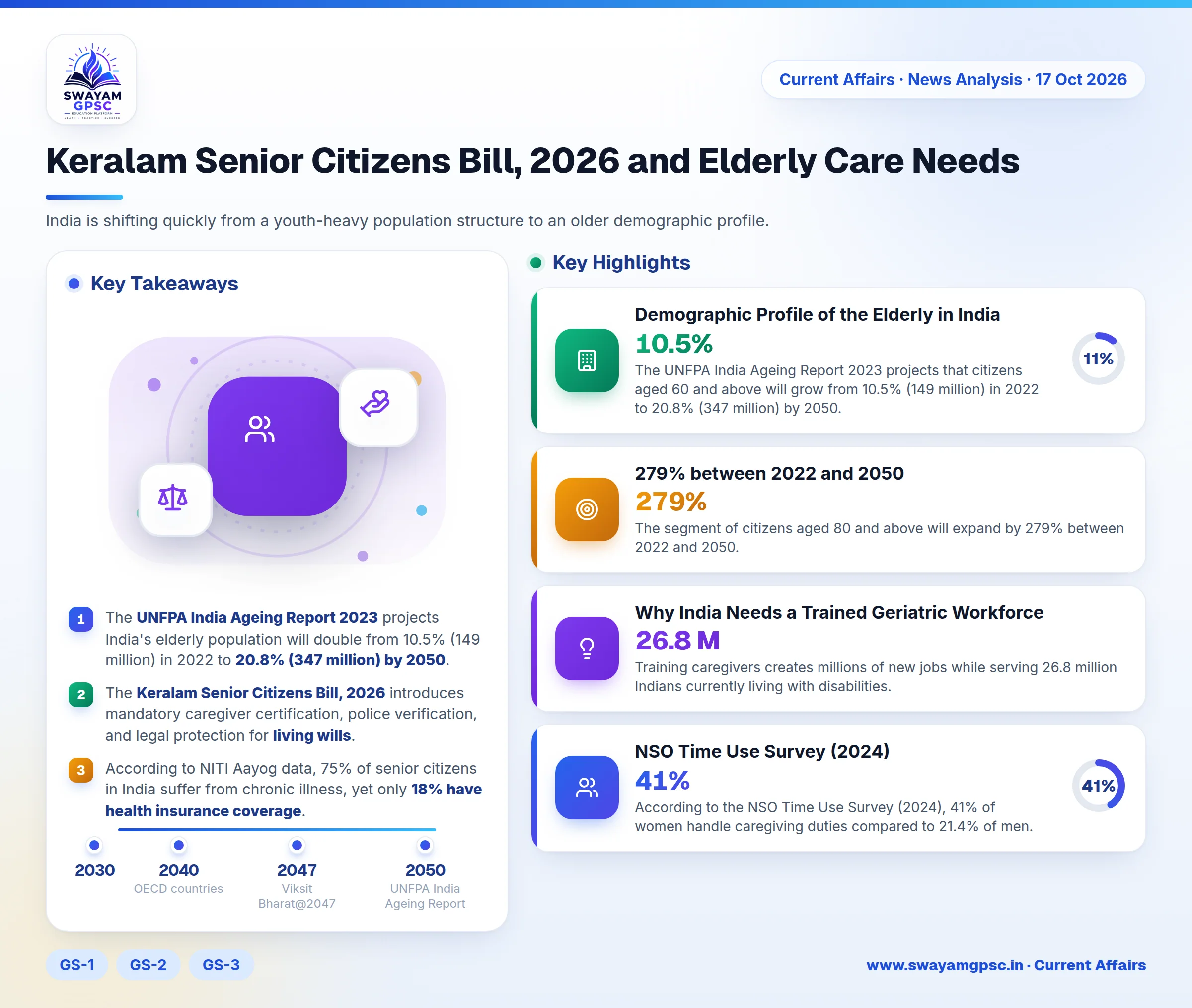
Keralam Senior Citizens Bill, 2026 and Elderly Care Needs
#GS-1 #GS-2 #GS-3 #Salient Features of Indian Society #Vulnerable Sections #Social Justice #Growth & Development #Employment #Current Events #National #Health #Governance & Social Justice #Indian Society
Key takeaways
- The UNFPA India Ageing Report 2023 projects India's elderly population will double from 10.5% (149 million) in 2022 to 20.8% (347 million) by 2050.
- The Keralam Senior Citizens Bill, 2026 introduces mandatory caregiver certification, police verification, and legal protection for living wills.
- According to NITI Aayog data, 75% of senior citizens in India suffer from chronic illness, yet only 18% have health insurance coverage.
- The Indian care service market is projected to expand from USD 29.62 billion in 2023 to USD 72.31 billion by 2030.
- Women bear a heavy care burden, spending 140 minutes daily on caregiving compared to 74 minutes for men according to the NSO Time Use Survey (2024).
Why in News
- The Kerala state government introduced the Keralam Senior Citizens (Care and Protection of Rights) Bill, 2026 to regulate elder-care facilities and certify professional caregivers.
- This bill recognizes progressive end-of-life healthcare choices by giving legal standing to living wills.
- India faces an urgent need to build a qualified elder-care workforce because the population is aging rapidly across all states.
Demographic Profile of the Elderly in India
- India is shifting quickly from a youth-heavy population structure to an older demographic profile.
- The UNFPA India Ageing Report 2023 projects that citizens aged 60 and above will grow from 10.5% (149 million) in 2022 to 20.8% (347 million) by 2050.
- The segment of citizens aged 80 and above will expand by 279% between 2022 and 2050.
- Women live longer than men at age 60, which leads to a higher proportion of dependent and widowed elderly women.
- Southern states like Kerala are aging faster than northern states, offering an early preview of nationwide demographic challenges.
Key Provisions of the Keralam Senior Citizens Bill, 2026
- The bill allows individuals to sign living wills to state their end-of-life medical preferences in advance.
- It mandates specialized training, police verification, and refresher courses every three years for all professional caregivers.
- It guarantees elderly citizens access to affordable home care, digital tools, free legal aid, and safe public places.
- It sets prison terms up to 3 years for elder abuse and requires people to report suspected abuse within 48 hours.
- It promotes home care services while securing fair wages, safe working conditions, and social security for care workers.
Why India Needs a Trained Geriatric Workforce
- Rising cases of chronic illness, dementia, and age-related ailments require structured long-term and home-based geriatric care.
- Training caregivers creates millions of new jobs while serving 26.8 million Indians currently living with disabilities.
- According to the NSO Time Use Survey (2024), 41% of women handle caregiving duties compared to 21.4% of men.
- Women spend 140 minutes per day on caregiving tasks, whereas men spend only 74 minutes.
- Formalizing care services reduces unpaid home burdens on women and boosts female labor force participation.
- A organized workforce converts demographic shifts into skilled employment opportunities under Viksit Bharat@2047.
- The World Health Organization (WHO) predicts a shortage of 11 million health workers globally by 2030.
- OECD countries will need 13.5 million additional care workers by 2040, creating major overseas demand.
- India can expand upon its health worker exports to GCC nations under trade agreements like the India-UAE CEPA.
- Training informal workers with language and cultural skills helps India supply certified caregivers to aging nations like Japan.
- Government-to-government placement channels will increase foreign remittances and strengthen global soft power.
- The Indian care service market was valued at USD 29.62 billion in 2023 and will reach USD 72.31 billion by 2030.
- A formal purple economy allows Persons with Disabilities (PwDs) to gain skilled employment as caregivers.
- The rise of nuclear families and urban migration leaves fewer family members available for informal home care.
- Formal training prevents medical complications during emergencies and reduces stress for family members.
Challenges in Elderly Care in India
- NITI Aayog reports that 75% of elderly Indians have chronic diseases, but only 18% hold health insurance.
- The RPwD Act, 2016 acknowledges family support, but informal caregivers still lack pension, health, and insurance coverage.
- The lack of safety nets creates an unpaid care penalty that hurts female employment and worsens household poverty.
- Indian healthcare focuses mainly on maternal and child health, leaving palliative and psychogeriatric care underdeveloped.
- Over 40% of elderly citizens fall into the poorest wealth group, leading to heavy out-of-pocket medical expenses.
- Existing laws like the MWPSC Act, 2007 focus on financial maintenance from children rather than regulating commercial care providers.
- The Union Budget 2026-27 set NSQF-aligned training for 1.5 lakh caregivers, but the actual market demand is far higher.
Way Forward for a Future-Ready Care Ecosystem
- NITI Aayog recommends setting up a National Caregiver Council (NCC) to set skill standards and manage a worker registry.
- States should establish NSQF training for dementia and palliative care, following models like the Keralam Geriatric Care Certification Framework.
- Kerala created the K4Care programme under Kudumbashree to train care executives, while Karnataka provides a monthly carer allowance.
- Kerala introduced an Elderly Budget in 2026 to fund retirement homes, palliative care, and medicine delivery through Vayomithram.
- Caregivers must receive minimum wage protections and social security under the Unorganised Workers' Social Security Act, 2008.
- Governments should support unpaid family caregivers through respite care centers, formal care leave, and Recognition of Prior Learning (RPL).
- Clear legal steps must be implemented across India so citizens can easily file living wills.