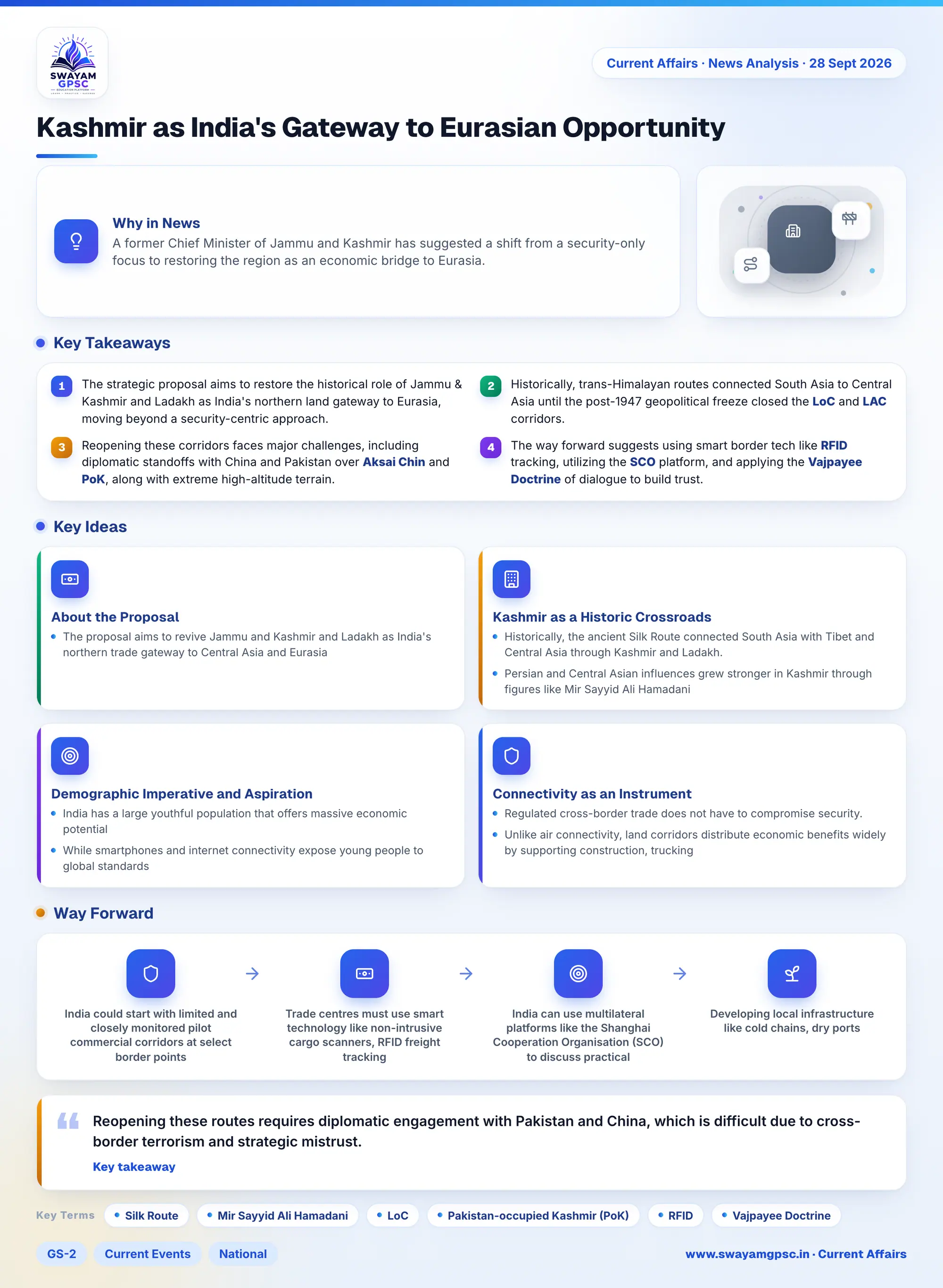
Kashmir as India's Gateway to Eurasian Opportunity
#GS-2 #Current Events #National #International #GS-3 #Economy #Infrastructure
Key takeaways
- The strategic proposal aims to restore the historical role of Jammu & Kashmir and Ladakh as India's northern land gateway to Eurasia, moving beyond a security-centric approach.
- Historically, trans-Himalayan routes connected South Asia to Central Asia until the post-1947 geopolitical freeze closed the LoC and LAC corridors.
- Reopening these corridors faces major challenges, including diplomatic standoffs with China and Pakistan over Aksai Chin and PoK, along with extreme high-altitude terrain.
- The way forward suggests using smart border tech like RFID tracking, utilizing the SCO platform, and applying the Vajpayee Doctrine of dialogue to build trust.
Why in News
- A former Chief Minister of Jammu and Kashmir has suggested a shift from a security-only focus to restoring the region as an economic bridge to Eurasia.
About the Proposal
- The proposal aims to revive Jammu and Kashmir and Ladakh as India's northern trade gateway to Central Asia and Eurasia through secure and regulated trans-Himalayan connectivity.
Kashmir as a Historic Crossroads
- Historically, the ancient Silk Route connected South Asia with Tibet and Central Asia through Kashmir and Ladakh. This facilitated the trade of shawls, silk, and spices alongside cultural ideas.
- Persian and Central Asian influences grew stronger in Kashmir through figures like Mir Sayyid Ali Hamadani and accompanying artisans, which helped establish local traditions like carpet weaving and papier-mache.
- The geopolitical events after 1947, including partition and tensions along the LoC and LAC, disrupted these traditional routes and turned Kashmir into a sensitive geopolitical frontier rather than a transit hub.
Demographic Imperative and Aspiration Gap
- India has a large youthful population that offers massive economic potential, especially as competing manufacturing economies like China face rapid population ageing.
- While smartphones and internet connectivity expose young people to global standards, a lack of local job creation creates a wide gap between their aspirations and economic reality.
- Delayed recruitment, examination irregularities, and limited industrial growth can increase frustration among qualified young jobseekers when education does not lead to secure jobs.
- Decades of conflict have shaped the experiences of Kashmiri youth, making economic opportunity and personal dignity just as important as legitimate security considerations.
Connectivity as an Instrument of Stability
- Regulated cross-border trade does not have to compromise security. Instead, economic interdependence can give local communities a strong material incentive to maintain peace.
- Unlike air connectivity, land corridors distribute economic benefits widely by supporting construction, trucking, warehousing, hospitality, agriculture, and trade finance.
- Using J&K and Ladakh as regulated gateways can link Indian businesses directly to Central Asian markets, bypassing longer maritime and multimodal routes.
Challenges
- Reopening these routes requires diplomatic engagement with Pakistan and China, which is difficult due to cross-border terrorism and strategic mistrust.
- The proposed routes pass through territories with competing claims, including Pakistan-occupied Kashmir (PoK) and Aksai Chin, making trade inseparable from sovereignty issues.
- High-altitude Himalayan corridors suffer from extreme winters, seismic risks, and fragile ecosystems, making infrastructure development highly expensive and ecologically risky.
- Cross-border trade requires strict customs inspection, cargo tracking, and financial monitoring to prevent the trafficking of narcotics, weapons, and counterfeit currency.
Way Forward
- India could start with limited and closely monitored pilot commercial corridors at select border points, expanding them only after positive security and diplomatic outcomes.
- Trade centres must use smart technology like non-intrusive cargo scanners, RFID freight tracking, and digital payments to ease legitimate trade while maintaining high security.
- India can use multilateral platforms like the Shanghai Cooperation Organisation (SCO) to discuss practical connectivity without needing to resolve larger territorial disputes first.
- Developing local infrastructure like cold chains, dry ports, and quality testing labs will help connect Kashmiri horticulture, saffron, and handicrafts to global markets.
- Applying the Vajpayee Doctrine of dialogue and economic engagement can help India look beyond rigid positions to find peaceful, human-centric solutions.
Conclusion
- Reimagining Jammu and Kashmir as a northern economic gateway shows that connectivity can complement national security rather than replace it.