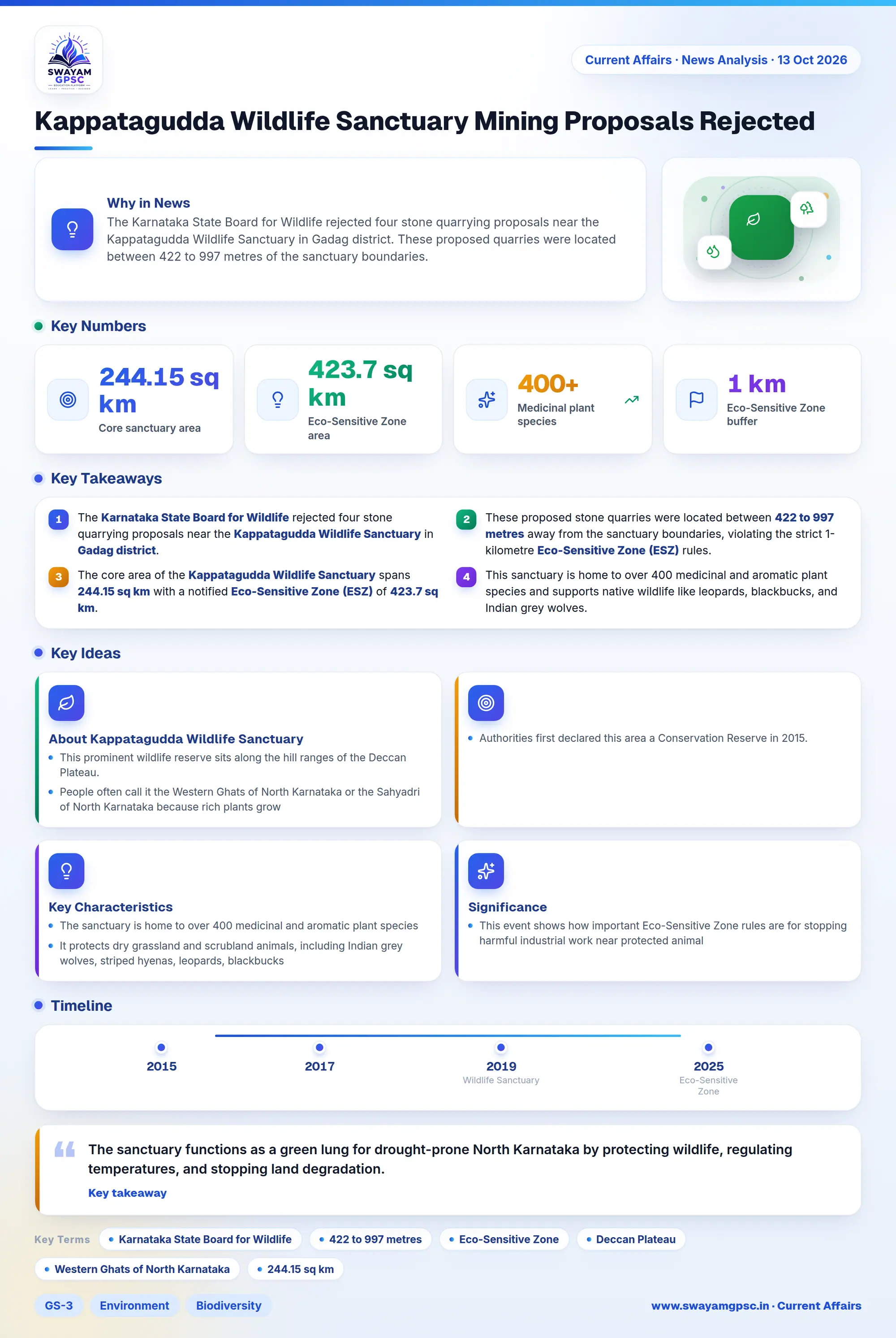
Kappatagudda Wildlife Sanctuary Mining Proposals Rejected
#GS-3 #Environment #Biodiversity #Protected Areas #Wildlife Sanctuary #Karnataka #Current Events #National
Key takeaways
- The Karnataka State Board for Wildlife rejected four stone quarrying proposals near the Kappatagudda Wildlife Sanctuary in Gadag district.
- These proposed stone quarries were located between 422 to 997 metres away from the sanctuary boundaries, violating the strict 1-kilometre Eco-Sensitive Zone (ESZ) rules.
- The core area of the Kappatagudda Wildlife Sanctuary spans 244.15 sq km with a notified Eco-Sensitive Zone (ESZ) of 423.7 sq km.
- This sanctuary is home to over 400 medicinal and aromatic plant species and supports native wildlife like leopards, blackbucks, and Indian grey wolves.
Why in News
- The Karnataka State Board for Wildlife rejected four stone quarrying proposals near the Kappatagudda Wildlife Sanctuary in Gadag district.
- These proposed quarries were located between 422 to 997 metres of the sanctuary boundaries.
- This decision strictly upholds mining bans within the 1-kilometre Eco-Sensitive Zone (ESZ).
About Kappatagudda Wildlife Sanctuary
- This prominent wildlife reserve sits along the hill ranges of the Deccan Plateau.
- People often call it the Western Ghats of North Karnataka or the Sahyadri of North Karnataka because rich plants grow here despite the semi-arid surroundings.
- The sanctuary covers Gadag district in northern Karnataka across four taluks named Gadag, Mundargi, Shirahatti, and adjoining tracts.
- The core sanctuary area measures 244.15 sq km while the surrounding notified Eco-Sensitive Zone (ESZ) spans 423.7 sq km.
Background
- Authorities first declared this area a Conservation Reserve in 2015.
- Mining pressures caused officials to de-notify the reserve briefly, which sparked strong protests from local communities, environmentalists, and spiritual leaders.
- Public protests and court intervention led to its re-notification in 2017.
- The government upgraded the status to a Wildlife Sanctuary in May 2019.
- A final Eco-Sensitive Zone (ESZ) notification was issued in June 2025.
Key Characteristics
- The sanctuary is home to over 400 medicinal and aromatic plant species, which connects its reputation to the mythological Sanjeevini Parvata.
- It protects dry grassland and scrubland animals, including Indian grey wolves, striped hyenas, leopards, blackbucks, chinkaras, four-horned antelopes, and Bengal foxes.
- The region acts as a vital watershed in North Karnataka, helping groundwater recharge and feeding the Tungabhadra River basin.
- Ancient greenstone formations, quartz veins, and iron-rich rocks make this mineral-rich landscape vulnerable to mining and industrial pressures.
Significance
- The sanctuary functions as a green lung for drought-prone North Karnataka by protecting wildlife, regulating temperatures, and stopping land degradation.
- This event shows how important Eco-Sensitive Zone rules are for stopping harmful industrial work near protected animal habitats.