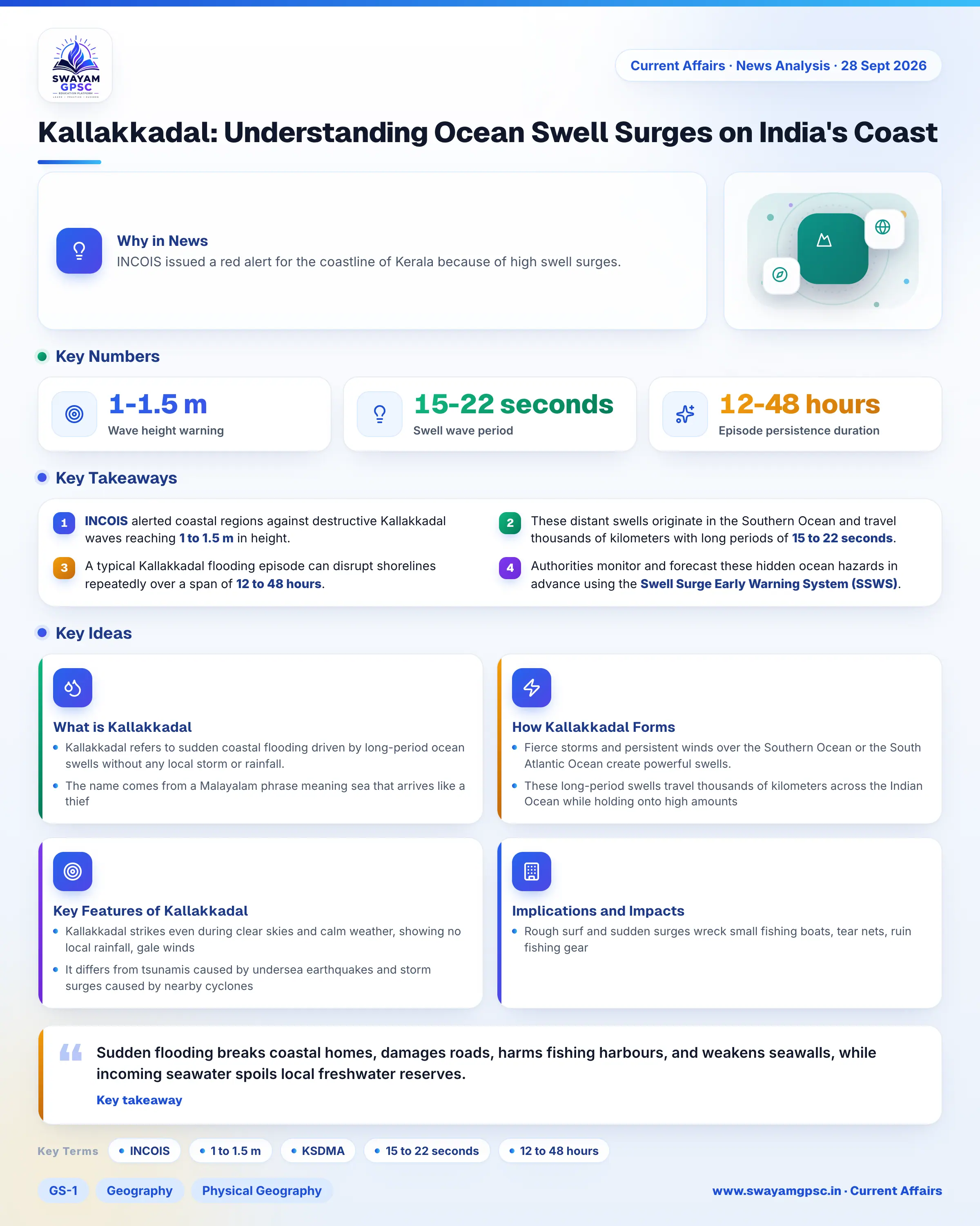
Kallakkadal: Understanding Ocean Swell Surges on India's Coast
#GS-1 #Geography #Physical Geography #Disaster Geography #GS-3 #Disaster Management #Disaster Preparedness #Prelims #Kallakkadal #INCOIS #Coastal Flooding #Ocean Swells
Key takeaways
- INCOIS alerted coastal regions against destructive Kallakkadal waves reaching 1 to 1.5 m in height.
- These distant swells originate in the Southern Ocean and travel thousands of kilometers with long periods of 15 to 22 seconds.
- A typical Kallakkadal flooding episode can disrupt shorelines repeatedly over a span of 12 to 48 hours.
- Authorities monitor and forecast these hidden ocean hazards in advance using the Swell Surge Early Warning System (SSWS).
Why in News
- INCOIS issued a red alert for the coastline of Kerala because of high swell surges.
- The alert warned of strong Kallakkadal ocean waves reaching heights between 1 to 1.5 m.
- Because of coastal flooding and erosion risks, KSDMA temporarily stopped fishing activities and beach tourism across Kerala, southern Tamil Nadu, and Lakshadweep.
What is Kallakkadal
- Kallakkadal refers to sudden coastal flooding driven by long-period ocean swells without any local storm or rainfall.
- The name comes from a Malayalam phrase meaning sea that arrives like a thief, highlighting how quietly and unexpectedly it strikes.
- This event mainly strikes the coastline of Kerala, especially Thiruvananthapuram, Kollam, Alappuzha, and Ernakulam, along with Lakshadweep and southern Tamil Nadu.
How Kallakkadal Forms
- Fierce storms and persistent winds over the Southern Ocean or the South Atlantic Ocean create powerful swells.
- These long-period swells travel thousands of kilometers across the Indian Ocean while holding onto high amounts of energy without local weather disturbances.
- When these waves enter shallow coastal waters, their height shoots upward through shoaling, flooding the shore heavily during astronomical high tides.
Key Features of Kallakkadal
- Kallakkadal strikes even during clear skies and calm weather, showing no local rainfall, gale winds, or drop in atmospheric pressure.
- It differs from tsunamis caused by undersea earthquakes and storm surges caused by nearby cyclones, since distant storms create it.
- These waves carry long wave periods exceeding 15 to 22 seconds, delivering enormous energy straight onto coastal land.
- INCOIS tracks and forecasts these surge events using ocean observation tools and numerical wave models through its Swell Surge Early Warning System (SSWS).
- A typical Kallakkadal event lasts between 12 to 48 hours, sending waves of water inland repeatedly, particularly at high tide.
Implications and Impacts
- Sudden flooding breaks coastal homes, damages roads, harms fishing harbours, and weakens seawalls, while incoming seawater spoils local freshwater reserves.
- Rough surf and sudden surges wreck small fishing boats, tear nets, ruin fishing gear, and stop fishing communities from earning their daily living.