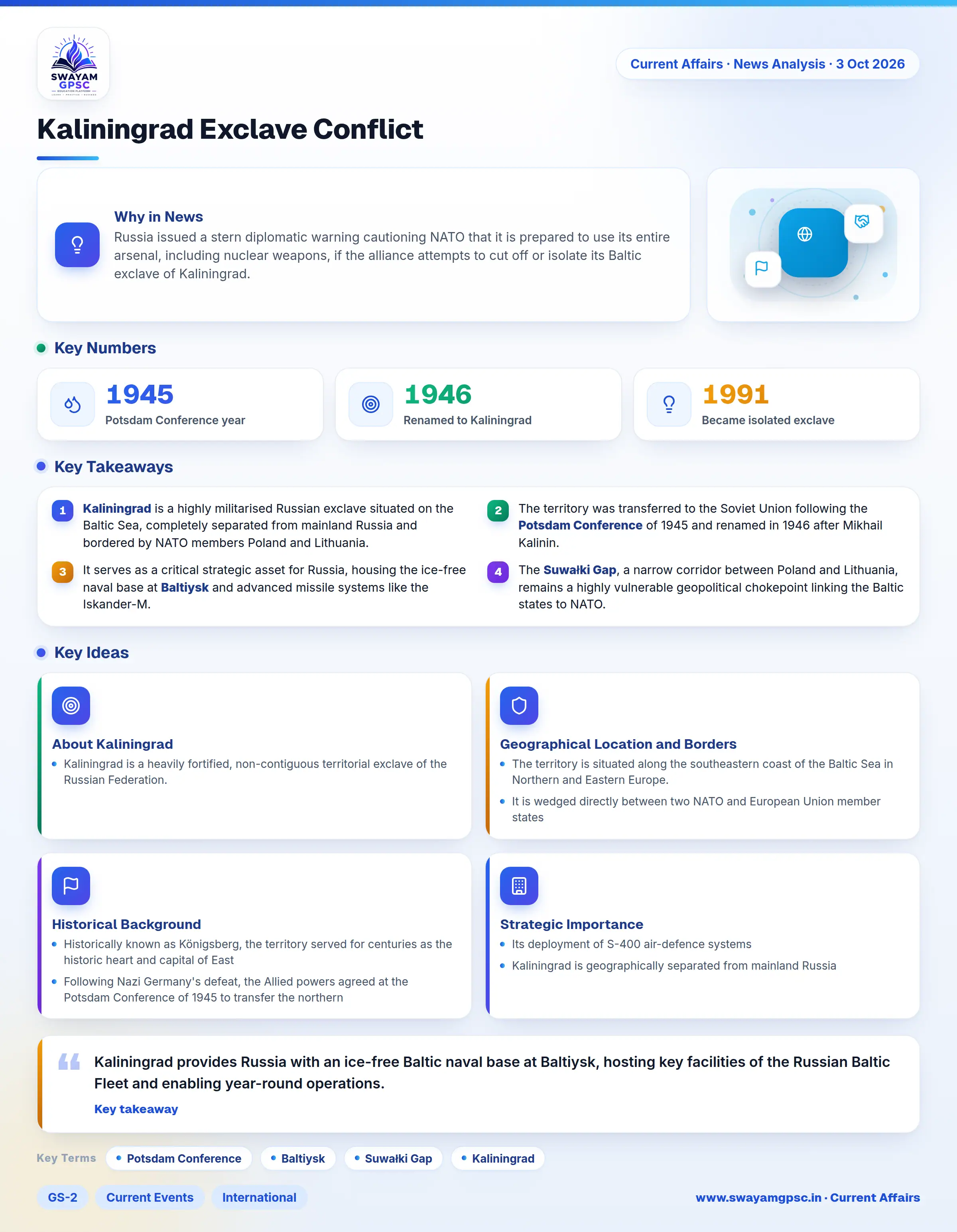
Kaliningrad Exclave Conflict
#GS-2 #Current Events #International
Key takeaways
- Kaliningrad is a highly militarised Russian exclave situated on the Baltic Sea, completely separated from mainland Russia and bordered by NATO members Poland and Lithuania.
- The territory was transferred to the Soviet Union following the Potsdam Conference of 1945 and renamed in 1946 after Mikhail Kalinin.
- It serves as a critical strategic asset for Russia, housing the ice-free naval base at Baltiysk and advanced missile systems like the Iskander-M.
- The Suwałki Gap, a narrow corridor between Poland and Lithuania, remains a highly vulnerable geopolitical chokepoint linking the Baltic states to NATO.
- With Finland and Sweden recently joining NATO, Kaliningrad is now almost entirely surrounded by alliance territory, raising the risk of a direct Russia-NATO military conflict.
Why in News
- Russia issued a stern diplomatic warning cautioning NATO that it is prepared to use its entire arsenal, including nuclear weapons, if the alliance attempts to cut off or isolate its Baltic exclave of Kaliningrad.
About Kaliningrad
- Kaliningrad is a heavily fortified, non-contiguous territorial exclave of the Russian Federation. It is the westernmost administrative region (Oblast) and is physically separated from mainland Russia by Belarus and Lithuania.
Geographical Location and Borders
- The territory is situated along the southeastern coast of the Baltic Sea in Northern and Eastern Europe.
- It is wedged directly between two NATO and European Union member states, Poland to the south and Lithuania to the north and east.
Historical Background
- Historically known as Königsberg, the territory served for centuries as the historic heart and capital of East Prussia.
- Following Nazi Germany's defeat, the Allied powers agreed at the Potsdam Conference of 1945 to transfer the northern half of East Prussia, including Königsberg, to the Soviet Union.
- The region was incorporated into the Russian Soviet Federative Socialist Republic (RSFSR) and renamed Kaliningrad in 1946 in honour of Soviet revolutionary Mikhail Kalinin.
- Following the dissolution of the Soviet Union in 1991 and the independence of the Baltic republics and Belarus, Kaliningrad became an isolated exclave surrounded by foreign states.
Strategic Importance
- Kaliningrad provides Russia with an ice-free Baltic naval base at Baltiysk, hosting key facilities of the Russian Baltic Fleet and enabling year-round operations.
- Its deployment of S-400 air-defence systems, coastal missiles and Iskander-M missiles strengthens Russia's ability to deter or restrict NATO military operations in the Baltic region.
- Kaliningrad is geographically separated from mainland Russia, while the Suwałki Gap between Poland and Lithuania forms a strategically sensitive corridor linking the Baltic States with other NATO members.
Why It Matters as a Geopolitical Flashpoint
- With Finland and Sweden joining NATO, Kaliningrad is increasingly surrounded by NATO territory and waters, heightening its strategic importance in Russia-NATO tensions.
- Disputes over transit, military movements, airspace or maritime access around Kaliningrad could escalate tensions between Russia and NATO, including risks associated with nuclear deterrence.