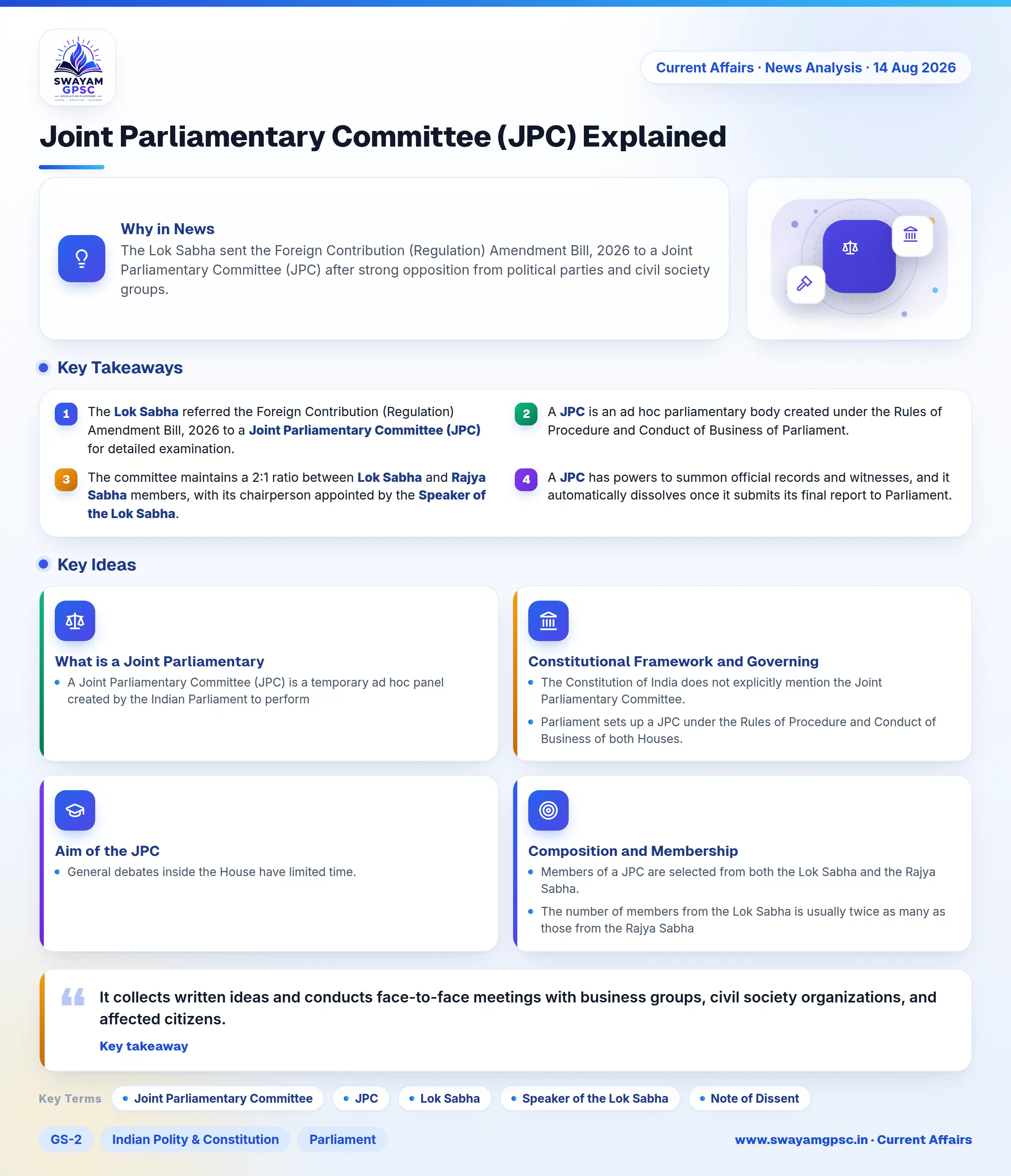
Joint Parliamentary Committee (JPC) Explained
#GS-2 #Indian Polity & Constitution #Parliament #Constitution #JPC #Current Events #National
Key takeaways
- The Lok Sabha referred the Foreign Contribution (Regulation) Amendment Bill, 2026 to a Joint Parliamentary Committee (JPC) for detailed examination.
- A JPC is an ad hoc parliamentary body created under the Rules of Procedure and Conduct of Business of Parliament.
- The committee maintains a 2:1 ratio between Lok Sabha and Rajya Sabha members, with its chairperson appointed by the Speaker of the Lok Sabha.
- A JPC has powers to summon official records and witnesses, and it automatically dissolves once it submits its final report to Parliament.
Why in News
- The Lok Sabha sent the Foreign Contribution (Regulation) Amendment Bill, 2026 to a Joint Parliamentary Committee (JPC) after strong opposition from political parties and civil society groups.
What is a Joint Parliamentary Committee
- A Joint Parliamentary Committee (JPC) is a temporary ad hoc panel created by the Indian Parliament to perform a detailed clause-by-clause study of a controversial bill or complex public issue.
Constitutional Framework and Governing Rules
- The Constitution of India does not explicitly mention the Joint Parliamentary Committee.
- Parliament sets up a JPC under the Rules of Procedure and Conduct of Business of both Houses. It comes into existence when one House passes a motion for it and the other House accepts it.
Aim of the JPC
- General debates inside the House have limited time. A JPC provides a dedicated cross-party platform to examine laws, study evidence, consult experts, and suggest changes before a bill becomes law.
Composition and Membership
- Members of a JPC are selected from both the Lok Sabha and the Rajya Sabha.
- The number of members from the Lok Sabha is usually twice as many as those from the Rajya Sabha, maintaining a 2:1 ratio.
- Party representation in the committee matches each party's strength in Parliament, which gives the ruling coalition a majority.
- The Speaker of the Lok Sabha appoints the Chairperson of the committee.
Key Functions of JPC
- The committee examines every clause of the bill carefully to fix legal, administrative, or constitutional flaws.
- It has powers to demand government papers, call officials, and ask experts or citizens to give evidence.
- It collects written ideas and conducts face-to-face meetings with business groups, civil society organizations, and affected citizens.
- It prepares a detailed report with recommendations, while members who disagree can attach a formal Note of Dissent.
- After submitting its final report to Parliament, the temporary committee stops existing automatically.