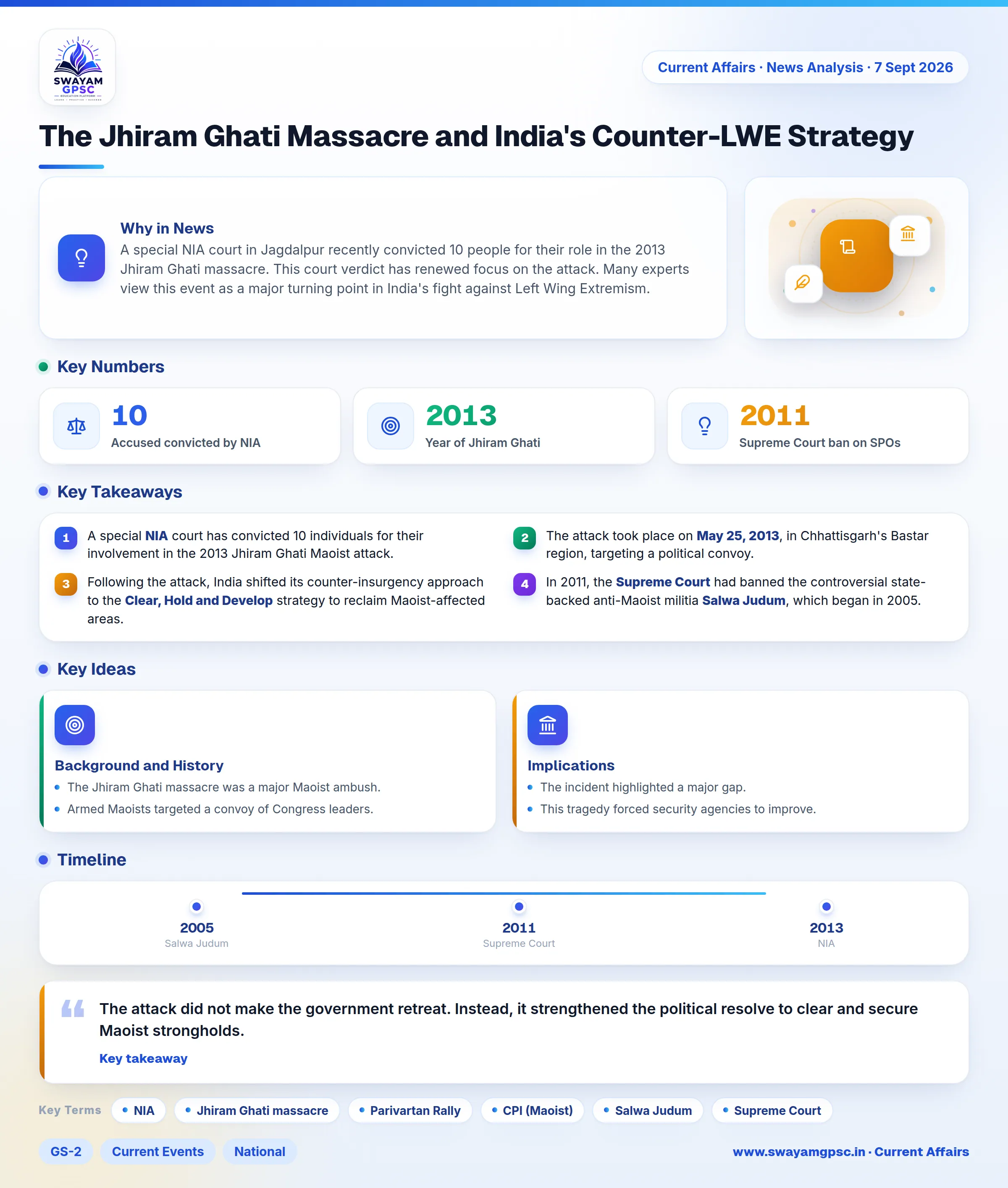
The Jhiram Ghati Massacre and India's Counter-LWE Strategy
#GS-2 #Current Events #National #Internal Security #Left Wing Extremism
Key takeaways
- A special NIA court has convicted 10 individuals for their involvement in the 2013 Jhiram Ghati Maoist attack.
- The attack took place on May 25, 2013, in Chhattisgarh's Bastar region, targeting a political convoy.
- Following the attack, India shifted its counter-insurgency approach to the Clear, Hold and Develop strategy to reclaim Maoist-affected areas.
- In 2011, the Supreme Court had banned the controversial state-backed anti-Maoist militia Salwa Judum, which began in 2005.
Why in News
- A special NIA court in Jagdalpur recently convicted 10 people for their role in the 2013 Jhiram Ghati massacre.
- This court verdict has renewed focus on the attack. Many experts view this event as a major turning point in India's fight against Left Wing Extremism.
Background and History
- The Jhiram Ghati massacre was a major Maoist ambush. It took place on May 25, 2013, in the Bastar region of Chhattisgarh.
- Armed Maoists targeted a convoy of Congress leaders. These leaders were returning from a political campaign called the Parivartan Rally.
- The Bastar region had become a stronghold for the CPI (Maoist) group. Difficult terrain, poor connectivity, and weak government presence helped them grow.
- In 2005, a controversial anti-Maoist movement named Salwa Judum started in Chhattisgarh. A local Congress leader named Mahendra Karma led this initiative.
- The Supreme Court stepped in during 2011. The court ordered the state government to stop arming tribal youth as Special Police Officers.
- By 2013, security forces used a new strategy called Clear, Hold and Develop. They entered Maoist areas, secured them, and built roads and communication networks.
- Maoists launched the Jhiram Ghati attack to resist this expansion. Security forces were setting up new camps in Maoist-dominated areas.
- This attack was different because it directly targeted state political leaders. Most earlier Maoist attacks only targeted security personnel.
Implications
- The attack did not make the government retreat. Instead, it strengthened the political resolve to clear and secure Maoist strongholds.
- The incident highlighted a major gap. Security forces expanded quickly, but roads, healthcare, and administration reached these areas very slowly.
- This tragedy forced security agencies to improve. They focused more on night helicopter evacuations, better intelligence sharing, and deeper security camps.