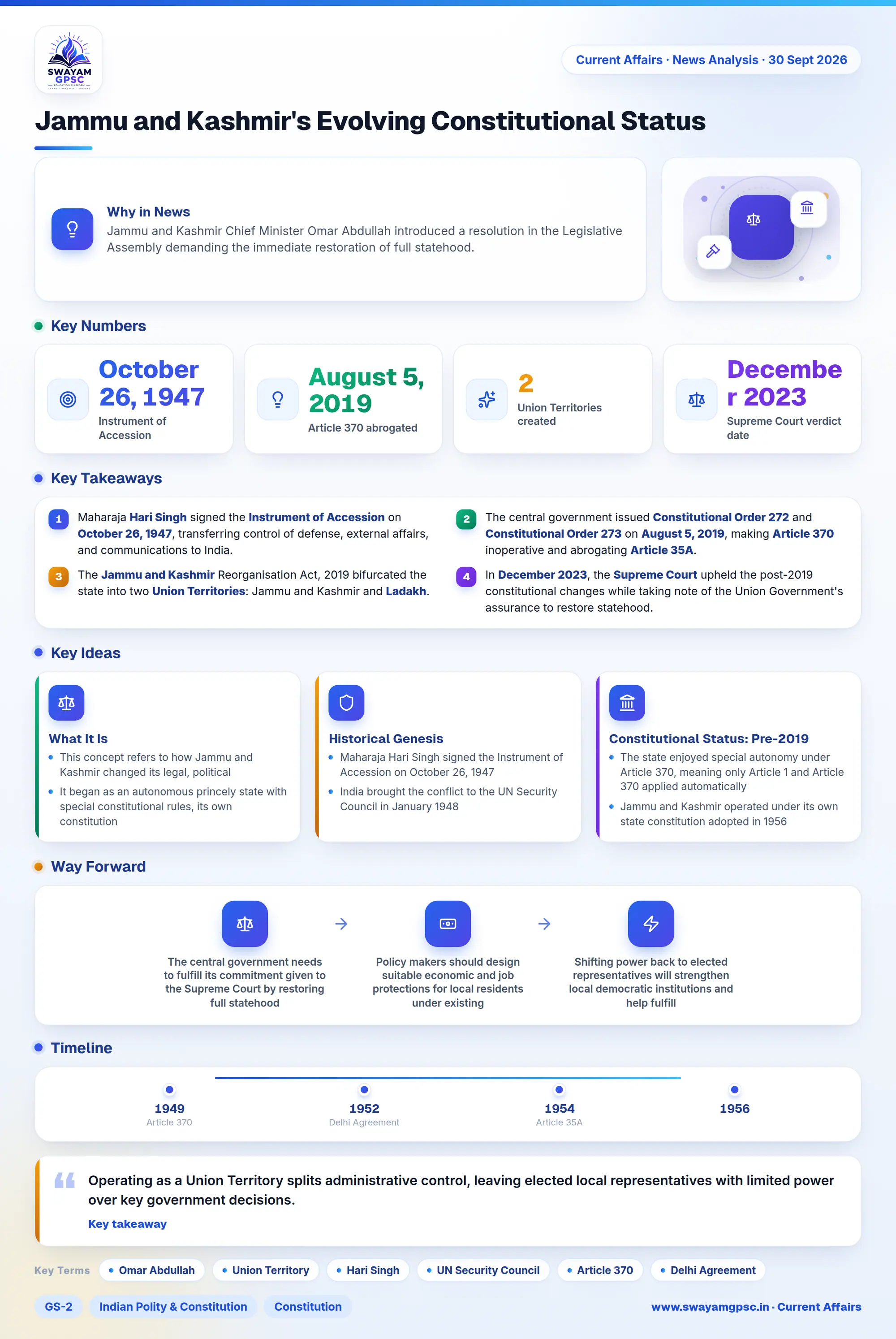
Jammu and Kashmir's Evolving Constitutional Status
#GS-2 #Indian Polity & Constitution #Constitution #Executive #Federalism #Current Events #National
Key takeaways
- Maharaja Hari Singh signed the Instrument of Accession on October 26, 1947, transferring control of defense, external affairs, and communications to India.
- The central government issued Constitutional Order 272 and Constitutional Order 273 on August 5, 2019, making Article 370 inoperative and abrogating Article 35A.
- The Jammu and Kashmir Reorganisation Act, 2019 bifurcated the state into two Union Territories: Jammu and Kashmir and Ladakh.
- In December 2023, the Supreme Court upheld the post-2019 constitutional changes while taking note of the Union Government's assurance to restore statehood.
- The elected assembly of Jammu and Kashmir recently passed a formal resolution demanding the immediate restoration of full statehood under Article 163 executive principles.
Why in News
- Jammu and Kashmir Chief Minister Omar Abdullah introduced a resolution in the Legislative Assembly demanding the immediate restoration of full statehood.
What It Is
- This concept refers to how Jammu and Kashmir changed its legal, political, and constitutional relationship with India over time.
- It began as an autonomous princely state with special constitutional rules, its own constitution, and unique citizenship definitions.
- Later, the region experienced complete integration and became a Union Territory.
- Today, local political leaders actively demand the return of full statehood.
Historical Genesis
- Maharaja Hari Singh signed the Instrument of Accession on October 26, 1947, after armed Pakistani tribal irregulars (Kabailis) invaded the region, handing over control of defense, external affairs, and communications to India.
- India brought the conflict to the UN Security Council in January 1948, leading to UNSC Resolution 47 which called for a truce and plebiscite after complete Pakistani demilitarization that never took place.
- The Constituent Assembly added Article 370 in 1949 after N. Gopalaswami Ayyangar drafted it as a temporary measure because ongoing external conflict and UN involvement made complete integration impossible at that time.
- Jawaharlal Nehru and Sheikh Abdullah signed the Delhi Agreement in 1952, which extended the Supreme Court's jurisdiction, accepted the National Flag, and allowed emergency powers under Article 325 and Article 352 while keeping the state flag.
- The President issued the Constitution (Application to Jammu and Kashmir) Order, 1954, which added Article 35A to empower the state assembly to define permanent residents and restrict land purchases and government jobs to them.
Constitutional Status: Pre-2019 Architecture
- The state enjoyed special autonomy under Article 370, meaning only Article 1 and Article 370 applied automatically, while other central laws required the state government's permission.
- Jammu and Kashmir operated under its own state constitution adopted in 1956, which declared the state an integral part of India but kept separate executive and legislative systems.
- The state used Article 35A to reserve land ownership, state scholarships, assembly voting, and public jobs exclusively for permanent residents while excluding outside citizens.
- The government recognized a separate state flag alongside the Indian national flag and protected local land rights and customary laws from standard constitutional amendments.
- Declaring an internal emergency under Article 352 inside the state required prior consent from the local government, which limited direct central control.
The 2019 Constitutional Changes and Reorganisation
- The President issued Constitutional Order (CO) 272 on August 5, 2019, using Article 370(1) to change Article 367 so that references to the Constituent Assembly meant the state Legislative Assembly.
- The central government treated the Governor's concurrence as the state assembly's approval because the local legislature was dissolved and the region was under President's Rule under Article 356.
- The government issued Constitutional Order (CO) 273 to make all parts of Article 370 inoperative, which removed Article 35A and applied the entire Indian Constitution to the region.
- Parliament passed the Jammu and Kashmir Reorganisation Act, 2019, dividing the state into two Union Territories: Jammu and Kashmir with a legislature and Ladakh without one.
Present Demand for Statehood
- The elected assembly of Jammu and Kashmir formally passed a resolution requesting an immediate end to its Union Territory status and the quick return of full statehood.
- Local political groups argue that Union Territory status leaves elected leaders powerless under a centrally appointed Lieutenant Governor.
- Regional leaders want legal protections for land and jobs similar to Article 371 or the Sixth Schedule to protect local youth from outside competition.
- Political parties highlight the Supreme Court judgment from December 2023 in In Re: Article 370, where the central government promised to restore statehood as soon as possible.
Challenges
- Operating as a Union Territory splits administrative control, leaving elected local representatives with limited power over key government decisions.
- Centrally appointed officials retain authority over public order and police, creating friction between the local cabinet and central administrators.
- Local youth express ongoing concerns over job competition and land ownership changes following the removal of resident protections.
Key Implications
- Restoring full statehood would rebuild federal balance and give the local elected government direct authority over public order and police affairs.
- Returning executive authority to the Chief Minister and Council of Ministers under Article 163 would reduce dependence on the central Lieutenant Governor.
- Establishing permanent constitutional status would clear up political uncertainty, boosting business confidence in cold-chain logistics, agriculture, and tourism.
- Resolving statehood issues would settle long-standing administrative political disputes, allowing leaders to focus on economic development and job creation.
Way Forward
- The central government needs to fulfill its commitment given to the Supreme Court by restoring full statehood to Jammu and Kashmir in a timely manner.
- Policy makers should design suitable economic and job protections for local residents under existing constitutional frameworks like Article 371.
- Shifting power back to elected representatives will strengthen local democratic institutions and help fulfill the political aspirations of the region.