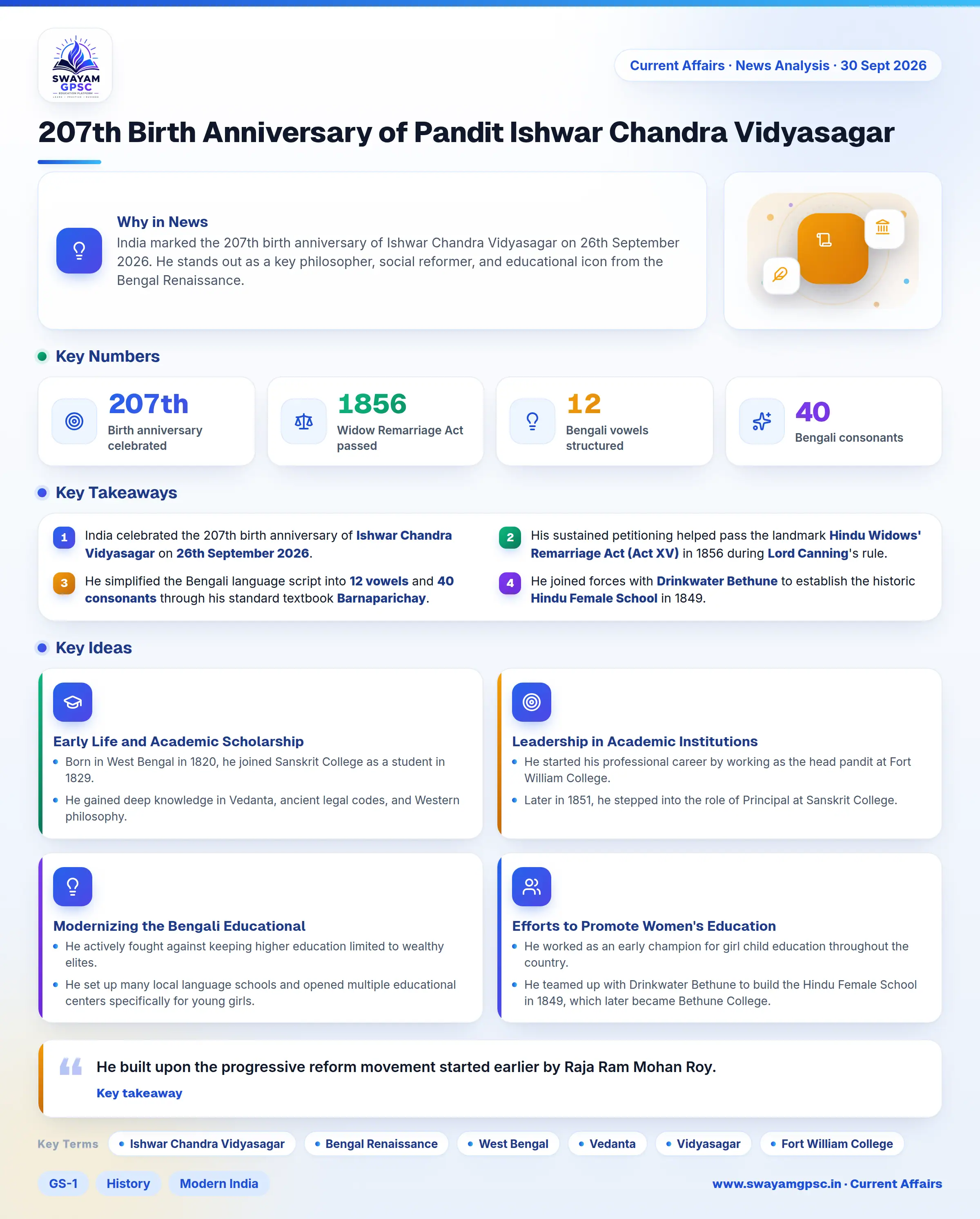
207th Birth Anniversary of Pandit Ishwar Chandra Vidyasagar
#GS-1 #History #Modern India #Freedom Struggle #Important Personalities
Key takeaways
- India celebrated the 207th birth anniversary of Ishwar Chandra Vidyasagar on 26th September 2026.
- His sustained petitioning helped pass the landmark Hindu Widows' Remarriage Act (Act XV) in 1856 during Lord Canning's rule.
- He simplified the Bengali language script into 12 vowels and 40 consonants through his standard textbook Barnaparichay.
- He joined forces with Drinkwater Bethune to establish the historic Hindu Female School in 1849.
- His progressive reforms influenced key leaders nationwide, including Jyotirao Phule and Vishnu Shastri Pandit.
Why in News
- India marked the 207th birth anniversary of Ishwar Chandra Vidyasagar on 26th September 2026.
- He stands out as a key philosopher, social reformer, and educational icon from the Bengal Renaissance.
- His life work focused heavily on developing local language education, expanding women's rights, and fixing social ills in 19th-century India.
Early Life and Academic Scholarship
- Born in West Bengal in 1820, he joined Sanskrit College as a student in 1829.
- He gained deep knowledge in Vedanta, ancient legal codes, and Western philosophy.
- By age 21, his exceptional scholarship earned him the title Vidyasagar, which means Sea of Knowledge.
Leadership in Academic Institutions
- He started his professional career by working as the head pandit at Fort William College.
- Later in 1851, he stepped into the role of Principal at Sanskrit College.
- He used these official positions to redesign and modernize the Indian learning system.
Modernizing the Bengali Educational System
- He actively fought against keeping higher education limited to wealthy elites.
- He set up many local language schools and opened multiple educational centers specifically for young girls.
- He wrote the famous foundational book Barnaparichay to structure the standard Bengali alphabet.
- He reformed the Bengali alphabet layout into 12 vowels and 40 consonants after removing unused Sanskrit sounds.
- His classic primer Barnaparichay continues to be the starting textbook for students learning Bengali language literacy today.
Efforts to Promote Women's Education
- He worked as an early champion for girl child education throughout the country.
- He teamed up with Drinkwater Bethune to build the Hindu Female School in 1849, which later became Bethune College.
Stance Against Child Marriage
- He published critical articles against early child marriage in the journal Sarva Subhakari in 1850.
- His essays attacked child marriage using health grounds, moral arguments, and societal well-being.
Legal Recognition of Widow Remarriage
- He studied classical Smriti texts to prove that Hindu scriptures allowed widows to remarry.
- He wrote persuasive booklets in 1855 and sent an official petition to the colonial authorities.
- His efforts led directly to the Hindu Widows' Remarriage Act (Act XV) of 1856.
- This historic law was prepared under Lord Dalhousie and passed during the time of Lord Canning.
Campaign Against Polygamy
- He used logic along with textual analysis to challenge the widespread practice of multiple marriages.
- He organized huge public petitions in 1857 and 1866 that gathered tens of thousands of signatures.
- His campaign targeted Kulin Brahmin polygamy, where high-caste men regularly took many wives.
Nationwide Impact and Legacy
- He built upon the progressive reform movement started earlier by Raja Ram Mohan Roy.
- His written work and legal victories gave strong momentum to leaders like Jyotirao Phule and Vishnu Shastri Pandit across India.