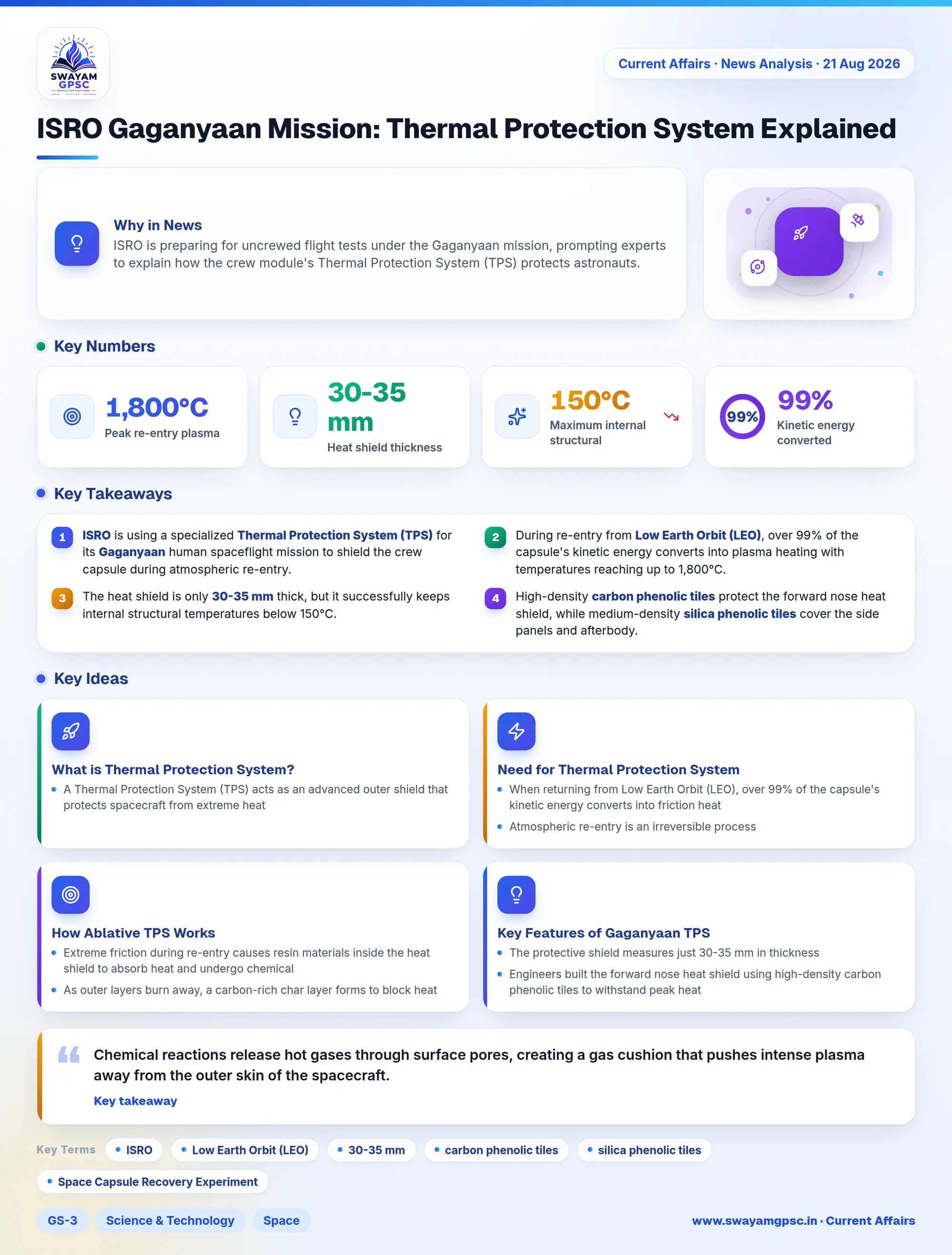
ISRO Gaganyaan Mission: Thermal Protection System Explained
#GS-3 #Science & Technology #Space #GS-2 #Current Events #National #Gaganyaan #ISRO
Key takeaways
- ISRO is using a specialized Thermal Protection System (TPS) for its Gaganyaan human spaceflight mission to shield the crew capsule during atmospheric re-entry.
- During re-entry from Low Earth Orbit (LEO), over 99% of the capsule's kinetic energy converts into plasma heating with temperatures reaching up to 1,800°C.
- The heat shield is only 30-35 mm thick, but it successfully keeps internal structural temperatures below 150°C.
- High-density carbon phenolic tiles protect the forward nose heat shield, while medium-density silica phenolic tiles cover the side panels and afterbody.
- The indigenous ablative technology builds upon flight-proven lineage from the Space Capsule Recovery Experiment and the 2014 LVM3 / CARE mission.
Why in News
- ISRO is preparing for uncrewed flight tests under the Gaganyaan mission, prompting experts to explain how the crew module's Thermal Protection System (TPS) protects astronauts.
What is Thermal Protection System?
- A Thermal Protection System (TPS) acts as an advanced outer shield that protects spacecraft from extreme heat while moving through the atmosphere at hypersonic speeds.
Need for Thermal Protection System
- When returning from Low Earth Orbit (LEO), over 99% of the capsule's kinetic energy converts into friction heat, reaching plasma temperatures up to 1,800°C that can melt metals.
- Atmospheric re-entry is an irreversible process, meaning astronauts cannot abort the mission once the spacecraft begins its descent toward Earth.
- Deceleration forces change too quickly for manual pilot controls, making an automatic, passive thermal barrier essential for safety.
- The system keeps temperatures inside the capsule low enough to protect human crew members and preserve the composite structural frame.
How Ablative TPS Works
- Extreme friction during re-entry causes resin materials inside the heat shield to absorb heat and undergo chemical breakdown.
- As outer layers burn away, a carbon-rich char layer forms to block heat, while shedding outer material carries thermal energy away from the capsule.
- Chemical reactions release hot gases through surface pores, creating a gas cushion that pushes intense plasma away from the outer skin of the spacecraft.
Key Features of Gaganyaan TPS
- The protective shield measures just 30-35 mm in thickness, yet it keeps internal structural temperatures below 150°C despite 1,800°C external heat.
- Engineers built the forward nose heat shield using high-density carbon phenolic tiles to withstand peak heat and pressure at the impact point.
- The side panels and rear sections use medium-density silica phenolic tiles to manage secondary turbulent air heating.
- The design skips fragile ceramic tiles to use durable single-use composites that handle impacts better and need less maintenance.
- This indigenous shield builds on flight-tested technology from the Space Capsule Recovery Experiment and the 2014 LVM3 / CARE mission.