Internet Shutdowns in India: Legal Rules, Judicial Mandates, and Key Challenges
#GS-2 #Indian Polity & Constitution #Constitution #Governance & Social Justice #Good Governance #Science & Technology #ICT #Current Events #National #Internet Shutdowns #Fundamental Rights #Telecommunications Act 2023
Why in News
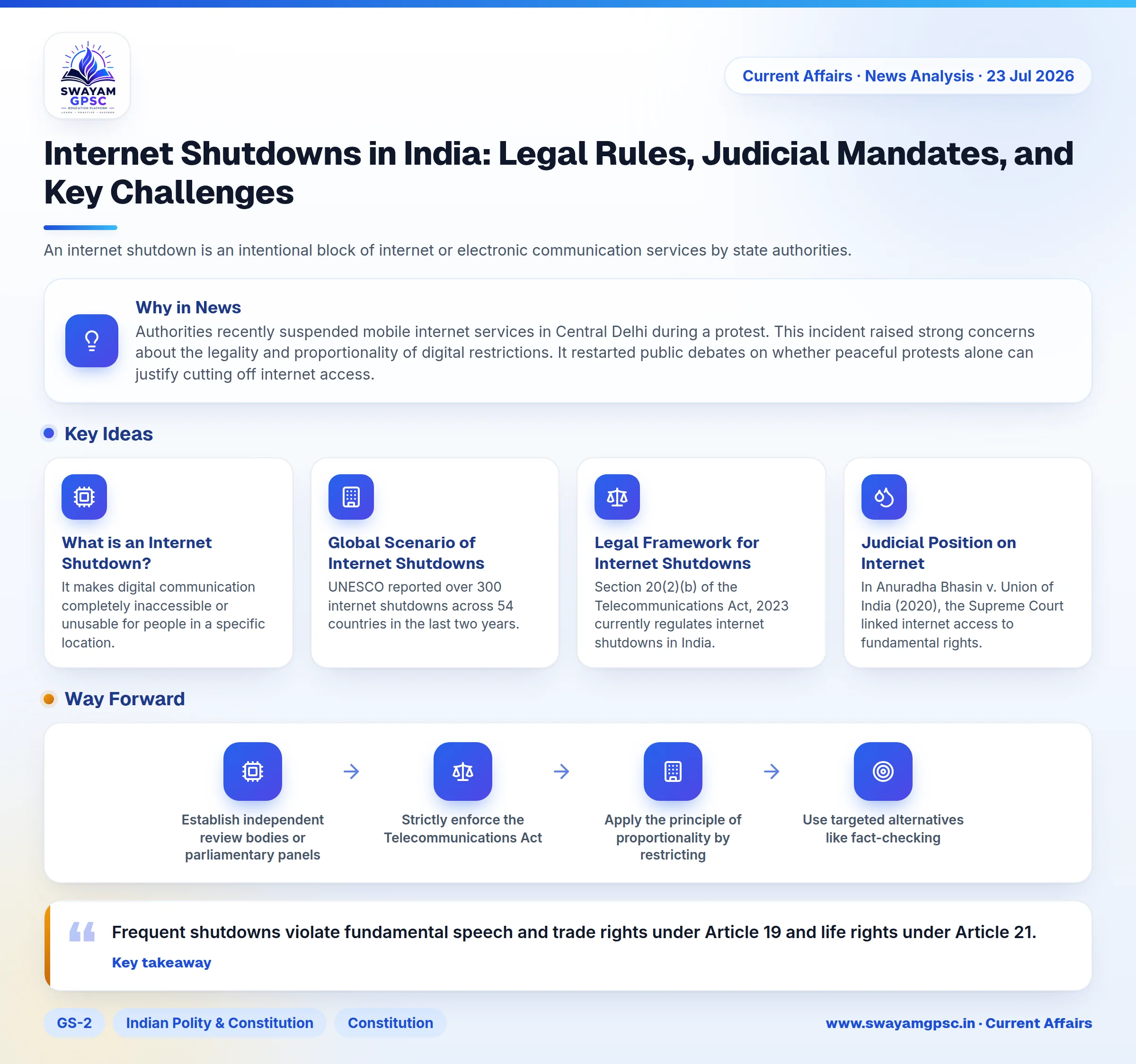
- Authorities recently suspended mobile internet services in Central Delhi during a protest.
- This incident raised strong concerns about the legality and proportionality of digital restrictions.
- It restarted public debates on whether peaceful protests alone can justify cutting off internet access.
- It also highlighted whether governments are properly publishing shutdown orders as mandated by law.
- The event questioned if authorities are following the legal safeguards set in the Anuradha Bhasin (2020) judgment.
What is an Internet Shutdown?
- An internet shutdown is an intentional block of internet or electronic communication services by state authorities.
- It makes digital communication completely inaccessible or unusable for people in a specific location.
- Shutdowns happen through full network blackouts, slowing connection speed (throttling), or blocking specific apps.
- Governments often use them to control information flow during public gatherings, protests, or political events.
- Officials impose shutdowns either as preventive steps before events or as reactive steps during ongoing unrest.
- These disruptions harm journalists and media organizations while spreading unverified rumors among the public.
Global Scenario of Internet Shutdowns
- UNESCO reported over 300 internet shutdowns across 54 countries in the last two years.
- Human rights group Access Now stated that 2024 saw the highest number of shutdowns since 2016.
- India regularly records one of the highest numbers of state-ordered internet suspensions globally.
- Access Now recorded 65 shutdowns across 12 States and UTs in India during 2025.
- India has already recorded around 24 shutdowns in 2026 up to July 22.
- The SFLC tracker shows Jammu & Kashmir recorded the highest total with 449 shutdowns since 2012.
- Rajasthan follows with 115 shutdowns and Manipur stands third with 62 shutdowns.
- UNESCO emphasizes that internet access protects freedom of expression, education, and political participation.
Legal Framework for Internet Shutdowns in India
- Section 20(2)(b) of the Telecommunications Act, 2023 currently regulates internet shutdowns in India.
- The Telecommunications (Temporary Suspension of Services) Rules, 2024 lay down the specific procedures.
- These new provisions replaced the older Temporary Suspension of Telecom Services Rules, 2017.
- Authorities can suspend services only during a public emergency or in the interest of public safety.
- A peaceful protest alone does not legally qualify as a ground for suspending telecom networks.
- The Union Home Secretary or State Home Secretary holds the main authority to issue suspension orders.
- In emergency cases, a Joint Secretary level officer can issue orders but needs confirmation within 24 hours.
- Under the 2024 Rules, a single suspension order cannot remain in force for more than 15 days.
- A multi-member Review Committee must examine every shutdown order within 5 working days.
- Citizens can challenge arbitrary shutdown orders before High Courts under Article 226 or the Supreme Court under Article 32.
Judicial Position on Internet Shutdowns
- In Anuradha Bhasin v. Union of India (2020), the Supreme Court linked internet access to fundamental rights.
- The Court ruled that freedom of expression under Article 19(1)(a) includes the right to use the internet.
- It also protected online trade and business activities under Article 19(1)(g) of the Constitution.
- The Supreme Court declared that indefinite internet shutdowns are completely unconstitutional.
- It mandated that every shutdown order must be reasoned, proportionate, and published immediately.
- The Court directed authorities to always consider alternative, less restrictive measures before cutting off connectivity.
- In Ashlesh Biradar v. State of West Bengal (2022), the Calcutta High Court stayed an arbitrary shutdown order.
Challenges
- Frequent shutdowns violate fundamental speech and trade rights under Article 19 and life rights under Article 21.
- There is a persistent lack of independent oversight to prevent arbitrary executive action.
- Several state authorities bypass the stricter 2024 Rules by citing outdated statutes like the Indian Telegraph Act, 1885.
- Governments rarely publish shutdown orders online, hiding their justifications from public scrutiny.
- Shutdowns cause massive financial harm, costing India USD 255.2 million in 2023 alone.
- Blanket blackouts disrupt critical services like healthcare, digital banking, online education, and business operations.
- Frequent internet cuts damage India's international image as a rising leader in Artificial Intelligence (AI) and digital technology.
Way Forward
- Establish independent review bodies or parliamentary panels to inspect every internet shutdown order.
- Strictly enforce the Telecommunications Act, 2023 and ensure orders strictly adhere to legal grounds.
- Apply the principle of proportionality by restricting suspensions to specific cell sites rather than entire districts.
- Use targeted alternatives like fact-checking, content moderation, and cyber monitoring instead of complete network blackouts.
- Publish all suspension orders and review committee decisions online immediately to ensure transparency.
- Train law enforcement agencies in modern digital risk management and align domestic policies with international standards.