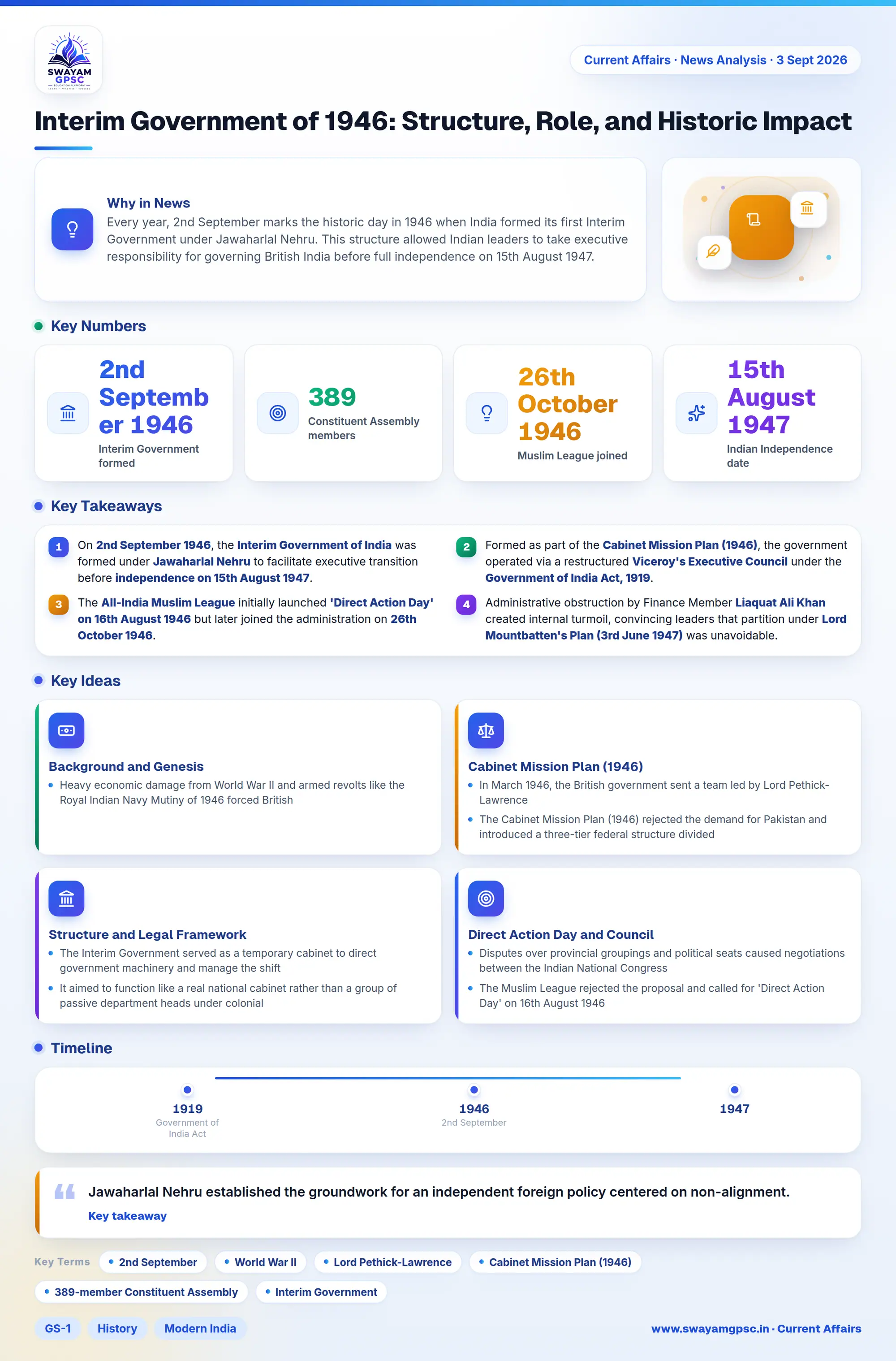
Interim Government of 1946: Structure, Role, and Historic Impact
#GS-1 #History #Modern India #Freedom Struggle #Current Events #National
Key takeaways
- On 2nd September 1946, the Interim Government of India was formed under Jawaharlal Nehru to facilitate executive transition before independence on 15th August 1947.
- Formed as part of the Cabinet Mission Plan (1946), the government operated via a restructured Viceroy's Executive Council under the Government of India Act, 1919.
- The All-India Muslim League initially launched 'Direct Action Day' on 16th August 1946 but later joined the administration on 26th October 1946.
- Administrative obstruction by Finance Member Liaquat Ali Khan created internal turmoil, convincing leaders that partition under Lord Mountbatten's Plan (3rd June 1947) was unavoidable.
Why in News
- Every year, 2nd September marks the historic day in 1946 when India formed its first Interim Government under Jawaharlal Nehru.
- This structure allowed Indian leaders to take executive responsibility for governing British India before full independence on 15th August 1947.
Background and Genesis
- Heavy economic damage from World War II and armed revolts like the Royal Indian Navy Mutiny of 1946 forced British Prime Minister Clement Attlee to speed up the exit plan.
Cabinet Mission Plan (1946)
- In March 1946, the British government sent a team led by Lord Pethick-Lawrence, alongside Sir Stafford Cripps and A.V. Alexander.
- The Cabinet Mission Plan (1946) rejected the demand for Pakistan and introduced a three-tier federal structure divided into Section A (Hindu-majority), Section B (Muslim-majority), and Section C (Bengal and Assam).
- The plan set up a 389-member Constituent Assembly, ended British paramountcy over princely states, and paved the way for an Interim Government.
Structure and Legal Framework
- The Interim Government served as a temporary cabinet to direct government machinery and manage the shift toward independence.
- It aimed to function like a real national cabinet rather than a group of passive department heads under colonial oversight.
- The main goals were preparing the country for freedom, handling administrative handovers, and supporting the Constituent Assembly.
- Formally functioning under the Government of India Act, 1919, it modified the Viceroy's Executive Council so Indian leaders could exercise practical executive control.
- Viceroy Lord Wavell served as President of the council, while Jawaharlal Nehru served as Vice-President of the Executive Council and acting head of internal affairs.
Direct Action Day and Council Formation
- Disputes over provincial groupings and political seats caused negotiations between the Indian National Congress and the Muslim League to break down.
- The Muslim League rejected the proposal and called for 'Direct Action Day' on 16th August 1946, which led to widespread violence known as the Great Calcutta Killings.
- Despite ongoing riots and the League's initial boycott, Lord Wavell asked Jawaharlal Nehru to form the administration on 2nd September 1946.
Entry of the Muslim League
- Fearing political isolation, the Muslim League decided to join the government on 26th October 1946 while still rejecting the main Cabinet Mission Plan.
- Three Congress leaders stepped down so five League members could join, leading to Liaquat Ali Khan taking charge as the Finance Member.
- Liaquat Ali Khan used his position over the budget to block and delay key development projects proposed by Congress ministers.
Significance of the Interim Government
- Jawaharlal Nehru established the groundwork for an independent foreign policy centered on non-alignment.
- The government began negotiating with princely states to prepare them for integration into the Indian Union.
- Indian leaders assumed control over crucial sectors, including the civil services, police and armed forces.
- Ministers gained vital experience in running national departments, distributing food, and planning long-term growth.
- Continuous deadlock inside the cabinet convinced leaders like Sardar Patel and Jawaharlal Nehru that partition under Lord Mountbatten's Partition Plan (3rd June 1947) was necessary to avoid civil war.