The Intelligent Traffic Management System in Delhi
#GS-2 #GS-3 #Governance & Social Justice #Infrastructure #Good Governance #E-Governance #Economy #Current Events #National
Key takeaways
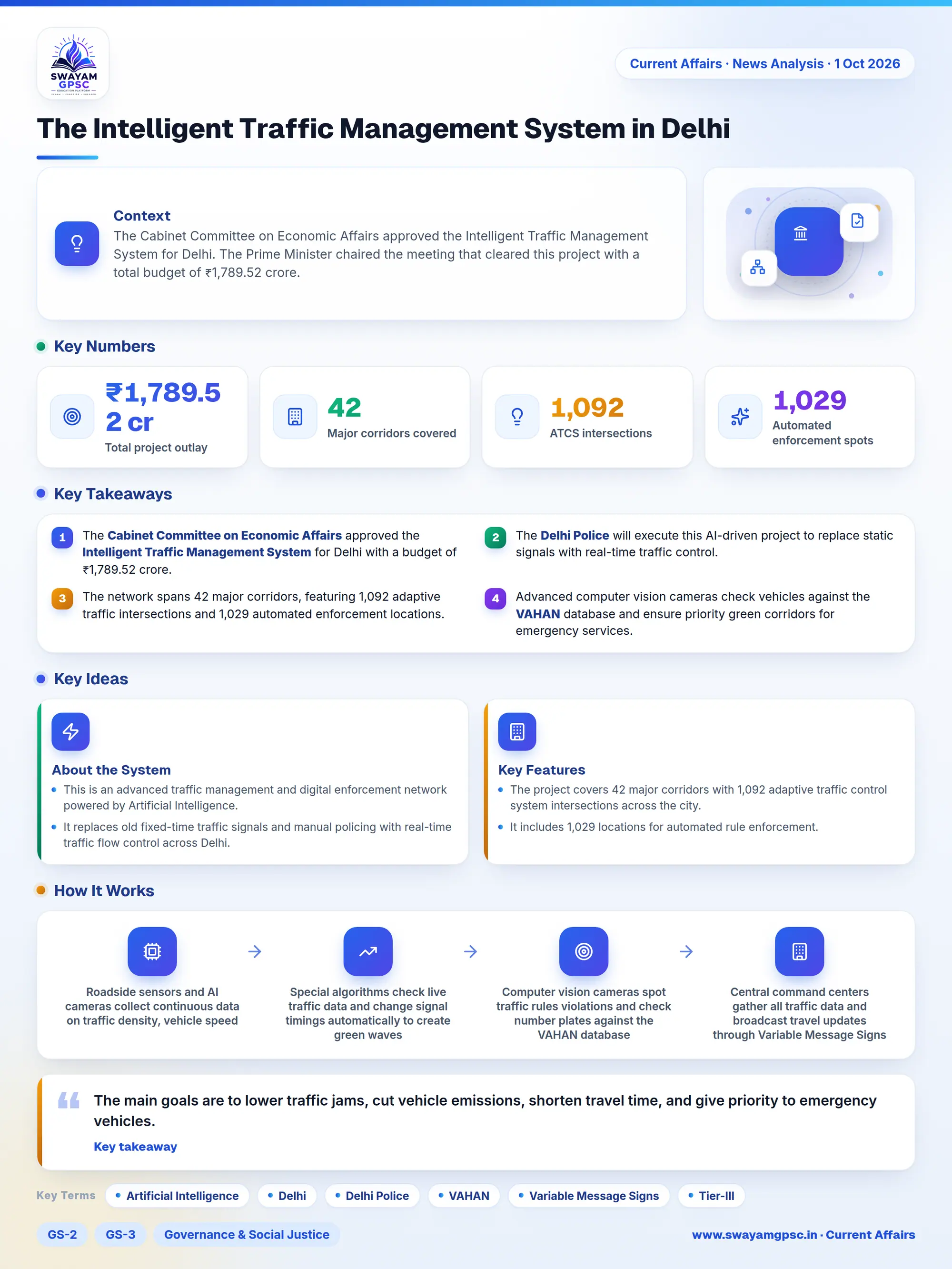
- The Cabinet Committee on Economic Affairs approved the Intelligent Traffic Management System for Delhi with a budget of ₹1,789.52 crore.
- The Delhi Police will execute this AI-driven project to replace static signals with real-time traffic control.
- The network spans 42 major corridors, featuring 1,092 adaptive traffic intersections and 1,029 automated enforcement locations.
- Advanced computer vision cameras check vehicles against the VAHAN database and ensure priority green corridors for emergency services.
Context
- The Cabinet Committee on Economic Affairs approved the Intelligent Traffic Management System for Delhi.
- The Prime Minister chaired the meeting that cleared this project with a total budget of ₹1,789.52 crore.
About the System
- This is an advanced traffic management and digital enforcement network powered by Artificial Intelligence.
- It replaces old fixed-time traffic signals and manual policing with real-time traffic flow control across Delhi.
- The Delhi Police under the Ministry of Home Affairs is the executing agency for this project.
- The main goals are to lower traffic jams, cut vehicle emissions, shorten travel time, and give priority to emergency vehicles.
How It Works
- Roadside sensors and AI cameras collect continuous data on traffic density, vehicle speed, and queue length at road crossings.
- Special algorithms check live traffic data and change signal timings automatically to create green waves and ease congestion.
- Computer vision cameras spot traffic rules violations and check number plates against the VAHAN database to track stolen vehicles.
- Central command centers gather all traffic data and broadcast travel updates through Variable Message Signs and maps.
Key Features
- The project covers 42 major corridors with 1,092 adaptive traffic control system intersections across the city.
- It includes 1,029 locations for automated rule enforcement.
- Emergency green corridors use GPS and software to give instant green lights to ambulances and fire engines.
- AI cameras catch offences like jumping red lights, crossing stop lines, triple riding, and using mobile phones while driving.
- Central command hubs are backed by Tier-III data centres and safe disaster recovery setups.
- Drivers get live traffic updates on electronic display boards to choose clearer routes.