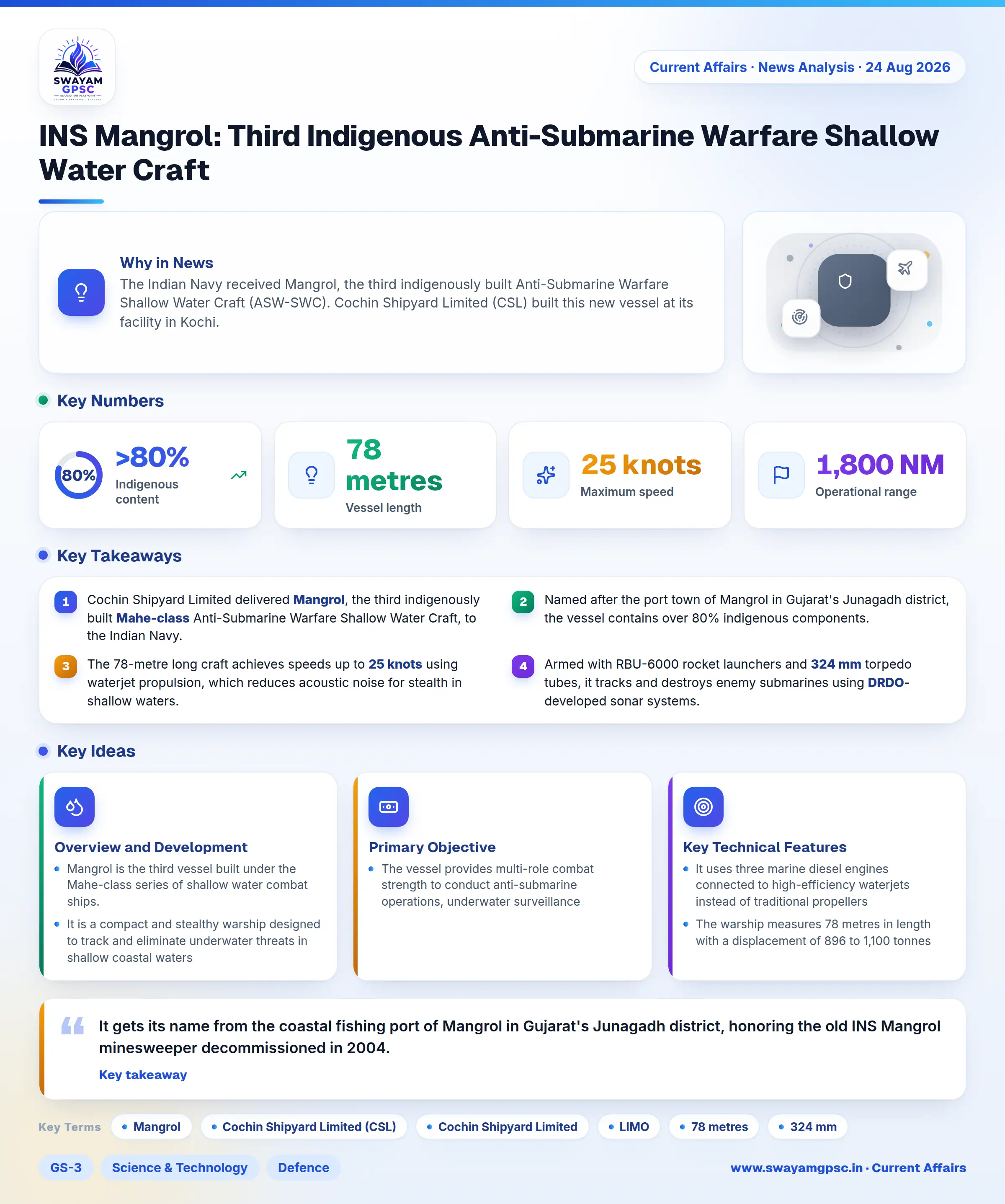
INS Mangrol: Third Indigenous Anti-Submarine Warfare Shallow Water Craft
#GS-3 #Science & Technology #Defence #GS-2 #Current Events #National #Gujarat
Key takeaways
- Cochin Shipyard Limited delivered Mangrol, the third indigenously built Mahe-class Anti-Submarine Warfare Shallow Water Craft, to the Indian Navy.
- Named after the port town of Mangrol in Gujarat's Junagadh district, the vessel contains over 80% indigenous components.
- The 78-metre long craft achieves speeds up to 25 knots using waterjet propulsion, which reduces acoustic noise for stealth in shallow waters.
- Armed with RBU-6000 rocket launchers and 324 mm torpedo tubes, it tracks and destroys enemy submarines using DRDO-developed sonar systems.
Why in News
- The Indian Navy received Mangrol, the third indigenously built Anti-Submarine Warfare Shallow Water Craft (ASW-SWC).
- Cochin Shipyard Limited (CSL) built this new vessel at its facility in Kochi.
Overview and Development
- Mangrol is the third vessel built under the Mahe-class series of shallow water combat ships.
- It is a compact and stealthy warship designed to track and eliminate underwater threats in shallow coastal waters where large ships cannot operate easily.
- Cochin Shipyard Limited is building eight such vessels under a contract with the Ministry of Defence.
- The warship reflects strong self-reliance with over 80% indigenous components and systems.
- It gets its name from the coastal fishing port of Mangrol in Gujarat's Junagadh district, honoring the old INS Mangrol minesweeper decommissioned in 2004.
Primary Objective
- The vessel provides multi-role combat strength to conduct anti-submarine operations, underwater surveillance, mine warfare, and Low-Intensity Maritime Operations (LIMO) across India's Exclusive Economic Zone (EEZ).
Key Technical Features
- It uses three marine diesel engines connected to high-efficiency waterjets instead of traditional propellers, lowering acoustic noise to avoid enemy sonar detection.
- The warship measures 78 metres in length with a displacement of 896 to 1,100 tonnes, achieving speeds up to 25 knots and a range of 1,800 nautical miles over 14 days of endurance.
- For sub-hunting, it carries an RBU-6000 anti-submarine rocket launcher, 324 mm lightweight torpedo tubes, and advanced decoy systems.
- Its sensor suite features DRDO-developed hull-mounted sonars, Low-Frequency Variable Depth Sonar (LFVDS), and an integrated combat management system.
- For surface defense, it carries a 30 mm naval gun and two 12.7 mm stabilized remote-controlled guns (SRCGs) to target fast craft, drones, and air threats.