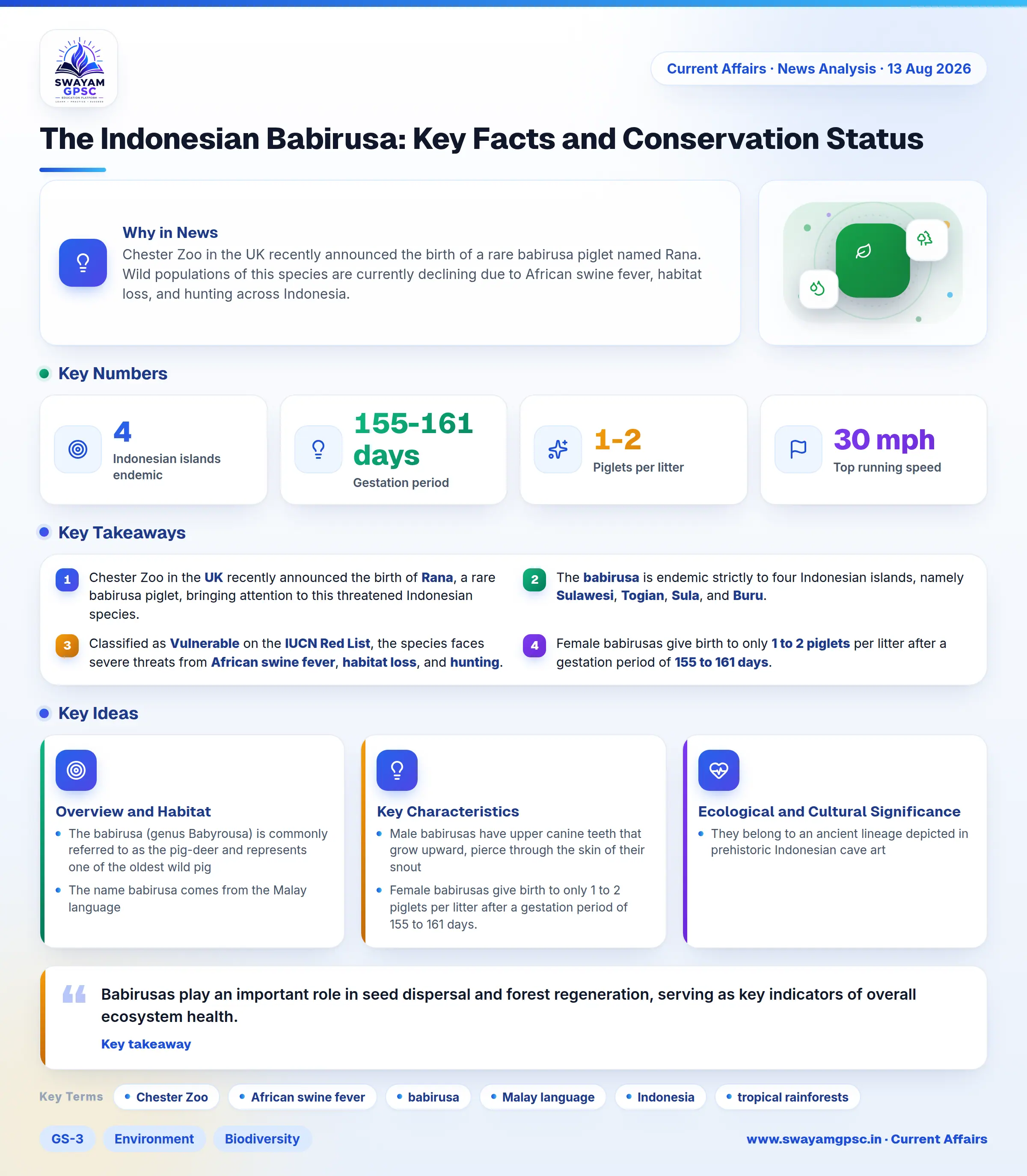
The Indonesian Babirusa: Key Facts and Conservation Status
#GS-3 #Environment #Biodiversity #Wildlife #Current Events #International #IUCN Red List
Key takeaways
- Chester Zoo in the UK recently announced the birth of Rana, a rare babirusa piglet, bringing attention to this threatened Indonesian species.
- The babirusa is endemic strictly to four Indonesian islands, namely Sulawesi, Togian, Sula, and Buru.
- Classified as Vulnerable on the IUCN Red List, the species faces severe threats from African swine fever, habitat loss, and hunting.
- Female babirusas give birth to only 1 to 2 piglets per litter after a gestation period of 155 to 161 days.
Why in News
- Chester Zoo in the UK recently announced the birth of a rare babirusa piglet named Rana.
- Wild populations of this species are currently declining due to African swine fever, habitat loss, and hunting across Indonesia.
Overview and Habitat
- The babirusa (genus Babyrousa) is commonly referred to as the pig-deer and represents one of the oldest wild pig species.
- The name babirusa comes from the Malay language, reflecting its distinct physical appearance and stag-like upper tusks.
- This species is strictly endemic to four islands in Indonesia: Sulawesi, Togian, Sula, and Buru.
- It inhabits tropical rainforests, swamps, and wetlands, preferring areas near riverbanks and natural ponds rich in aquatic plants.
- The species is currently classified as Vulnerable on the IUCN Red List of Threatened Species.
Key Characteristics
- Male babirusas have upper canine teeth that grow upward, pierce through the skin of their snout, and curve backward toward the forehead.
- Female babirusas give birth to only 1 to 2 piglets per litter after a gestation period of 155 to 161 days.
- They feature barrel-shaped bodies covered in sparse grey-brown skin, and newborn piglets uniquely lack protective camouflage stripes.
- They are active omnivores that use hooves to dig for roots, stand on hind legs to reach high leaves, and run at speeds up to 30 mph.
- They communicate using grunts and tooth-clattering, and display a unique ploughing behavior by pushing their heads through soft sand.
Ecological and Cultural Significance
- Babirusas play an important role in seed dispersal and forest regeneration, serving as key indicators of overall ecosystem health.
- They belong to an ancient lineage depicted in prehistoric Indonesian cave art, and captive breeding helps protect their genetics from extinction.