Indian-Origin Scientist to Lead NASA's PUFFINS Space Mission
#GS-3 #Science & Technology #Space #Current Events #International #Astrophysics
Key takeaways
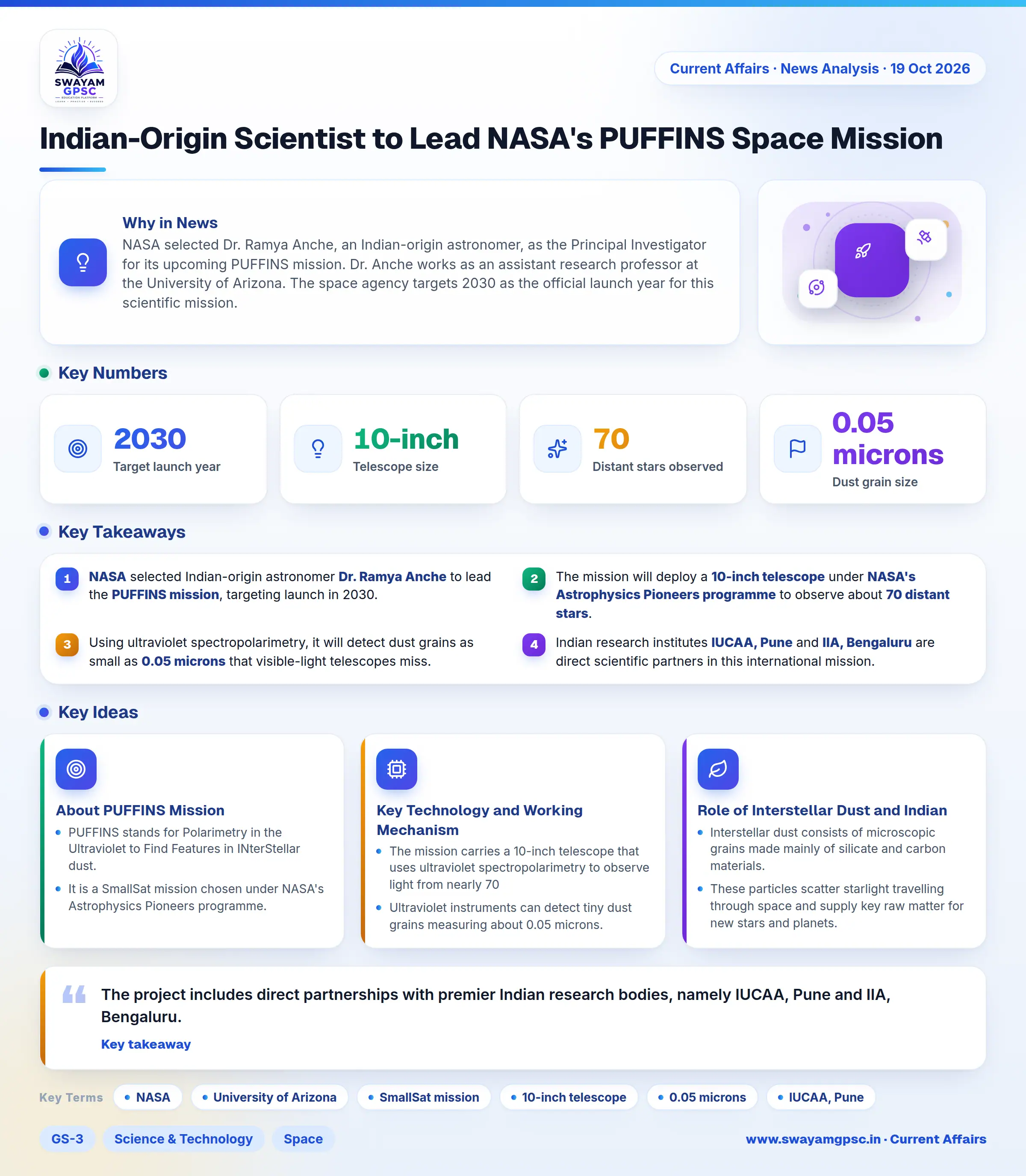
- NASA selected Indian-origin astronomer Dr. Ramya Anche to lead the PUFFINS mission, targeting launch in 2030.
- The mission will deploy a 10-inch telescope under NASA's Astrophysics Pioneers programme to observe about 70 distant stars.
- Using ultraviolet spectropolarimetry, it will detect dust grains as small as 0.05 microns that visible-light telescopes miss.
- Indian research institutes IUCAA, Pune and IIA, Bengaluru are direct scientific partners in this international mission.
Why in News
- NASA selected Dr. Ramya Anche, an Indian-origin astronomer, as the Principal Investigator for its upcoming PUFFINS mission.
- Dr. Anche works as an assistant research professor at the University of Arizona.
- The space agency targets 2030 as the official launch year for this scientific mission.
About PUFFINS Mission
- PUFFINS stands for Polarimetry in the Ultraviolet to Find Features in INterStellar dust.
- It is a SmallSat mission chosen under NASA's Astrophysics Pioneers programme.
- The project aims to study microscopic interstellar dust particles across deep space.
- These observations will help scientists understand how stars, planets, and the broader universe formed and evolved.
Key Technology and Working Mechanism
- The mission carries a 10-inch telescope that uses ultraviolet spectropolarimetry to observe light from nearly 70 distant stars.
- Ultraviolet instruments can detect tiny dust grains measuring about 0.05 microns.
- Standard visible-light and infrared telescopes struggle to see particles of such a small size.
- Spectropolarimetry records how dust particles line up with galactic magnetic fields and polarize starlight.
Role of Interstellar Dust and Indian Partnership
- Interstellar dust consists of microscopic grains made mainly of silicate and carbon materials.
- These particles scatter starlight travelling through space and supply key raw matter for new stars and planets.
- The project includes direct partnerships with premier Indian research bodies, namely IUCAA, Pune and IIA, Bengaluru.