India-Uzbekistan Elevate Relations to Comprehensive Strategic Partnership
#GS-2 #Current Events #International #India-Uzbekistan Relations #Comprehensive Strategic Partnership #Connect Central Asia Policy
Key takeaways
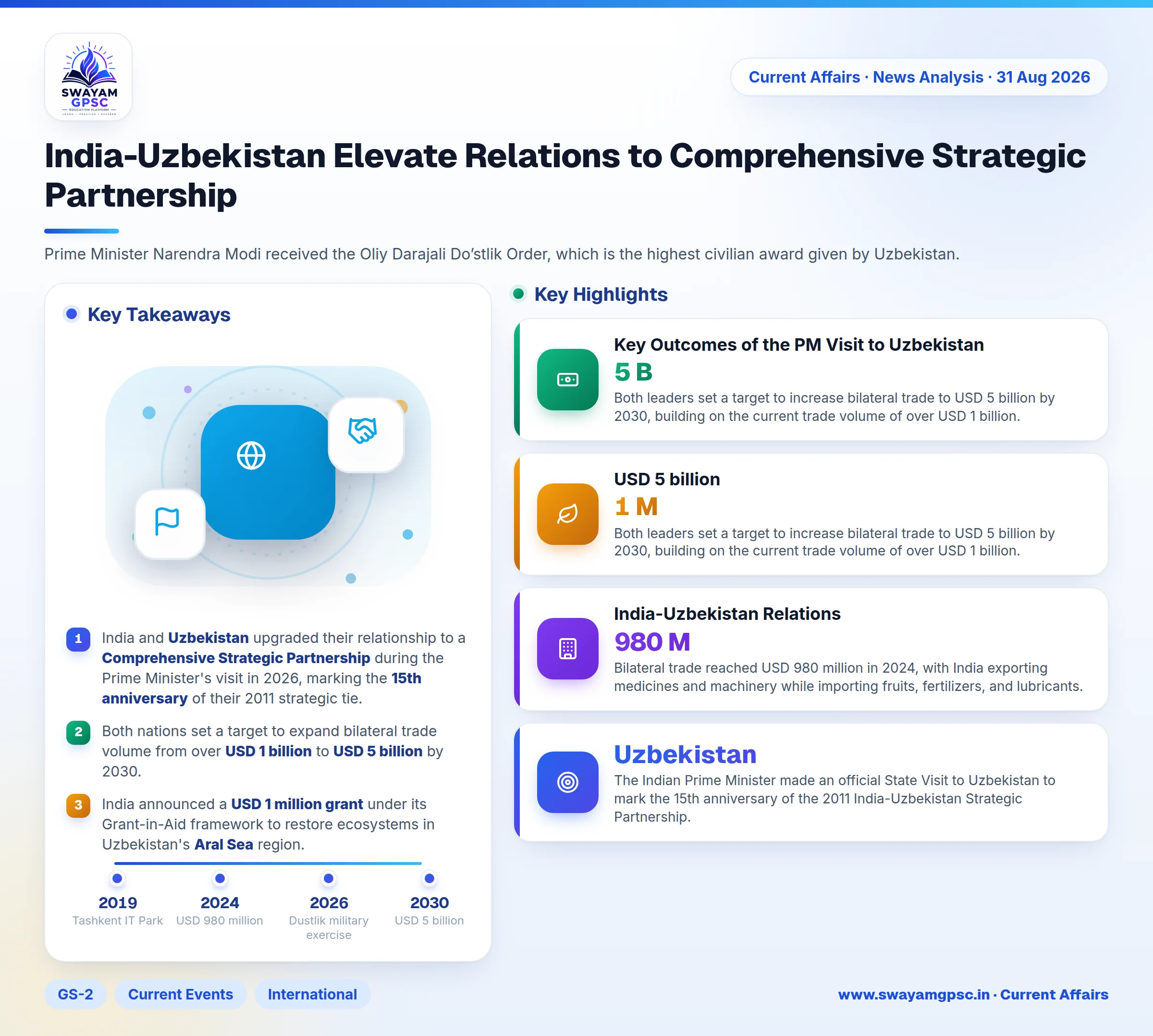
- India and Uzbekistan upgraded their relationship to a Comprehensive Strategic Partnership during the Prime Minister's visit in 2026, marking the 15th anniversary of their 2011 strategic tie.
- Both nations set a target to expand bilateral trade volume from over USD 1 billion to USD 5 billion by 2030.
- India announced a USD 1 million grant under its Grant-in-Aid framework to restore ecosystems in Uzbekistan's Aral Sea region.
- Bilateral trade stood at USD 980 million in 2024, with new commitments covering uranium supply, critical minerals, and digital payments via UPI and UZQR.
Why in News
- The Indian Prime Minister made an official State Visit to Uzbekistan to mark the 15th anniversary of the 2011 India-Uzbekistan Strategic Partnership.
- During this diplomatic visit, both nations formally upgraded their relationship to a Comprehensive Strategic Partnership to deepen ties across Central Asia.
Summary
- India and Uzbekistan expanded their collaboration across defence, bilateral trade, uranium supply, critical minerals, clean energy, digital systems, healthcare, and cultural preservation.
- Because of its central location, Uzbekistan is vital for India's Connect Central Asia Policy, requiring both countries to overcome transport barriers and regional security issues.
Key Outcomes of the PM Visit to Uzbekistan
- Prime Minister Narendra Modi received the Oliy Darajali Do’stlik Order, which is the highest civilian award given by Uzbekistan.
- Both governments officially elevated their relationship to a Comprehensive Strategic Partnership to expand long-term ties in security, trade, and technology.
- The two countries adopted a strict zero-tolerance position against terrorism and called for firm global action against terror financing and safe havens.
- Both nations agreed to boost defence manufacturing collaboration through the Joint Working Group on Military Cooperation.
- Leaders praised the military units from both sides for successfully completing the joint Dustlik military exercise in Uzbekistan in April 2026.
- Both leaders set a target to increase bilateral trade to USD 5 billion by 2030, building on the current trade volume of over USD 1 billion.
- The two governments agreed to set up a Foreign Minister-led Coordination Council and upgrade the Joint Commission to the ministerial level.
- A new Joint Working Group was established to remove non-tariff barriers in sectors like engineering, motor vehicles, electronics, and pharmaceuticals.
- Both sides committed to completing fixed time-bound steps toward signing an India-Uzbekistan PTA.
- India officially reiterated its strong support for Uzbekistan's entry into the World Trade Organization (WTO).
- A partnership between Invest India and Uzbekistan's Investment Promotion Agency will help drive two-way investment flows.
- Both countries agreed to start joint ventures for exploring, mining, processing, and recycling essential critical minerals.
- Both sides created a framework for long-term uranium supply from Uzbekistan to support India's civil nuclear energy program.
- The two nations agreed to expand technical cooperation in peaceful nuclear energy, electrical grid modernization, and clean energy systems.
- Both countries decided to connect tech incubators and IT hubs, building on the Tashkent IT Park established in 2019 with STPI support.
- The two partners agreed to develop safe Artificial Intelligence (AI) tools for economic growth and public problem-solving.
- An agreement between NPCI International Payments Ltd and Uzbekistan's National Interbank Processing Centre will enable Indian UPI apps to scan UZQR codes.
- India announced a USD 1 million grant for afforestation in the Aral Sea region, linking Uzbekistan's Yashil Makon initiative with India's Ek Ped Maa Ke Naam campaign.
- Both countries agreed to use the Tashkent Pharma Park cluster for joint medicine production, tech transfers, and setting up Indian medical labs.
- The two sides signed a Letter of Intent to restore ancient Buddhist sites at Fayaz Tepa and Karatepa, alongside a Cultural Exchange Program (2026-2030).
- India introduced the Lal Bahadur Shastri Scholarship for Uzbek students learning Hindi and signed an MoU to promote AYUSH traditional medicine systems.
- Uzbekistan reaffirmed its support for India's claim to a permanent seat on a reformed UN Security Council.
- Uzbekistan expressed its goal to join both the International Solar Alliance (ISA) and the International Big Cat Alliance (IBCA).
- Uzbekistan supported India's 2026 BRICS Chairship, while India backed Uzbekistan's leadership of the Non-Aligned Movement (NAM) for 2027-2030.
- Both nations committed to working together within the Shanghai Cooperation Organisation (SCO) and the Central Asia-India framework.
Why is Uzbekistan Strategically Important to India?
- Uzbekistan sits at the center of Central Asia, sharing borders with all four neighboring Central Asian states and Afghanistan, making it crucial for India's Connect Central Asia Policy.
- The nation holds large reserves of gold, natural gas, uranium, and critical minerals that India needs for green technology transformation.
- Instability in neighboring Afghanistan raises security risks like drug smuggling and extremism, which both nations counter through joint training like Exercise Dustlik.
- India offers transparent development options and digital solutions like UPI to balance China's heavy infrastructure spending under the Belt and Road Initiative (BRI).
- Because India lacks a direct land route to Central Asia, partnering with Uzbekistan is vital to run trade through Chabahar Port and the INSTC.
India-Uzbekistan Relations
- Historical ties go back to the ancient Silk Route, the historical movement of Buddhism, and shared heritage linked to Babur from the Fergana Valley.
- Formal diplomatic relations started in March 1992, and the bilateral relationship was elevated to a Strategic Partnership in 2011.
- The two armed forces regularly conduct Exercise DUSTLIK to improve joint counter-terrorism operational readiness.
- State-level cooperation has expanded through a direct partnership between Gujarat and the Samarkand region of Uzbekistan.
- Bilateral trade reached USD 980 million in 2024, with India exporting medicines and machinery while importing fruits, fertilizers, and lubricants.
- India assists local development through High Impact Community Development Projects (HICDPs) covering public healthcare, digital education, and technology infrastructure.
Challenges
- Lack of direct land access due to transit restrictions through Pakistan forces reliance on routes like Chabahar Port, which increases freight costs and travel time.
- Transporting strategic material like uranium across multiple transit countries presents security risks and complex administrative regulations.
- Limited direct banking connections and low international trading of the Uzbek Som increase currency exchange costs for small businesses.
- China remains Uzbekistan's largest trading partner, and its planned China-Kyrgyzstan-Uzbekistan (CKU) railway adds competitive pressure on Indian trade.
- Ongoing security problems in Afghanistan and active extremist groups like ISIS-K create persistent risks for regional trade corridors.
- Strict regulatory requirements, complex paperwork, and non-tariff barriers continue to slow down bilateral trade expansion.
Way Forward
- Both governments should create subsidized Air Freight Corridors to transport high-value items like medicines, electronic parts, and fresh farm products.
- Completing the India-Uzbekistan PTA quickly will help cut tariffs on major trade items like medicines, machinery, textiles, and fertilizers.
- The two countries need to sign mutual recognition agreements for quality checks to streamline pharmaceutical and agricultural import approvals.
- Indian solar firms should use the International Solar Alliance (ISA) framework to build commercial solar energy plants in Uzbekistan.
- The Joint Working Group on Counter-Terrorism must set up secure channels to share real-time security data regarding terrorism financing and illegal drug trade.
Conclusion
- Uzbekistan remains a core anchor for India's Connect Central Asia Policy, and executing key project commitments, expanding DPI, and strengthening transport links through Chabahar Port will ensure long-term regional stability.
Frequently Asked Questions (FAQs)
- India and Uzbekistan established diplomatic ties in March 1992 and upgraded their partnership to a Strategic Partnership in 2011.
- Uzbekistan is vital because it borders every Central Asian republic and Afghanistan, placing it at the core of India's Connect Central Asia Policy.
- The recent summit expanded bilateral cooperation into key sectors including defence, trade, uranium supply, AI, DPI, and healthcare.
- Connecting Indian UPI apps with Uzbekistan's UZQR system allows seamless digital payments across borders for travelers and businesses.
- Main ongoing obstacles involve transit limitations, insufficient banking channels, regulatory non-tariff barriers, and security risks from Afghanistan.