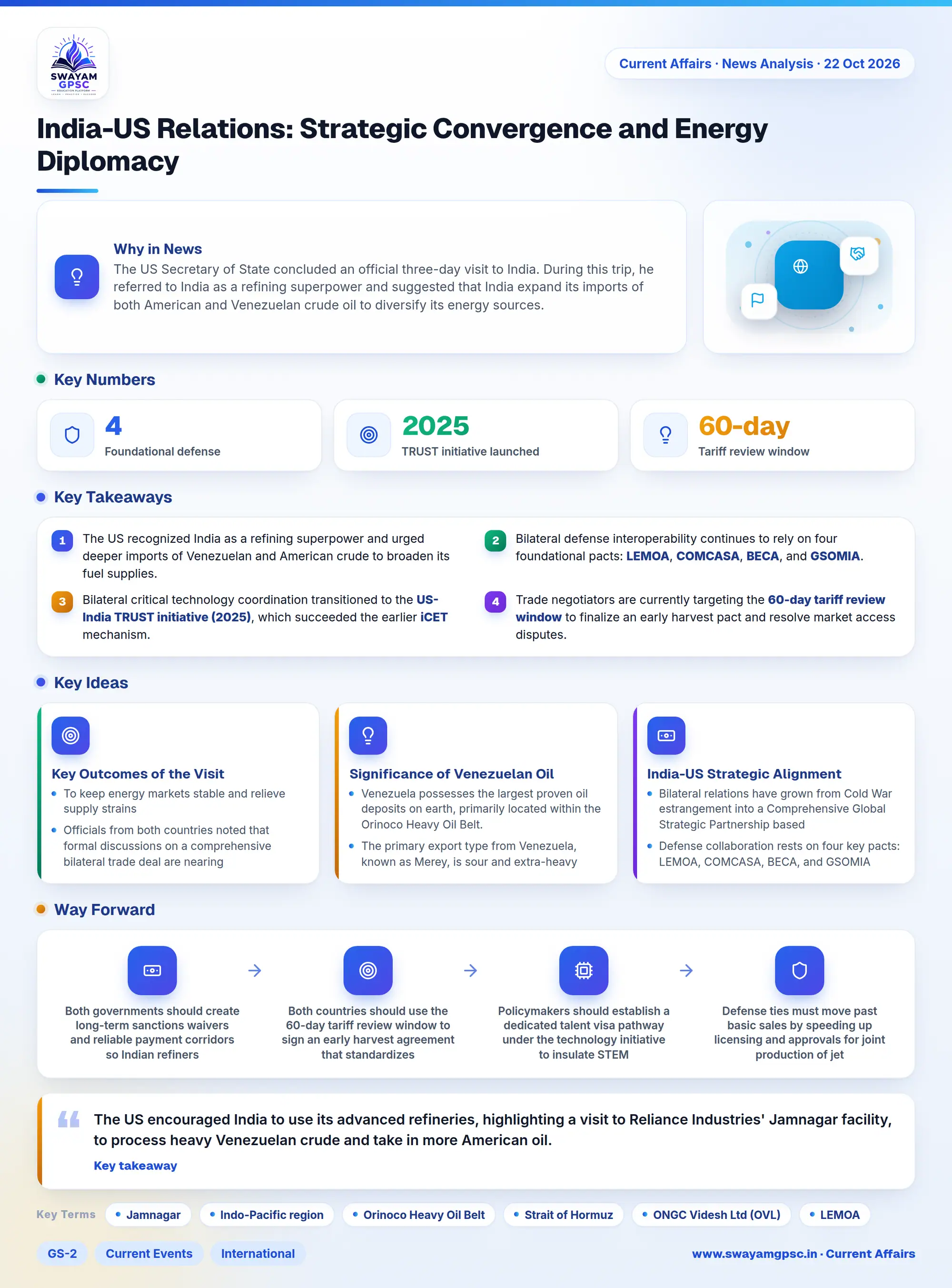
India-US Relations: Strategic Convergence and Energy Diplomacy
#GS-2 #Current Events #International #Bilateral Groupings & Agreements #Effect of Policies & Politics of Countries on India's Interests #Energy Security #Defence Cooperation
Key takeaways
- The US recognized India as a refining superpower and urged deeper imports of Venezuelan and American crude to broaden its fuel supplies.
- Bilateral defense interoperability continues to rely on four foundational pacts: LEMOA, COMCASA, BECA, and GSOMIA.
- Bilateral critical technology coordination transitioned to the US-India TRUST initiative (2025), which succeeded the earlier iCET mechanism.
- Trade negotiators are currently targeting the 60-day tariff review window to finalize an early harvest pact and resolve market access disputes.
Why in News
- The US Secretary of State concluded an official three-day visit to India.
- During this trip, he referred to India as a refining superpower and suggested that India expand its imports of both American and Venezuelan crude oil to diversify its energy sources.
- He also stated that even with tactical differences, both countries share strong alignment on essential national interests.
Key Outcomes of the Visit
- The US encouraged India to use its advanced refineries, highlighting a visit to Reliance Industries' Jamnagar facility, to process heavy Venezuelan crude and take in more American oil.
- To keep energy markets stable and relieve supply strains, Washington temporarily waived specific sanctions on major buyers of Russian crude, including India.
- Officials from both countries noted that formal discussions on a comprehensive bilateral trade deal are nearing completion.
- Both governments agreed on a collaborative framework for advanced artificial intelligence, aiming to steer emerging technologies toward human progress while checking systemic security dangers.
- American representatives urged deeper military procurement connections and reiterated that global stability relies heavily on deterrence and peace across the Indo-Pacific region.
Significance of Venezuelan Oil
- Venezuela possesses the largest proven oil deposits on earth, primarily located within the Orinoco Heavy Oil Belt.
- The primary export type from Venezuela, known as Merey, is sour and extra-heavy, meaning refiners require advanced delayed cokers to process it.
- For India, this supply offers crude diversification away from West Asia and Russia, limiting supply disruption risks around the Strait of Hormuz and the Red Sea.
- For the US, bringing this crude back to the market increases worldwide supply and helps calm fuel prices without relying entirely on domestic output.
- Indian plants like the Jamnagar refinery can turn heavy crude into valuable fuels, which helps raise their gross refining margins.
- The US sees Indian facilities as an efficient global hub to convert Venezuelan crude into exportable petroleum products.
- This supply channel helps ONGC Videsh Ltd (OVL) recover long-pending dividends and restart work on projects like San Cristobal and Carabobo-1, provided legal rules permit.
- At the same time, Washington expands its oversight of Venezuelan trade, prompts India to buy less Russian crude, and curtails Chinese and Iranian influence in Caracas.
India-US Strategic Alignment
- Bilateral relations have grown from Cold War estrangement into a Comprehensive Global Strategic Partnership based on democratic values, economic synergy, and shared regional realities.
- Defense collaboration rests on four key pacts: LEMOA, COMCASA, BECA, and GSOMIA, alongside production programs like INDUS-X and domestic assembly of GE F414 jet engines.
- Technology cooperation operates through the US-India TRUST initiative (2025), the successor to iCET, covering semiconductors, AI, quantum computing, space under the Artemis Accords, and the NISAR satellite project.
- Both nations also pursue shared goals through minilateral arrangements such as the Quad and the I2U2 group.
Significance of the Alignment
- This partnership balances unilateral regional actions in the Indo-Pacific, securing critical sea lines of communication for international trade.
- The partnership aids global supply chain realignments under frameworks like the Mineral Security Partnership (MSP) and the Indo-Pacific Economic Framework (IPEF), establishing India as an alternative manufacturing hub.
- It strengthens Indian surveillance and reconnaissance across its land borders and the broader Indian Ocean Region (IOR).
- India serves as a diplomatic link to the Global South for Washington, while gaining partner backing for its push to reform global institutions.
Challenges
- Recurring tariff disagreements, farm market access limits, digital tax disputes, and protectionist US policies continue to hold back the bilateral trade agreement.
- Sharp increases in H-1B visa fees and tighter green card processes hurt Indian tech firms like TCS and Wipro while impeding skilled labor movement.
- India's independent ties with Russia and Iran, including work at the Chabahar port and S-400 procurements, often trigger friction with US sanctions policies.
- Disagreements emerge over regional diplomacy, particularly whenever Washington attempts to mediate between India and Pakistan or downplays cross-border terror concerns.
- Strict American technology export controls under ITAR and EAR often slow the delivery of dual-use hardware, despite top-level political backing.
- Shipping costs for US crude remain high, while processing Venezuelan crude presents issues with degraded field infrastructure, payment channels, and uncertain sanctions.
Way Forward
- Both governments should create long-term sanctions waivers and reliable payment corridors so Indian refiners can handle Venezuelan crude without fear of sudden trade penalties.
- Both countries should use the 60-day tariff review window to sign an early harvest agreement that standardizes duties and safeguards service worker mobility.
- Policymakers should establish a dedicated talent visa pathway under the technology initiative to insulate STEM workers from domestic political debates.
- Defense ties must move past basic sales by speeding up licensing and approvals for joint production of jet engines, unmanned aerial vehicles, and maritime sensors.
- Both partners should expand the trilateral track with the United Arab Emirates to implement the IMEC network, combining Gulf finance, Indian refining power, and American technology.
Conclusion
- A changing world order requires India and the US to build their partnership around strategic convergence, defense alignment, and energy diplomacy.
- Working through trade frictions and visa limits will let both democracies build a stable and mutually advantageous partnership over the coming decades.