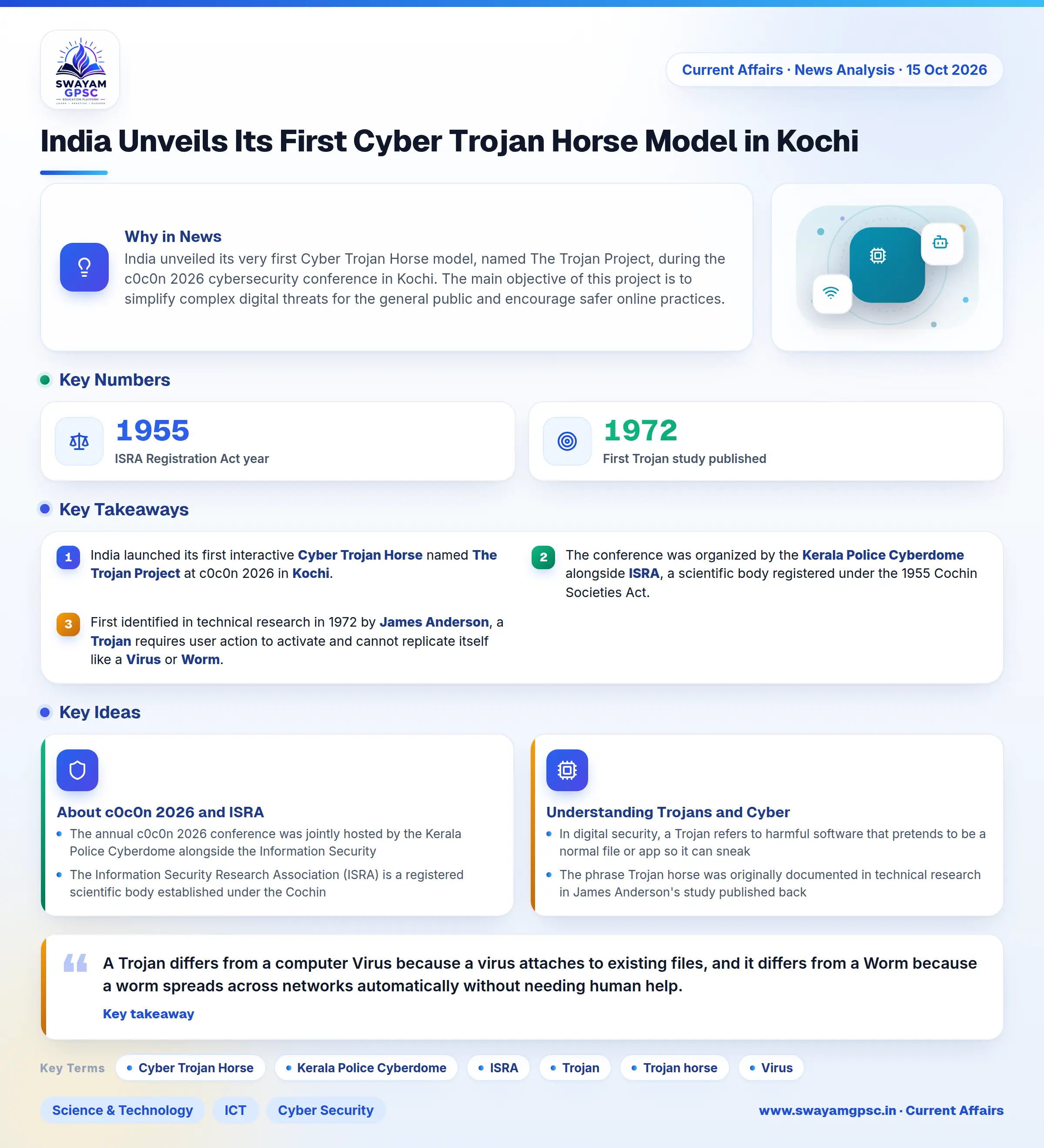
India Unveils Its First Cyber Trojan Horse Model in Kochi
#Science & Technology #ICT #Cyber Security #Current Events #National #Rapid Fire CA #Quick Facts For Prelims #Achievements of Indians in Science & Technology #GS-3 #GS-2
Key takeaways
- India launched its first interactive Cyber Trojan Horse named The Trojan Project at c0c0n 2026 in Kochi.
- The conference was organized by the Kerala Police Cyberdome alongside ISRA, a scientific body registered under the 1955 Cochin Societies Act.
- First identified in technical research in 1972 by James Anderson, a Trojan requires user action to activate and cannot replicate itself like a Virus or Worm.
Why in News
- India unveiled its very first Cyber Trojan Horse model, named The Trojan Project, during the c0c0n 2026 cybersecurity conference in Kochi.
- The main objective of this project is to simplify complex digital threats for the general public and encourage safer online practices.
About c0c0n 2026 and ISRA
- The annual c0c0n 2026 conference was jointly hosted by the Kerala Police Cyberdome alongside the Information Security Research Association (ISRA).
- The Information Security Research Association (ISRA) is a registered scientific body established under the Cochin Literary Scientific and Charitable Societies Registration Act 1955.
- This organization focuses on driving research forward in information security and building an innovative digital safety framework across the country.
Understanding Trojans and Cyber Malware
- In digital security, a Trojan refers to harmful software that pretends to be a normal file or app so it can sneak into devices and steal private information.
- The phrase Trojan horse was originally documented in technical research in James Anderson's study published back in 1972.
- A Trojan horse cannot activate on its own because it requires a user to manually open or download the malicious file.
- A Trojan differs from a computer Virus because a virus attaches to existing files, and it differs from a Worm because a worm spreads across networks automatically without needing human help.