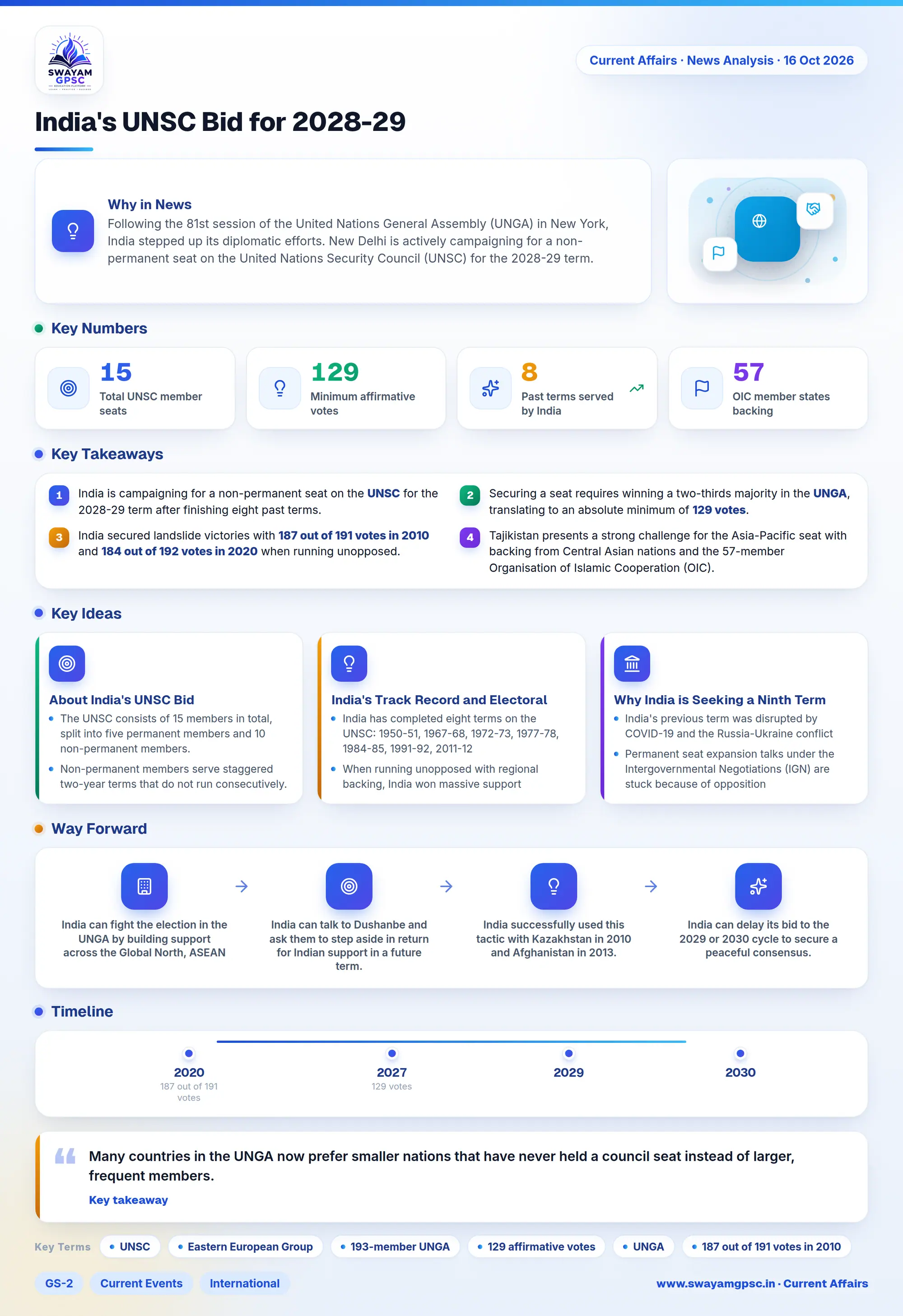
India's UNSC Bid for 2028-29
#GS-2 #Current Events #International #India's UNSC Bid for 2028-29 #United Nations Security Council #Global Diplomacy
Key takeaways
- India is campaigning for a non-permanent seat on the UNSC for the 2028-29 term after finishing eight past terms.
- Securing a seat requires winning a two-thirds majority in the UNGA, translating to an absolute minimum of 129 votes.
- India secured landslide victories with 187 out of 191 votes in 2010 and 184 out of 192 votes in 2020 when running unopposed.
- Tajikistan presents a strong challenge for the Asia-Pacific seat with backing from Central Asian nations and the 57-member Organisation of Islamic Cooperation (OIC).
Why in News
- Following the 81st session of the United Nations General Assembly (UNGA) in New York, India stepped up its diplomatic efforts.
- New Delhi is actively campaigning for a non-permanent seat on the United Nations Security Council (UNSC) for the 2028-29 term.
About India's UNSC Bid
- The UNSC consists of 15 members in total, split into five permanent members and 10 non-permanent members.
- Non-permanent members serve staggered two-year terms that do not run consecutively.
- The 10 seats are divided among regions: the African Group gets three, the Asia-Pacific Group gets two, the Latin American and Caribbean Group (GRULAC) gets two, the Western European and Others Group (WEOG) gets two, and the Eastern European Group gets one.
- The Asia-Pacific seat opens up once every year.
- Winning a seat requires a two-thirds majority of members present and voting in the 193-member UNGA.
- This means a candidate needs at least 129 affirmative votes if every member state votes.
- Regional groups usually negotiate a single consensus candidate decades early so the UNGA approves them easily without a contest.
India's Track Record and Electoral Math
- India has completed eight terms on the UNSC: 1950-51, 1967-68, 1972-73, 1977-78, 1984-85, 1991-92, 2011-12, and 2021-22.
- When running unopposed with regional backing, India won massive support: 187 out of 191 votes in 2010 and 184 out of 192 votes in 2020.
- Whenever regional consensus broke down in the past, India lost the elections.
- In 1975, India lost to Pakistan.
- In 1996, India lost badly to Japan by a vote count of 142 to 40.
- To win the 2028-29 seat in June 2027 against an opponent, India must gather at least 129 votes across different voting groups.
Why India is Seeking a Ninth Term
- India's previous term was disrupted by COVID-19 and the Russia-Ukraine conflict, leaving goals like counter-terrorism reform incomplete.
- Permanent seat expansion talks under the Intergovernmental Negotiations (IGN) are stuck because of opposition from the Coffee Club and P5 vetoes.
- Running for non-permanent seats keeps India involved in core global governance discussions.
- A seat at the main table allows India to speak up for developing economies on climate finance and debt relief.
Challenges
- Many countries in the UNGA now prefer smaller nations that have never held a council seat instead of larger, frequent members.
- For example, Tajikistan based its run on representing small nations, much like Kyrgyzstan beating the Philippines earlier.
- Tajikistan enjoys backing from Central Asian neighbors and the 57-member Organisation of Islamic Cooperation (OIC).
- Global South countries are increasingly voting against major powers during geopolitical disagreements.
- For example, Portugal and Austria defeated Germany in the WEOG elections after developing nations criticized Western policies.
- Fighting an election against Tajikistan could harm India's relations with a vital Central Asian security partner.
- Tajikistan previously gave India access to the Ayni air base and Farkhor hospital facility for security operations.
Way Forward
- India can fight the election in the UNGA by building support across the Global North, ASEAN, and Pacific Island countries to reach 129 votes.
- India can talk to Dushanbe and ask them to step aside in return for Indian support in a future term.
- India successfully used this tactic with Kazakhstan in 2010 and Afghanistan in 2013.
- India can delay its bid to the 2029 or 2030 cycle to secure a peaceful consensus.
- This polite delay would show India as a leader of the Global South while protecting ties with Central Asia.