India Under US Scrutiny Over Alleged Chinese Transshipment and Tariff Evasion
#GS-2 #GS-3 #Current Events #International #Economy #Taxation
Key takeaways
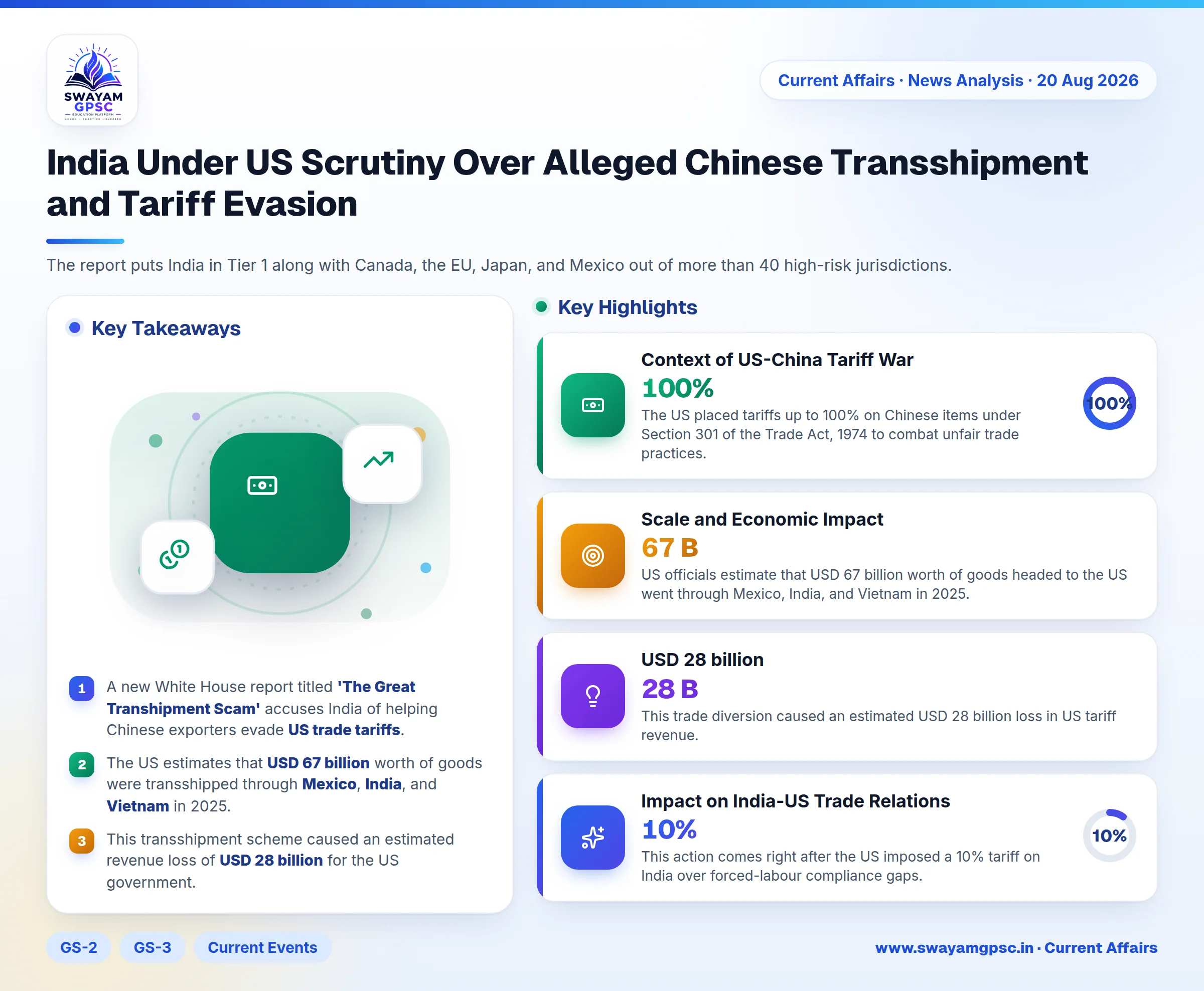
- A new White House report titled 'The Great Transhipment Scam' accuses India of helping Chinese exporters evade US trade tariffs.
- The US estimates that USD 67 billion worth of goods were transshipped through Mexico, India, and Vietnam in 2025.
- This transshipment scheme caused an estimated revenue loss of USD 28 billion for the US government.
- The report categorizes India as a Tier 1 risk jurisdiction and highlights the Pune-Gujarat-Chennai production belt for absorbing Chinese goods.
Why in News
- The White House released a report titled 'The Great Transhipment Scam', putting India under close scrutiny.
- The report claims that India and other nations help Chinese exporters illegally bypass US trade tariffs through proxy routes.
Context of US-China Tariff War
- The US placed tariffs up to 100% on Chinese items under Section 301 of the Trade Act, 1974 to combat unfair trade practices.
- Chinese companies responded by sending products through third countries to hide their true origin and lower tariff costs.
- The report puts India in Tier 1 along with Canada, the EU, Japan, and Mexico out of more than 40 high-risk jurisdictions.
- It specifically highlights the Pune-Gujarat-Chennai production belt for receiving Chinese industrial inputs.
Mechanics of Transshipment
- Transshipment means shipping goods through an intermediate country where basic packaging, minimal assembly, or documentation changes make the products look locally made.
- Chinese sellers use 'screwdriver factories' in third countries to do minor assembly work and bypass standard origin rules.
Scale and Economic Impact
- US officials estimate that USD 67 billion worth of goods headed to the US went through Mexico, India, and Vietnam in 2025.
- This trade diversion caused an estimated USD 28 billion loss in US tariff revenue.
Impact on India-US Trade Relations
- These allegations add fresh stress to bilateral trade between India and the United States.
- This action comes right after the US imposed a 10% tariff on India over forced-labour compliance gaps.
- It also coincides with proposed US laws threatening up to 100% tariffs on nations buying Russian oil.