India's Strategy for Clean Mobility and CAFE III Norms
#GS-3 #Environment #Climate Change #Sustainable Development #Pollution #Economy #Infrastructure #Current Events #National #CAFE III Norms #Clean Mobility
Why in News
- The Ministry of Power released the third draft notification of the **Corporate Average Fuel Efficiency (CAFE) III** standards for public and industry feedback.
- The **Bureau of Energy Efficiency (BEE)** administers these proposed rules under the **Energy Conservation Act, 2001** to set stricter carbon emission limits for passenger vehicles between **FY2027-28** and **FY2031-32**.
Overview of Clean Mobility in India
- Clean mobility involves shifting the transport sector away from internal combustion engines using fossil fuels toward electric, hybrid, and alternative fuel vehicles.
- Rather than evaluating vehicles individually, **CAFE** standards set sales-weighted average carbon dioxide emission targets across an automaker's entire annual vehicle fleet.
Key Data and Statistics on Mobility in India
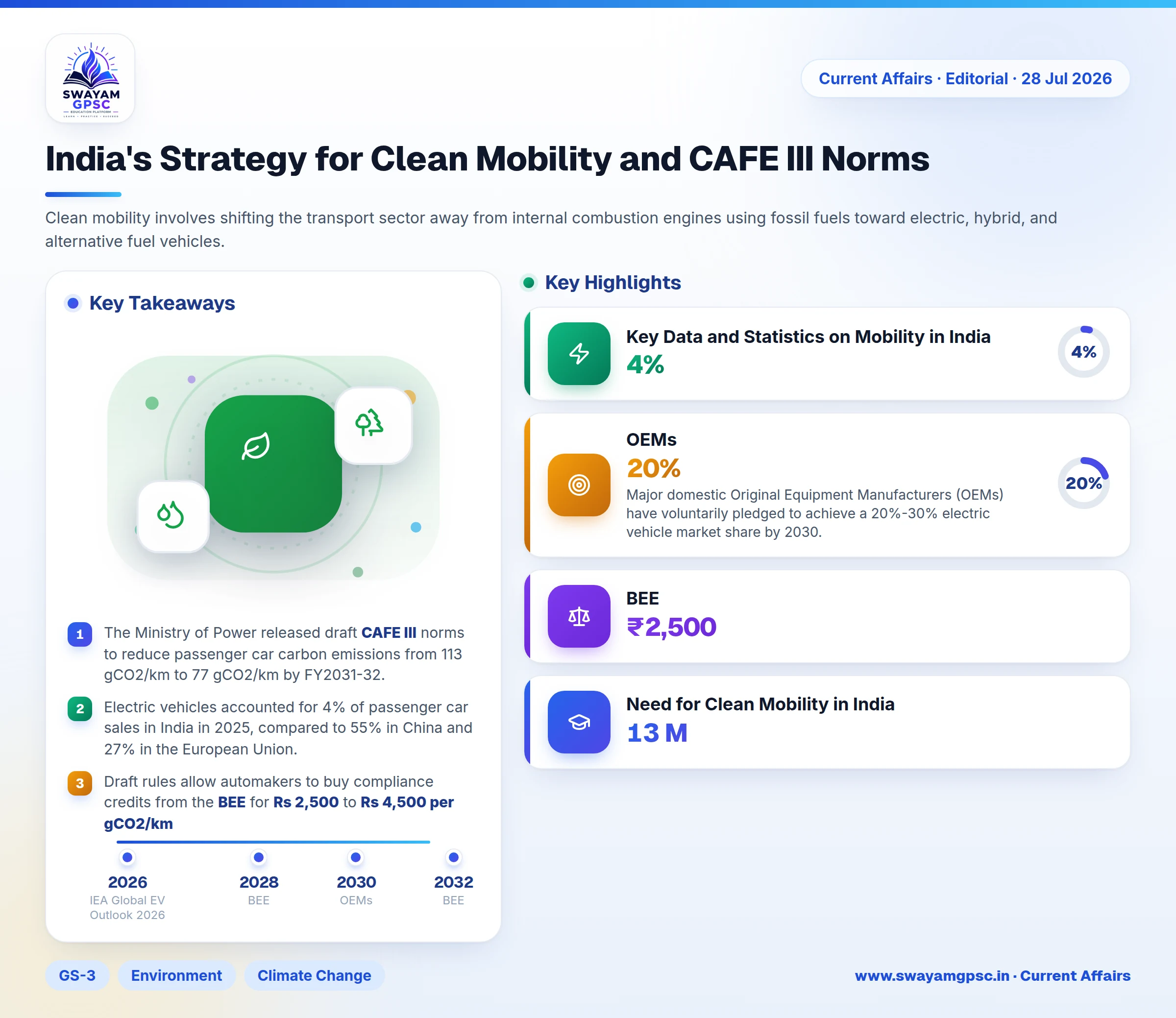
- The proposed **CAFE III** framework aims to reduce fleet-average carbon emissions from about **113 gCO2/km** to **77 gCO2/km** by **FY2031-32**.
- According to the **IEA Global EV Outlook 2026**, electric vehicles made up roughly **4%** of new passenger car sales in India in **2025**, compared to **55%** in China, **27%** in the European Union, and **10%** in the United States.
- Major domestic Original Equipment Manufacturers (**OEMs**) have voluntarily pledged to achieve a **20%-30%** electric vehicle market share by **2030**.
- Under the draft rules, automakers facing credit deficits can buy compliance credits from the **BEE** starting at **Rs 2,500 per gCO2/km** in **FY2028** and rising to **Rs 4,500** by **FY2032**, which is lower than the statutory penalty of **Rs 5,000 per gCO2/km** under the **Energy Conservation Act**.
Need for Clean Mobility in India
- Cutting crude oil imports protects India's economy from international fuel price shocks and conflict in West Asia, such as recent maritime blockades that drove up local fuel prices.
- Reducing transport emissions controls severe urban air pollution because motor vehicles are primary sources of **PM2.5** and greenhouse gases, especially in northern cities during winter.
- Building strong domestic supply chains for electric vehicles helps Indian automakers stay competitive globally, following China's example of exporting over **13 million** electric vehicles in **2025**.
- Lowering transport emissions supports India's **Panchamrit** climate commitments made at **COP26**, helping the nation reach net-zero emissions by **2070**.
Key Government Initiatives
- The government introduced **CAFE-I** in **FY2017-18** and **CAFE-II** in **FY2022-23**, followed by the draft **CAFE-III** notification for **FY2027-32**.
- Central incentive schemes like **FAME** and **PM E-DRIVE** provide subsidies for public charging stations and reduce upfront costs for two-wheelers, three-wheelers, and four-wheelers.
- The government allocated public funds under Production-Linked Incentive (**PLI**) schemes for Auto Components and **Advanced Chemistry Cell (ACC) Battery Storage** to encourage local manufacturing.
- The national Ethanol Blending Programme aims for **E20** (20% ethanol blended with petrol), giving carbon-neutrality credit benefits to flexible-fuel vehicles.
Challenges Associated with the Transition
- Regulatory provisions like **Carbon Neutrality Factors** for E20 fuel, multi-year averaging, and super-credits allow automakers to meet targets without introducing zero-emission vehicles.
- Low credit buyout prices between **Rs 2,500** and **Rs 4,500 per gCO2/km** make it cheaper for automakers to purchase credits from the **BEE** rather than investing in cleaner technologies.
- Blending **20%** ethanol (**E20**) lowers fuel efficiency because ethanol contains less energy per liter than petrol, increasing costs for drivers without lowering fuel prices.
- Unlike China's **Dual Credit System**, India lacks separate penalties for zero-emission vehicles, allowing carmakers to offset zero EV sales by selling high numbers of fuel-efficient petrol or CNG cars.
Way Forward
- India should establish a dual-credit policy modeled on China by separating corporate fuel consumption rules from mandatory New Energy Vehicle (**NEV**) production targets.
- Authorities should increase **BEE** credit buyout prices above the **Energy Conservation Act** penalty threshold of **Rs 5,000 per gCO2/km** to prevent easy compliance buyouts.
- Regulators need to reduce super-credit multipliers for hybrid cars and link ethanol incentives directly to measured emission reductions.
- India should transition emission testing from the Modified Indian Driving Cycle (**MIDC**) to the Worldwide Harmonised Light Vehicles Test Procedure (**WLTP**) for realistic measurement.
Conclusion
- The draft **CAFE III** norms provide an opportunity to modernize India's auto market and enhance national energy security.
- Closing loopholes like cheap credit buyouts and excessive incentives for hybrid vehicles is essential to build a competitive and sustainable zero-emission auto industry.