India's Strategic Role in the WHO Global Pandemic Agreement
#GS-2 #Governance & Social Justice #Current Events #Health #International #Global Pandemic Agreement #World Health Organization #PABS System
Key takeaways
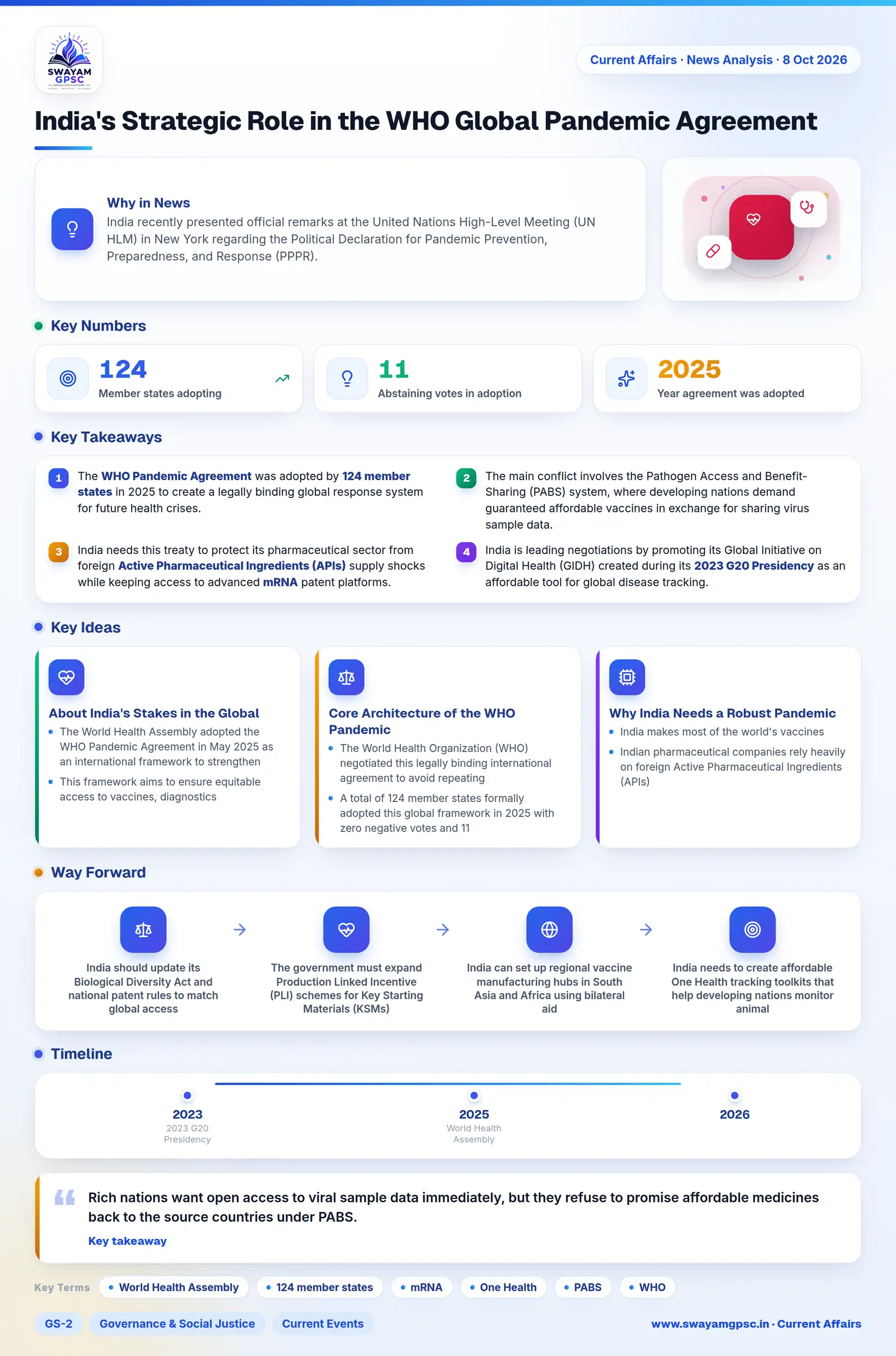
- The WHO Pandemic Agreement was adopted by 124 member states in 2025 to create a legally binding global response system for future health crises.
- The main conflict involves the Pathogen Access and Benefit-Sharing (PABS) system, where developing nations demand guaranteed affordable vaccines in exchange for sharing virus sample data.
- India needs this treaty to protect its pharmaceutical sector from foreign Active Pharmaceutical Ingredients (APIs) supply shocks while keeping access to advanced mRNA patent platforms.
- India is leading negotiations by promoting its Global Initiative on Digital Health (GIDH) created during its 2023 G20 Presidency as an affordable tool for global disease tracking.
Why in News
- India recently presented official remarks at the United Nations High-Level Meeting (UN HLM) in New York regarding the Political Declaration for Pandemic Prevention, Preparedness, and Response (PPPR).
- These official remarks strongly supported and reinforced the World Health Organization (WHO) led Global Pandemic Agreement.
About India's Stakes in the Global Pandemic Agreement
- The World Health Assembly adopted the WHO Pandemic Agreement in May 2025 as an international framework to strengthen global pandemic prevention, preparedness, and response.
- This framework aims to ensure equitable access to vaccines, diagnostics, and medical treatments while improving disease surveillance and health system resilience.
Core Architecture of the WHO Pandemic Agreement
- The World Health Organization (WHO) negotiated this legally binding international agreement to avoid repeating the severe vaccine shortages and distribution unfairness seen during COVID-19.
- A total of 124 member states formally adopted this global framework in 2025 with zero negative votes and 11 abstentions.
- The Pathogen Access and Benefit-Sharing (PABS) system is a critical remaining annex that requires countries sharing pathogen data to receive guaranteed and affordable medical countermeasures.
- A major global disagreement pits High-Income Countries against Low- and Middle-Income Countries regarding forced technology transfers and mandatory intellectual property waivers.
Why India Needs a Robust Pandemic Treaty
- India makes most of the world's vaccines, but Western pharmaceutical companies still own the patents for advanced mRNA technologies.
- Indian pharmaceutical companies rely heavily on foreign Active Pharmaceutical Ingredients (APIs), leaving local manufacturing vulnerable to international supply disruptions.
- India can use its successful domestic digital health tools and laboratory networks as Digital Public Infrastructure (DPI) to build stronger diplomatic ties across the Global South.
- A balanced treaty protects national sovereignty so that international One Health surveillance rules do not place heavy regulatory burdens on local farmers and health systems.
Major Challenges in Global Health Governance
- Rich nations want open access to viral sample data immediately, but they refuse to promise affordable medicines back to the source countries under PABS.
- High-Income Countries want voluntary patent licensing agreements, while developing nations demand mandatory technology transfers during health emergencies.
- Global monitoring rules for human and animal health create expensive infrastructure demands that developing countries cannot afford without external funding.
- Some developed nations reject international oversight because they fear WHO emergency declarations will override their domestic policy decisions.
India's Strategic Position and Leadership
- India defended two main principles at the UN HLM: guaranteed access to emergency medical supplies and complete respect for national policy independence.
- India uses its Global Initiative on Digital Health (GIDH) platform from its 2023 G20 Presidency to provide affordable disease tracking systems globally.
- India builds consensus between rich donor nations and developing countries through international coalitions like the 2026 Partners for Multilateralism group.
- India uses global platforms like the UK-led H20 summit to keep equity for developing nations at the center of future health policy plans.
Way Forward
- India should update its Biological Diversity Act and national patent rules to match global access and benefit-sharing standards under the Nagoya Protocol.
- The government must expand Production Linked Incentive (PLI) schemes for Key Starting Materials (KSMs) to reduce import dependence for local vaccine makers.
- India can set up regional vaccine manufacturing hubs in South Asia and Africa using bilateral aid and technical assistance.
- India needs to create affordable One Health tracking toolkits that help developing nations monitor animal diseases without harming local livestock farming.
Conclusion
- India is uniquely qualified to connect developed and developing nations because it is both a major medicine exporter and a leading voice for the Global South.
- By promoting a fair pathogen-sharing system, India can protect its pharmaceutical supply chains while helping build a safer global health system.