India's Strategic Leap in Research, Innovation, and R&D
#GS-3 #Science & Technology #Economy #Current Events #Research and Development #ANRF #Innovation
Why in News
- The Chief Executive Officer of ANRF and the Chief Economic Adviser highlighted that recent disruptions in global supply chains offer India a valuable chance to rebuild its research network.
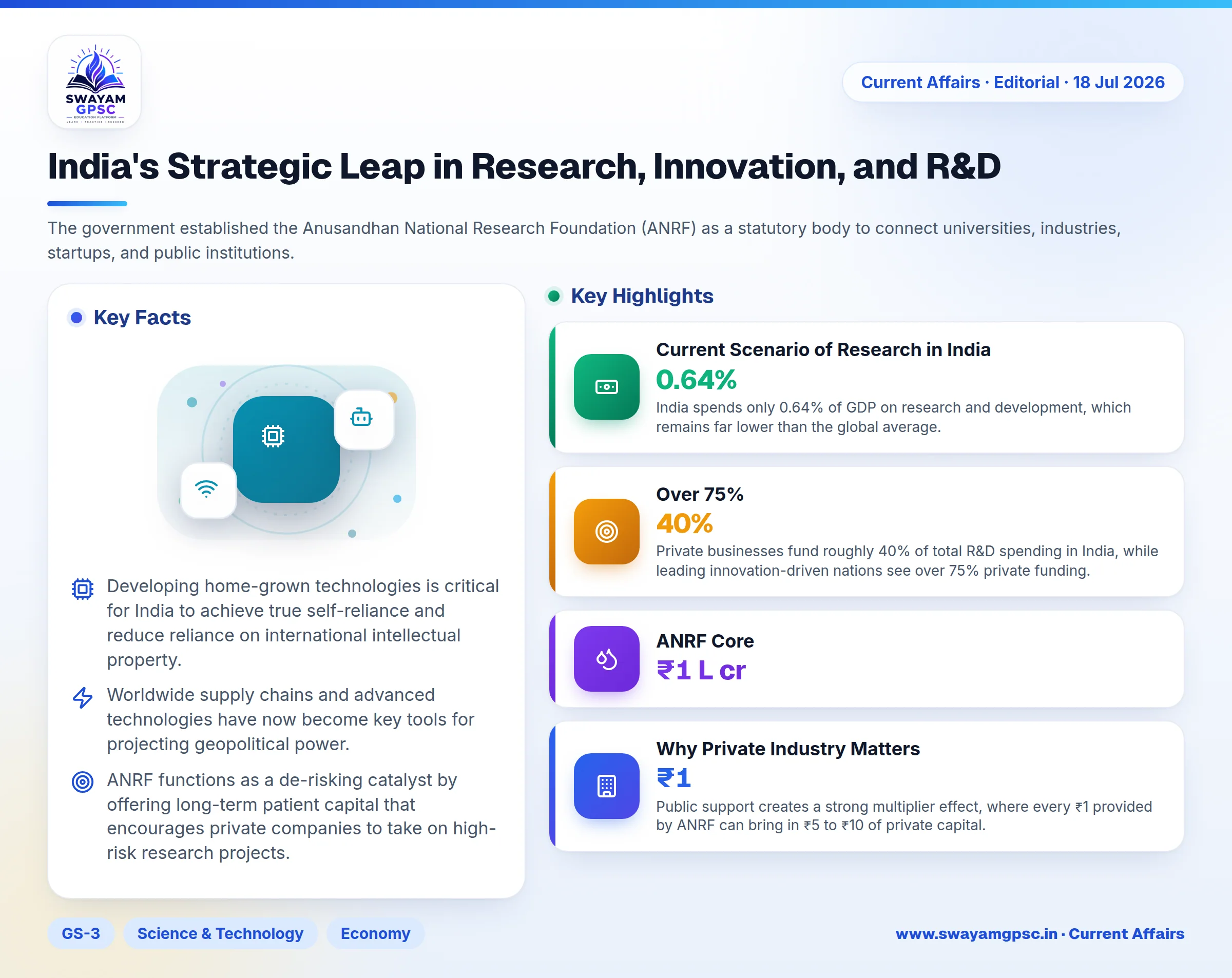
- Developing home-grown technologies is critical for India to achieve true self-reliance and reduce reliance on international intellectual property.
- Worldwide supply chains and advanced technologies have now become key tools for projecting geopolitical power.
Current Scenario of Research in India
- India spends only 0.64% of GDP on research and development, which remains far lower than the global average.
- Private businesses fund roughly 40% of total R&D spending in India, while leading innovation-driven nations see over 75% private funding.
- The government established the Anusandhan National Research Foundation (ANRF) as a statutory body to connect universities, industries, startups, and public institutions.
- The foundation provides ₹1 lakh crore through the Research, Development and Innovation (RDI) Fund for corporate research and ₹50,000 crore through ANRF Core for fundamental science.
Why Private Industry Matters
- ANRF functions as a de-risking catalyst by offering long-term patient capital that encourages private companies to take on high-risk research projects.
- Public support creates a strong multiplier effect, where every ₹1 provided by ANRF can bring in ₹5 to ₹10 of private capital.
- Private enterprises have the manufacturing strength and market channels needed to convert raw laboratory prototypes into commercial products.
- Businesses can participate through direct co-investment, joint ventures with deep-tech startups, national innovation programs, or CSR allocations to the ANRF fund.
Lessons from India's Pharmaceutical Sector
- When India joined the World Trade Organization (WTO) in the mid-1990s and agreed to product patent rules, analysts feared local drug makers would collapse under foreign competition.
- Indian pharmaceutical firms adapted by mastering advanced process chemistry and satisfying strict international regulatory guidelines.
- This transformation turned India into the pharmacy of the world, proving that tough international standards can spark major domestic growth.
Opportunities for India
- Expanding advanced research programs creates high-level domestic jobs, helping stop the brain drain of highly trained doctoral scholars.
- Shifts toward a multi-polar world encourage global firms to seek dependable alternatives to single country suppliers, creating new export markets for Indian tech.
- India can build advanced automated services and specialized software by leveraging its established digital public infrastructure.
- The wide presence of foreign Global Capability Centres (GCCs) inside India offers a ready platform for joint research programs.
Challenges in the Innovation Ecosystem
- Protected domestic market conditions historically led local firms to focus on minor operational upgrades rather than breakthrough high-risk research.
- Competing economies spend massive funds on research, such as China allocating 2.43% of GDP to R&D with 75% funded directly by its firms.
- Pressure to show quarterly earnings leads corporate leaders to cut back on long-term laboratory spending.
- Government procurement practices traditionally favored the lowest-cost bidder under L1 frameworks instead of evaluating technical quality and innovation.
Way Forward
- The government must speed up the release of funding from the ₹1 lakh crore ANRF pool to support ambitious private research projects.
- Private businesses should establish independent research divisions shielded from short-term financial pressure.
- Public procurement guidelines need reforms to favor locally registered patents and create a reliable domestic market for innovation.
- Universities, startups, and private corporations must align behind multi-year national targets like energy storage systems and domestic semiconductor design.
Conclusion
- The government has laid a strong foundation by creating the ANRF and committing substantial financial backing.
- Private enterprise must now match this public effort with its own investments to transform India from an importer of foreign technology into a global innovation leader.