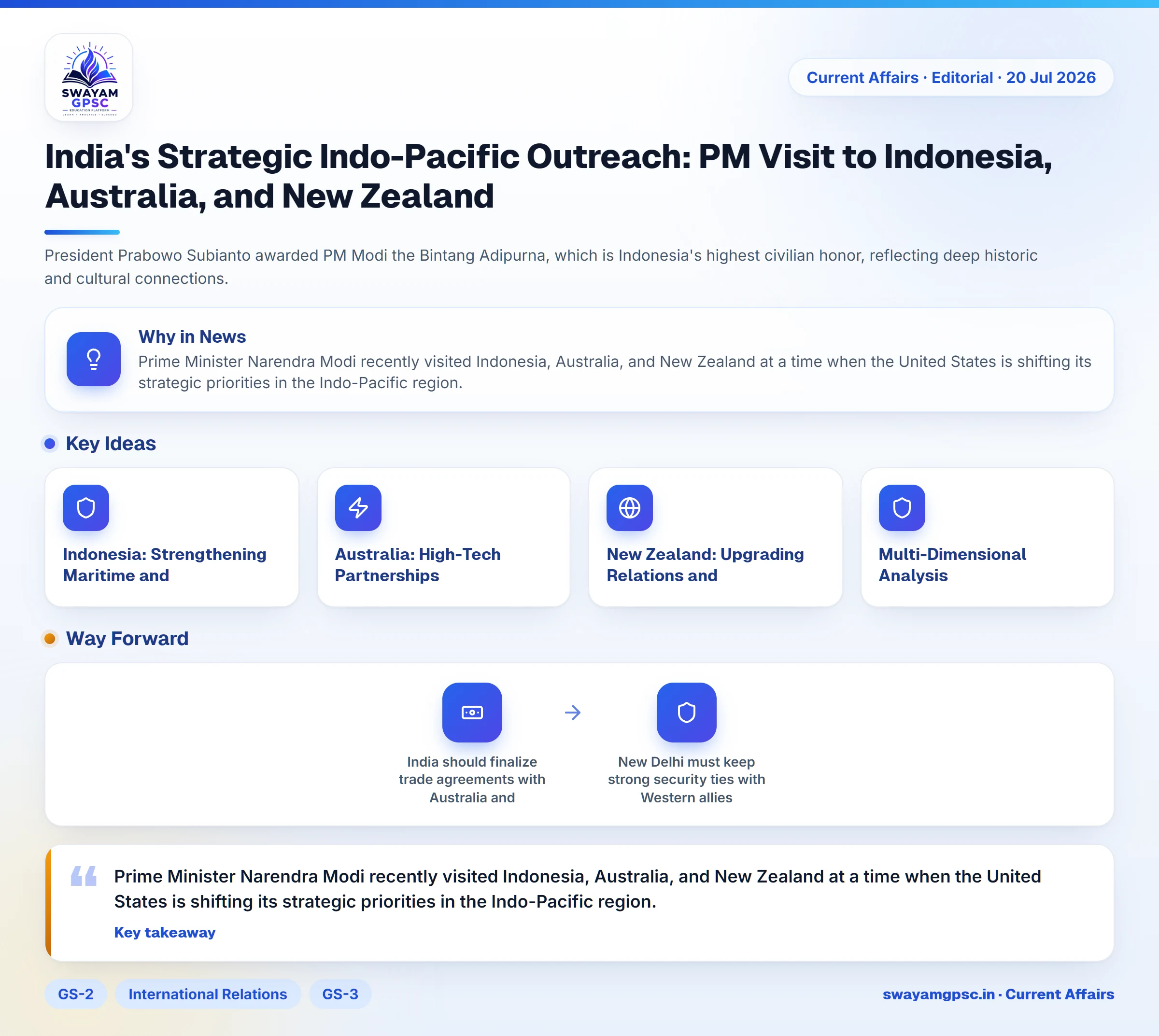
India's Strategic Indo-Pacific Outreach: PM Visit to Indonesia, Australia, and New Zealand
#GS-2 #International Relations #GS-3 #Economy #Current Events #National #Indo-Pacific
Why in News
- Prime Minister Narendra Modi recently visited Indonesia, Australia, and New Zealand at a time when the United States is shifting its strategic priorities in the Indo-Pacific region.
- This diplomatic trip highlights India's transition from a regional balancing force to an active security provider under its “Act East” Policy and MAHASAGAR Vision.
- The visit reinforces India's focus on building multi-layered bilateral partnerships to maintain regional autonomy and ensure an open, rules-based Indo-Pacific.
- India's strategy promotes multi-alignment by forging defense, nuclear, and critical mineral ties with key regional partners to protect vital sea routes and prevent regional dominance.
Indonesia: Strengthening Maritime and Defense Axis
- President Prabowo Subianto awarded PM Modi the Bintang Adipurna, which is Indonesia's highest civilian honor, reflecting deep historic and cultural connections.
- India signed major deals to export BrahMos supersonic cruise missiles and Astra beyond-visual-range missiles, marking its shift from a defense importer to a strategic defense exporter.
- The joint development of Sabang Port near the Strait of Malacca, linked with infrastructure on India's Andaman and Nicobar Islands, gives New Delhi key maritime monitoring capabilities to balance China's naval presence.
- Both nations launched a joint restoration project for the historic Prambanan Temple complex in Yogyakarta to highlight shared Hindu-Buddhist heritage.
Australia: High-Tech Partnerships, Nuclear Energy, and Space
- Australia changed its long-standing policy regarding non-NPT nations and agreed to supply uranium for India's civilian nuclear energy facilities.
- Both nations created partnerships to secure supply chains for critical minerals like lithium, cobalt, and nickel, which are essential for India's electric vehicles, semiconductors, and defense manufacturing.
- Australia agreed to support India's Gaganyaan human spaceflight mission through ground-telemetry tracking facilities located in the Cocos (Keeling) Islands under their Comprehensive Strategic Partnership (CSP).
- Negotiations for a full Free Trade Agreement are building upon the existing Economic Cooperation and Trade Agreement (ECTA) to reduce trade dependency on China.
New Zealand: Upgrading Relations and Diaspora Engagement
- This visit marked the first state visit by an Indian Prime Minister to New Zealand in 40 years, upgrading bilateral relations to a Strategic Partnership.
- Both countries adopted the “India-New Zealand Strategic Partnership: Roadmap to 2030” to double bilateral trade by 2030 through agri-tech, education, and digital innovation.
- New Zealand joined the maritime security pillar of the Indo-Pacific Oceans Initiative (IPOI) to combat illegal fishing and signed an agreement on hydrographic cooperation.
- PM Modi connected with New Zealand's 240,000 strong Indian diaspora to enhance tourism, technology sharing, and higher education links.
Multi-Dimensional Analysis
- Strategic Aspect: India follows a flexible multi-alignment policy, building issue-based security ties with Western partners while keeping strong connections with non-aligned Southeast Asian nations.
- Resource and Energy Aspect: The Australian uranium agreement helps India reach its target of getting 50% of its energy from non-fossil sources by 2030, while critical minerals protect domestic industries.
- Maritime Aspect: Developing Sabang Port and using telemetry facilities in the Cocos Islands secures key eastern chokepoints in the Indian Ocean, improving overall maritime monitoring.
Challenges
- Execution Delays: India has faced delays in completing foreign infrastructure projects in the past, making the timely development of Sabang Port necessary to offer a reliable alternative to China's Belt and Road Initiative (BRI).
- Economic Dominance: China remains the largest trading partner for Indonesia, Australia, and New Zealand, making it challenging for India to balance regional trade influence.
- Trade Negotiation Friction: Balancing domestic agriculture and dairy interests against competitive exports from Australia and New Zealand complicates free trade negotiations.
Way Forward
- India should finalize trade agreements with Australia and New Zealand while expanding domestic capacity to process imported uranium and critical minerals safely.
- New Delhi must keep strong security ties with Western allies without alienating non-aligned partners in ASEAN, supporting a balanced and rules-based Indo-Pacific.
Conclusion
- PM Modi's 2026 Indo-Pacific tour shows the expansion of India's foreign policy from regional focus to a wider oceanic footprint.
- By combining maritime defense, mineral diplomacy, and cultural links, India is helping build an inclusive and cooperative regional order.