India’s Statistical Database Overhaul
#GS-2 #GS-3 #Government Policies & Interventions #Industrial Policy #Industrial Growth #Growth & Development #Economic and Social Development #Economy #Governance & Social Justice #Good Governance #Infrastructure #Poverty
Key takeaways
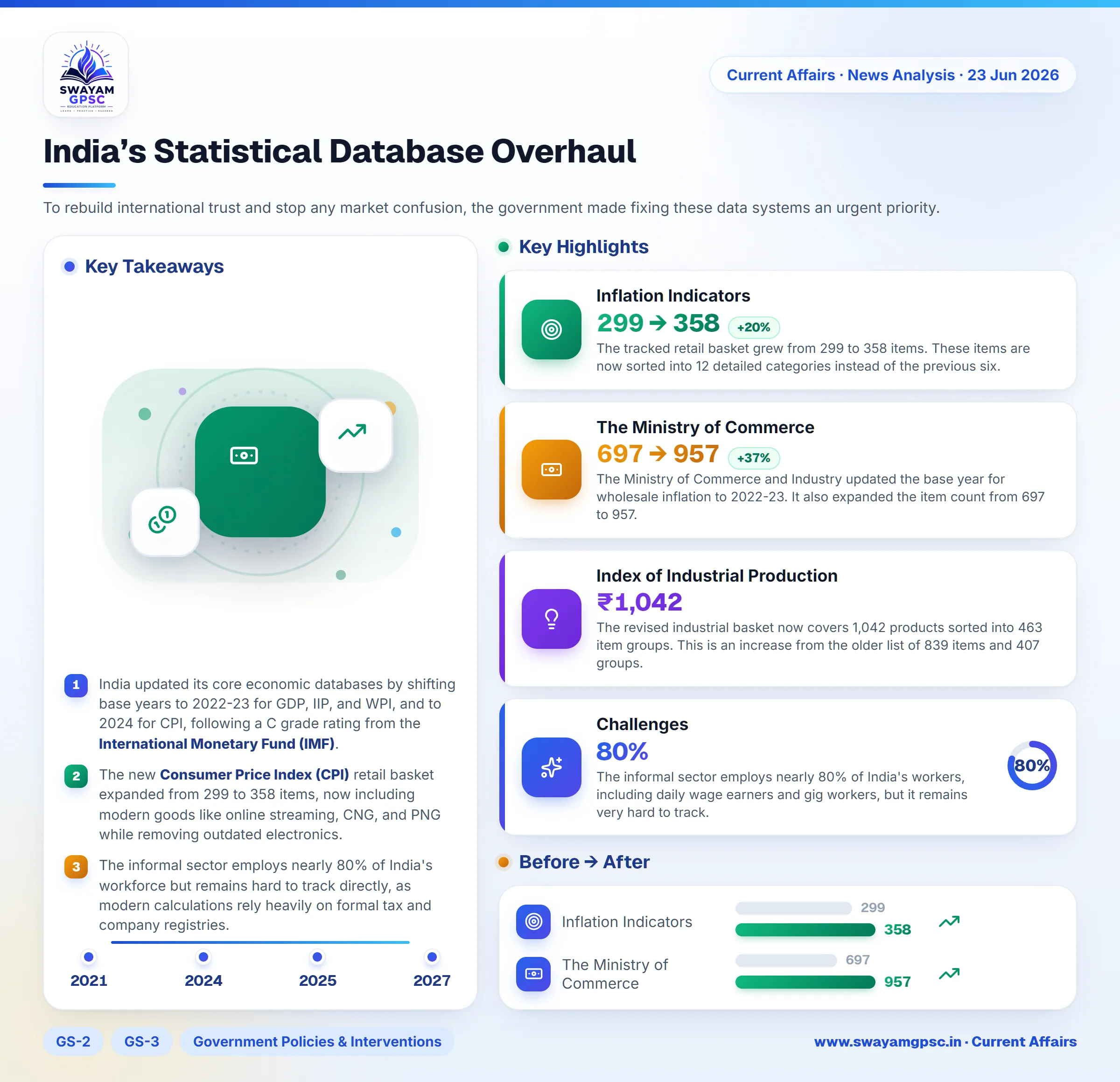
- India updated its core economic databases by shifting base years to 2022-23 for GDP, IIP, and WPI, and to 2024 for CPI, following a C grade rating from the International Monetary Fund (IMF).
- The new Consumer Price Index (CPI) retail basket expanded from 299 to 358 items, now including modern goods like online streaming, CNG, and PNG while removing outdated electronics.
- The informal sector employs nearly 80% of India's workforce but remains hard to track directly, as modern calculations rely heavily on formal tax and company registries.
- Experts recommend granting statutory independence to the National Statistical Commission, matching recommendations from the C. Rangarajan Commission (2000) and the Standing Committee on Finance (2025).
Why in News
- The Indian government has carried out a major upgrade of its main statistical databases. This upgrade aims to make economic data more timely, representative, accurate, and complete.
- These updates affect important macroeconomic figures. They change how India calculates its Gross Domestic Product (GDP), Gross Value Added (GVA), industrial production, and price inflation.
Why Have India’s Statistical Databases Been Upgraded
- The main trigger for these changes was a 'C' grade rating given by the International Monetary Fund (IMF) in late 2025. This rating pointed out flaws in the quality, representativeness, and timeliness of India's national accounts.
- To rebuild international trust and stop any market confusion, the government made fixing these data systems an urgent priority.
- Before these updates, India used the year 2011-12 as the baseline for its economic data.
- Over the last fifteen years, the Indian economy went through massive changes. Events like the rollout of the Goods and Services Tax (GST) and the rise of digital payments made the old 2011-12 weights outdated for measuring modern output.
- Older inflation baskets relied on household spending surveys from nearly a generation ago.
- For example, the old Consumer Price Index (CPI) with a base year of 2012 still tracked items like VCRs and portable radios. At the same time, it ignored modern items like online streaming services, CNG, and high-speed internet data.
- Accurate price indices are necessary to calculate real economic growth properly.
- Real growth is found by removing the effect of inflation from nominal data using the Gross Domestic Product (GDP) Deflator.
- Using outdated inflation baskets distorted this deflation process. As a result, previous calculations of the actual size and growth of the economy might have been wrong.
- Economic data does more than sit in textbooks. It directly guides government tax and monetary decisions.
- For instance, the Reserve Bank of India (RBI) uses the Consumer Price Index (CPI) through its Monetary Policy Committee (MPC) to track retail inflation and set the repo rate.
- Also, government benefits like Dearness Allowance (DA) for current and former employees are legally tied to these inflation indices.
What are the Key Methodological Upgrades to India’s Statistical Databases
- The Ministry of Statistics and Programme Implementation (MoSPI) shifted the base year for national accounts to 2022-23. This change links Gross Domestic Product (GDP) and Gross Value Added (GVA) directly to current economic activity.
- India now uses the double deflator method to estimate real GDP growth in farming and manufacturing.
- This technique adjusts input and output prices separately. It captures the true impact of price changes much better than single deflation methods.
- In the past, a multi-activity business had all its output counted under its main sector. The new system splits and distributes these activities properly across their respective sectors for a clearer picture.
- The updated national accounts now include new large databases. Specifically, they use Goods and Services Tax (GST) records and the Periodic Labour Force Survey (PLFS) to reduce statistical errors.
Index of Industrial Production
- The Ministry of Statistics and Programme Implementation (MoSPI) updated the Index of Industrial Production (IIP) by moving its base year to 2022-23.
- The updated index now covers key utility sectors like gas supply, water supply, sewerage, and waste management.
- The index now separates renewable electricity from non-renewable sources. It also gives clearer details on specific mineral variations.
- The revised industrial basket now covers 1,042 products sorted into 463 item groups. This is an increase from the older list of 839 items and 407 groups.
Inflation Indicators
- The Ministry of Statistics and Programme Implementation (MoSPI) moved the base year for retail inflation to 2024. It based item weights on the Household Consumption Expenditure Survey (HCES) 2023-24.
- The tracked retail basket grew from 299 to 358 items. These items are now sorted into 12 detailed categories instead of the previous six.
- The updated retail index now includes rural house rent, online media streaming, CNG, and PNG for the first time. It also completely removes outdated electronics like tape recorders.
- To connect the old and new retail inflation series, the government uses a linking factor based on 2025 data. This creates a back-series so analysts can study long-term trends without breaking historical comparisons.
- The Ministry of Commerce and Industry updated the base year for wholesale inflation to 2022-23. It also expanded the item count from 697 to 957.
- This update fixed sorting errors by moving crude petroleum and natural gas out of primary articles and into the fuel and power group.
- The Ministry of Commerce and Industry also introduced the Producer Price Index (PPI). This is a standard used in developed economies to track the prices producers pay for inputs and receive for outputs.
- By leaving out volatile transport costs and indirect taxes, the Producer Price Index (PPI) will slowly replace the wholesale price index over the next five years.
Challenges
- The decennial Census, which was due in 2021, has faced major historical delays.
- The Census is the foundation of a nation's data systems. It provides the population numbers used to calculate per-capita figures, poverty lines, and welfare funds.
- Without a fresh Census, planners and researchers must rely on regular sample surveys and population projections based on the 2011 numbers.
- This lack of updated population data creates growing errors when estimating urban migration and rural realities.
- The informal sector employs nearly 80% of India's workers, including daily wage earners and gig workers, but it remains very hard to track.
- The new GDP method relies heavily on formal databases like the Goods and Services Tax (GST) network and company registries.
- As a result, informal sector output is often guessed by looking at formal sector growth. If the formal economy grows while the informal sector struggles, the national GDP looks artificially high and hides grassroots pain.
- A statistical system is only as good as its perceived independence. Critics point to a growing centralization of data control.
- The merger of the Central Statistics Office and the National Sample Survey Office into the National Statistical Office (NSO) in 2019 reduced the power of the National Statistical Commission.
- Recent steps like the draft Indian Statistical Institute Bill 2025 have sparked protests among academics.
- Plans to replace elected councils with a government-named board have raised fears about losing academic freedom and facing political interference in top data bodies.
- India suffers from a serious lack of frequent and universally accepted jobs data.
- While the government uses the Periodic Labour Force Survey (PLFS) and Employees Provident Fund Organisation (EPFO) payroll numbers to show strong job growth, private groups like the Centre for Monitoring Indian Economy often report much higher unemployment.
- India has not officially updated its national poverty line since the Tendulkar Committee used 2011-12 data. This leaves a gap in measuring how well modern welfare schemes and post-pandemic recoveries are working.
- National totals often hide deep regional differences. While national GDP and retail inflation numbers are easy to find, local district or block-level economic data is very scarce.
- Good local governance needs local numbers. Without data broken down by district, gender, and caste, state programs remain blunt tools rather than targeted solutions.
Way Forward
- Census 2027 will be India's first digital census, using mobile apps and optional self-counting. To make it work, strong safeguards like door-to-door checks, offline options, and good training are needed.
- Adding caste counting to the census will change welfare planning. It will provide exact data to replace the outdated Socio-Economic and Caste Census and allow for better targeted affirmative action.
- The National Statistical Commission currently relies on executive orders. It must be given constitutional independence, much like the Comptroller and Auditor General of India.
- This independence would let the commission audit data freely, set release dates, and protect federal numbers from political interference, matching ideas from the C. Rangarajan Commission (2000) and the Standing Committee on Finance (2025).
- The Ministry of Statistics and Programme Implementation (MoSPI) must standardize and push for District Domestic Project (DDP) estimates across all states.
- Linking district estimates with local surveys under the Periodic Labour Force Survey (PLFS) will give local bodies real-time data to plan better and use resources wisely.
- The central government's Support for Statistical Strengthening (SSS) scheme must grow to help states use modern tools like artificial intelligence, tablet-based surveys, and real-time validation software.
- Institutions like the Indian Statistical Institute must keep their elected, academic-led management models.
- Keeping top data bodies safe from bureaucratic control is necessary to support high-level research and innovation.
- Portals like e-Sankhyiki are helpful, but India must build an open-data system. Anonymized microdata from all government surveys should be free for researchers and economists without paywalls.