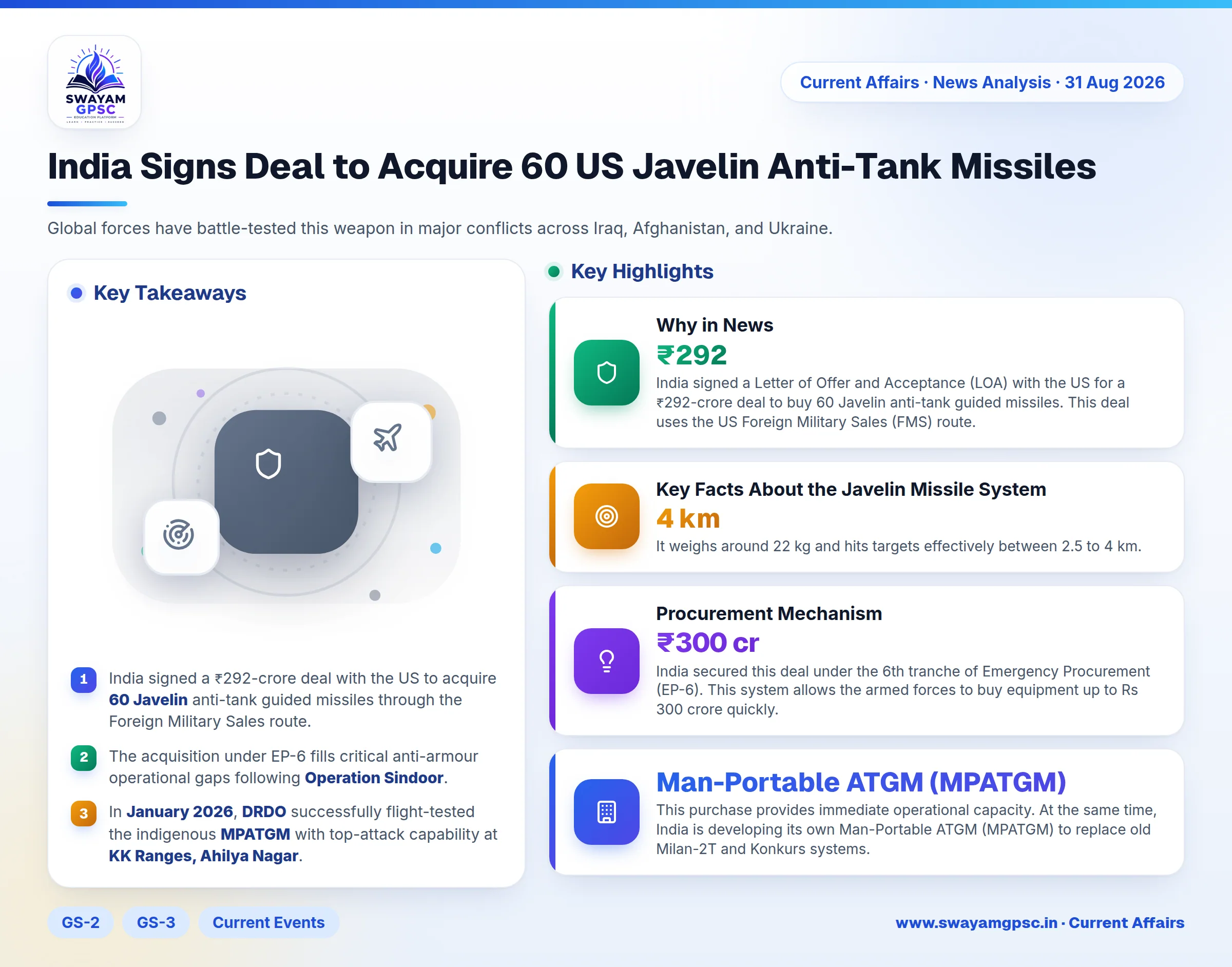
India Signs Deal to Acquire 60 US Javelin Anti-Tank Missiles
#GS-2 #GS-3 #Current Events #National #International Relations #Defence #Science & Technology
Key takeaways
- India signed a ₹292-crore deal with the US to acquire 60 Javelin anti-tank guided missiles through the Foreign Military Sales route.
- The acquisition under EP-6 fills critical anti-armour operational gaps following Operation Sindoor.
- In January 2026, DRDO successfully flight-tested the indigenous MPATGM with top-attack capability at KK Ranges, Ahilya Nagar.
Why in News
- India signed a Letter of Offer and Acceptance (LOA) with the US for a ₹292-crore deal to buy 60 Javelin anti-tank guided missiles. This deal uses the US Foreign Military Sales (FMS) route.
- This purchase provides immediate operational capacity. At the same time, India is developing its own Man-Portable ATGM (MPATGM) to replace old Milan-2T and Konkurs systems.
Key Facts About the Javelin Missile System
- The Javelin is a shoulder-fired, medium-range anti-tank missile made for infantry soldiers on foot.
- It uses fire-and-forget technology with an imaging-infrared seeker. Soldiers can leave the site immediately after firing to avoid enemy counter-fire.
- The missile features a soft launch mechanism that clears the launcher before ignition. This allows troops to fire safely from enclosed spaces like bunkers.
- It weighs around 22 kg and hits targets effectively between 2.5 to 4 km.
- Global forces have battle-tested this weapon in major conflicts across Iraq, Afghanistan, and Ukraine.
- The Javelin Joint Venture, formed by US defence companies Lockheed Martin and RTX, manufactures the weapon.
- This deal strengthens the U.S.-India Major Defence Partnership and creates opportunities for future co-production.
Procurement Mechanism
- India secured this deal under the 6th tranche of Emergency Procurement (EP-6). This system allows the armed forces to buy equipment up to Rs 300 crore quickly.
- The military expects deliveries of the missiles by the end of fiscal year 2026-27.
- The purchase aims to fill operational gaps in anti-armour capabilities along forward borders after Operation Sindoor.
Man-Portable ATGM (MPATGM)
- DRDO is creating the indigenous MPATGM to replace the army's older Milan-2T and Konkurs missiles. India also bought Spike-LR missiles in 2019 for emergency needs.
- In January 2026, DRDO tested the third-generation MPATGM with top-attack capability against a moving target at KK Ranges, Ahilya Nagar, Maharashtra.
- The missile uses local technologies like an Imaging Infrared (IIR) seeker, electric control systems, and a tandem warhead.
- Soldiers can fire it from a tripod or a vehicle. Its seeker works day and night to destroy modern main battle tanks.
- Bharat Dynamics Limited (BDL) and Bharat Electronics Limited (BEL) serve as production partners to help induct the system into the army.