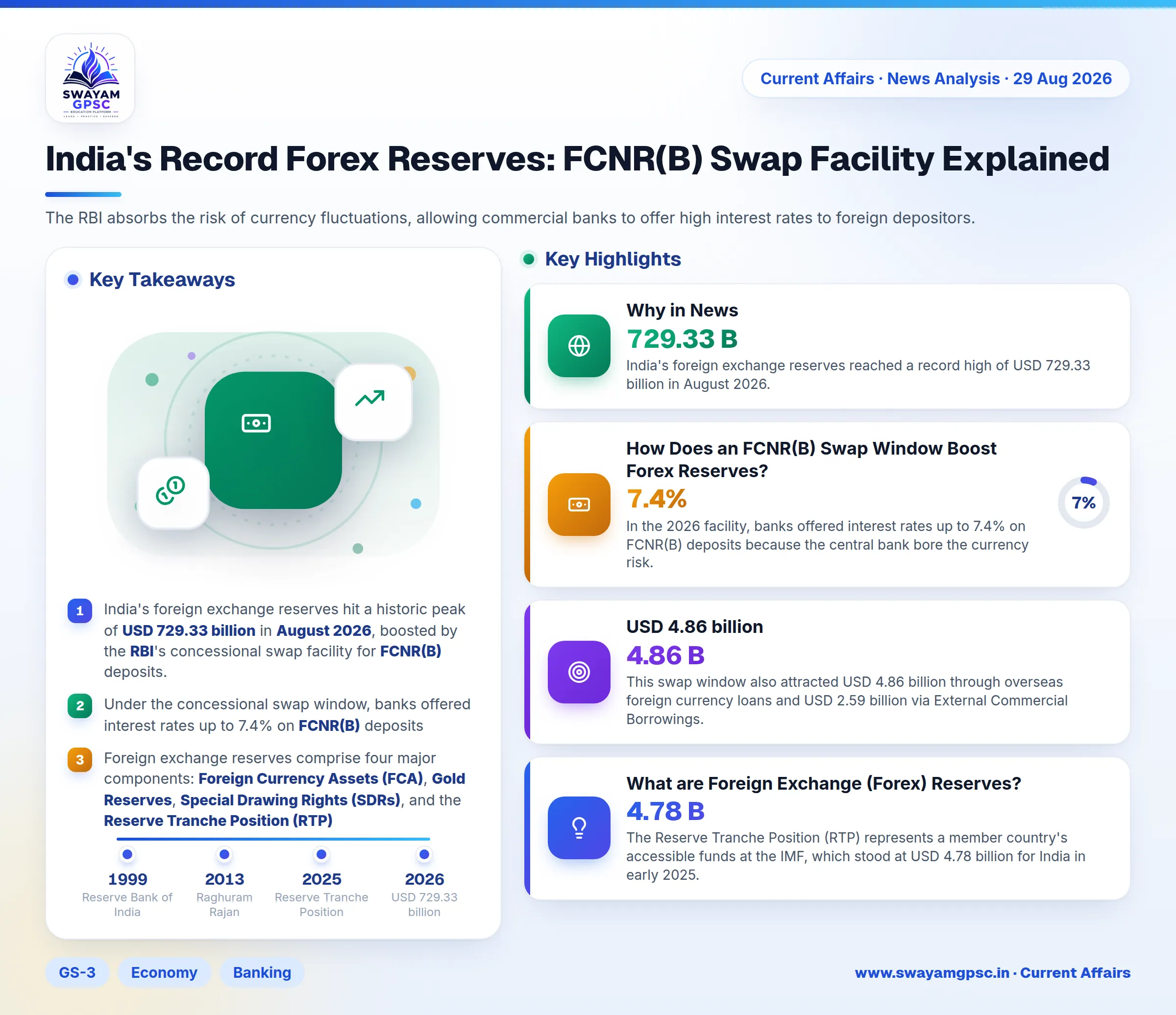
India's Record Forex Reserves: FCNR(B) Swap Facility Explained
#GS-3 #Economy #Banking #Monetary Policy #Foreign Exchange Reserves
Key takeaways
- India's foreign exchange reserves hit a historic peak of USD 729.33 billion in August 2026, boosted by the RBI's concessional swap facility for FCNR(B) deposits.
- Under the concessional swap window, banks offered interest rates up to 7.4% on FCNR(B) deposits, while raising USD 4.86 billion through overseas foreign currency borrowings and USD 2.59 billion via External Commercial Borrowings.
- Foreign exchange reserves comprise four major components: Foreign Currency Assets (FCA), Gold Reserves, Special Drawing Rights (SDRs), and the Reserve Tranche Position (RTP), with India's RTP standing at USD 4.78 billion.
- The Reserve Bank of India (RBI) manages India's forex reserves under the Reserve Bank of India Act, 1934 and the Foreign Exchange Management Act, 1999, prioritising safety, liquidity, and return.
Why in News
- India's foreign exchange reserves reached a record high of USD 729.33 billion in August 2026.
- This sharp rise came after the Reserve Bank of India (RBI) introduced a special swap window for FCNR(B) deposits.
- This large cushion of foreign money helps the central bank keep the Indian rupee stable during global tensions and capital outflows.
How Does an FCNR(B) Swap Window Boost Forex Reserves?
- A concessional swap window is a special financial tool where the central bank swaps USD for INR with commercial banks at forward rates far cheaper than market rates.
- Its main goal is to attract large foreign currency deposits through FCNR(B) accounts and External Commercial Borrowings, raising forex reserves without reducing dollar availability in the regular spot market.
- When the domestic currency faces extreme pressure, the RBI opens this swap window so banks can bring foreign currency from non-resident Indians and exchange those dollars for rupees with the central bank.
- The RBI absorbs the risk of currency fluctuations, allowing commercial banks to offer high interest rates to foreign depositors.
- The incoming dollars flow directly into the central bank's foreign currency assets, increasing total reserves without needing direct market intervention.
- Former governor Raghuram Rajan successfully used this same mechanism during the 2013 Taper Tantrum to pull in foreign currency and stabilize the rupee.
- In the 2026 facility, banks offered interest rates up to 7.4% on FCNR(B) deposits because the central bank bore the currency risk.
- This swap window also attracted USD 4.86 billion through overseas foreign currency loans and USD 2.59 billion via External Commercial Borrowings.
- Tax concessions on government bonds and higher market values of gold further boosted reserves to the record USD 729.33 billion level.
Role of Forex Reserves in Defending the Rupee
- Reserves act as a vital safety net against wild exchange rate movements, allowing the RBI to sell dollars during sharp drops to maintain market balance and financial stability.
- Even with record reserves, foreign portfolio capital outflows, elevated global interest rates, and high crude oil prices kept constant pressure on the Indian rupee.
- Conflict in West Asia disrupted global oil supplies and pushed energy costs up, increasing dollar demand and fueling local inflation due to India's high oil import dependence.
FCNR(B) Account Structure
- An FCNR(B) account is a fixed deposit facility available in India for non-resident Indians and persons of Indian origin.
- Unlike regular rupee accounts like NRE or NRO, depositors hold FCNR(B) funds in convertible foreign currencies such as USD, GBP, EUR, or JPY.
- Depositors face zero exchange rate risk because saving in foreign currency shields their money from any fall in the Indian rupee value.
- Depositors can freely send both principal and interest earnings back to their home country, while India exempts all interest earned on these accounts from income tax.
What are Foreign Exchange (Forex) Reserves?
- Foreign exchange reserves are international assets held by a central bank in foreign currencies to act as a cushion against economic shocks and guarantee debt payments.
- Foreign Currency Assets (FCA) form the largest part of India's reserves, containing currencies like USD, EUR, GBP, and JPY invested in foreign government bonds.
- The central bank maintains physical and digital Gold Reserves as a dependable safe-haven asset during global financial instability.
- Special Drawing Rights (SDRs) act as an international reserve asset created by the IMF to support the official reserves of member nations.
- The Reserve Tranche Position (RTP) represents a member country's accessible funds at the IMF, which stood at USD 4.78 billion for India in early 2025.
- The Reserve Bank of India (RBI) controls and manages these reserves under the Reserve Bank of India Act, 1934 and the Foreign Exchange Management Act, 1999.
- When investing reserve assets, the RBI strictly follows three core principles: safety first, liquidity second, and return third.
- Strong forex reserves ensure that India can pay for essential imports like crude oil, electronics, and gold during global market disruptions.
- When the rupee experiences sudden drops, the RBI sells dollars from its holdings to supply the market and stabilize the currency value.
- High reserve levels boost confidence among Foreign Direct Investment (FDI) and Foreign Portfolio Investment (FPI) investors regarding India's debt management ability.
- Adequate foreign reserves guarantee that both the government and private companies repay their foreign currency loans on schedule.