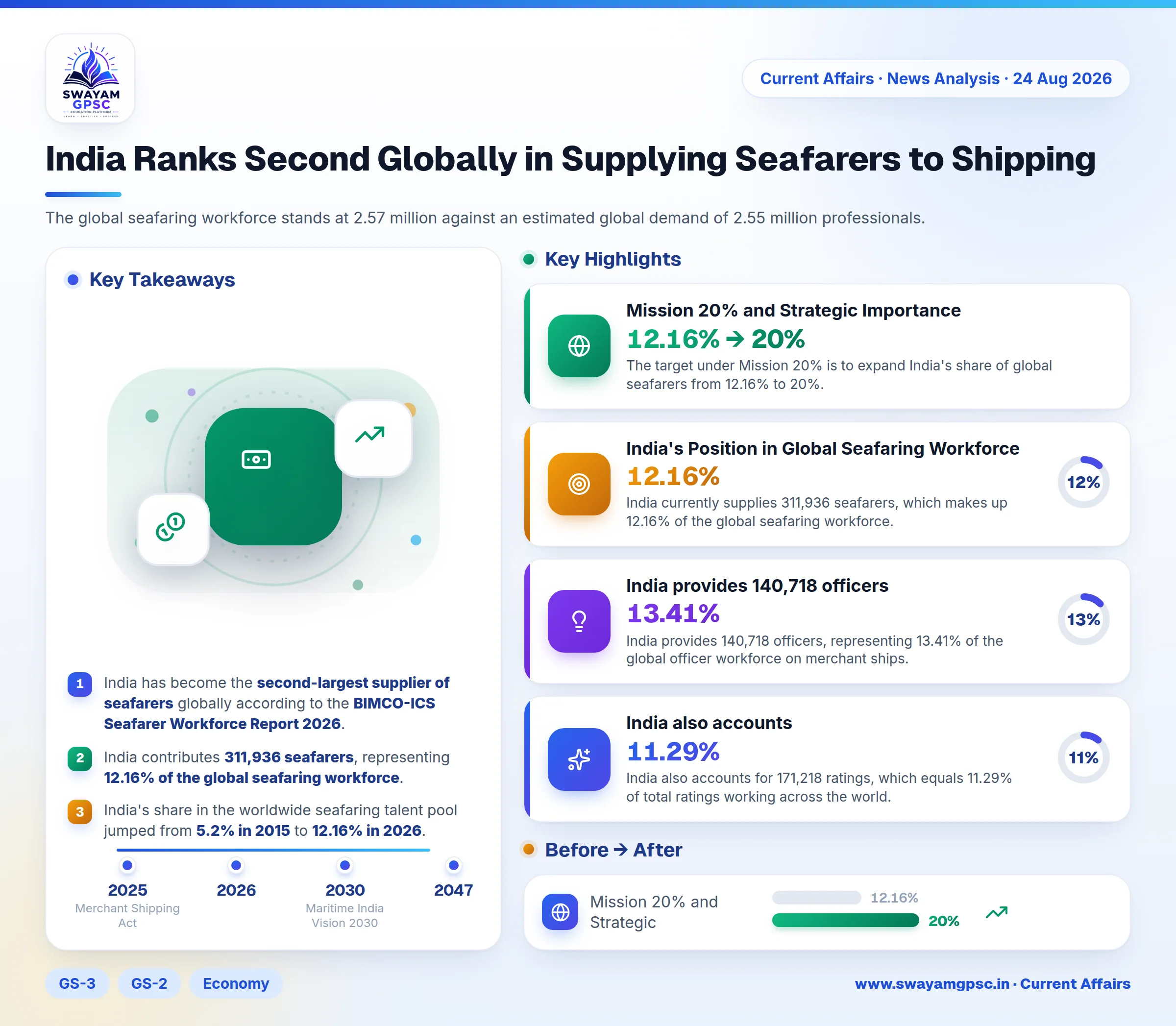
India Ranks Second Globally in Supplying Seafarers to Shipping
#GS-3 #GS-2 #Economy #Infrastructure #Employment #Current Events #National #Maritime Sector
Key takeaways
- India has become the second-largest supplier of seafarers globally according to the BIMCO-ICS Seafarer Workforce Report 2026.
- India contributes 311,936 seafarers, representing 12.16% of the global seafaring workforce.
- India's share in the worldwide seafaring talent pool jumped from 5.2% in 2015 to 12.16% in 2026.
- The government targets a 20% global share under Mission 20%, aiming to ensure that one in five seafarers globally is an Indian.
Why in News
- According to the BIMCO-ICS Seafarer Workforce Report 2026, India is now the second-largest supplier of seafarers globally.
- This achievement marks a significant strategic milestone for the growth and development of India's maritime sector.
India's Position in Global Seafaring Workforce
- India currently supplies 311,936 seafarers, which makes up 12.16% of the global seafaring workforce.
- Among all countries, the Philippines continues to hold the first position as the world's top supplier of maritime personnel.
- India provides 140,718 officers, representing 13.41% of the global officer workforce on merchant ships.
- India also accounts for 171,218 ratings, which equals 11.29% of total ratings working across the world.
- The global seafaring workforce stands at 2.57 million against an estimated global demand of 2.55 million professionals.
- Even with this overall numeric balance, the global shipping industry faces an acute shortage of qualified officers.
- India's share in the global workforce grew from 5.2% in 2015 and 6% in 2021 to 12.16% in 2026.
- Due to this rapid growth, India jumped from the fifth-largest supplier to the second-largest supplier worldwide.
Key Drivers Behind the Growth
- India expanded its maritime training institutes and updated their curriculum to match international standards.
- Modernizing training infrastructure and enhancing skill development helped boost the global employability of Indian seafarers.
- The Directorate General of Shipping (DGS) digitized its certification processes and regulatory services to increase transparency.
- Strict compliance with the STCW Convention of the International Maritime Organization improved international recognition for Indian professionals.
Recent Maritime Legislative Reforms
- The government introduced the Inland Vessels Act, 2021 to update legal frameworks for inland water transport.
- The newly enacted Merchant Shipping Act, 2025 simplifies regulations and improves overall maritime governance.
- The Indian Ports Act, 2025 aims to modernize port management and streamline port operations across the nation.
- Laws like the Coastal Shipping Act, 2025, Bills of Lading Act, 2025, and Carriage of Goods by Sea Act, 2025 align Indian legislation with global conventions while strengthening seafarer welfare.
Mission 20% and Strategic Importance
- The target under Mission 20% is to expand India's share of global seafarers from 12.16% to 20%.
- This mission aims to ensure that one out of every five seafarers serving worldwide is Indian.
- Developing a skilled workforce establishes India as a major global maritime talent hub.
- This growth strengthens India's participation in global supply chains and international trade networks.
- It directly supports the strategic goals under Maritime India Vision 2030 and Maritime Amrit Kaal Vision 2047.