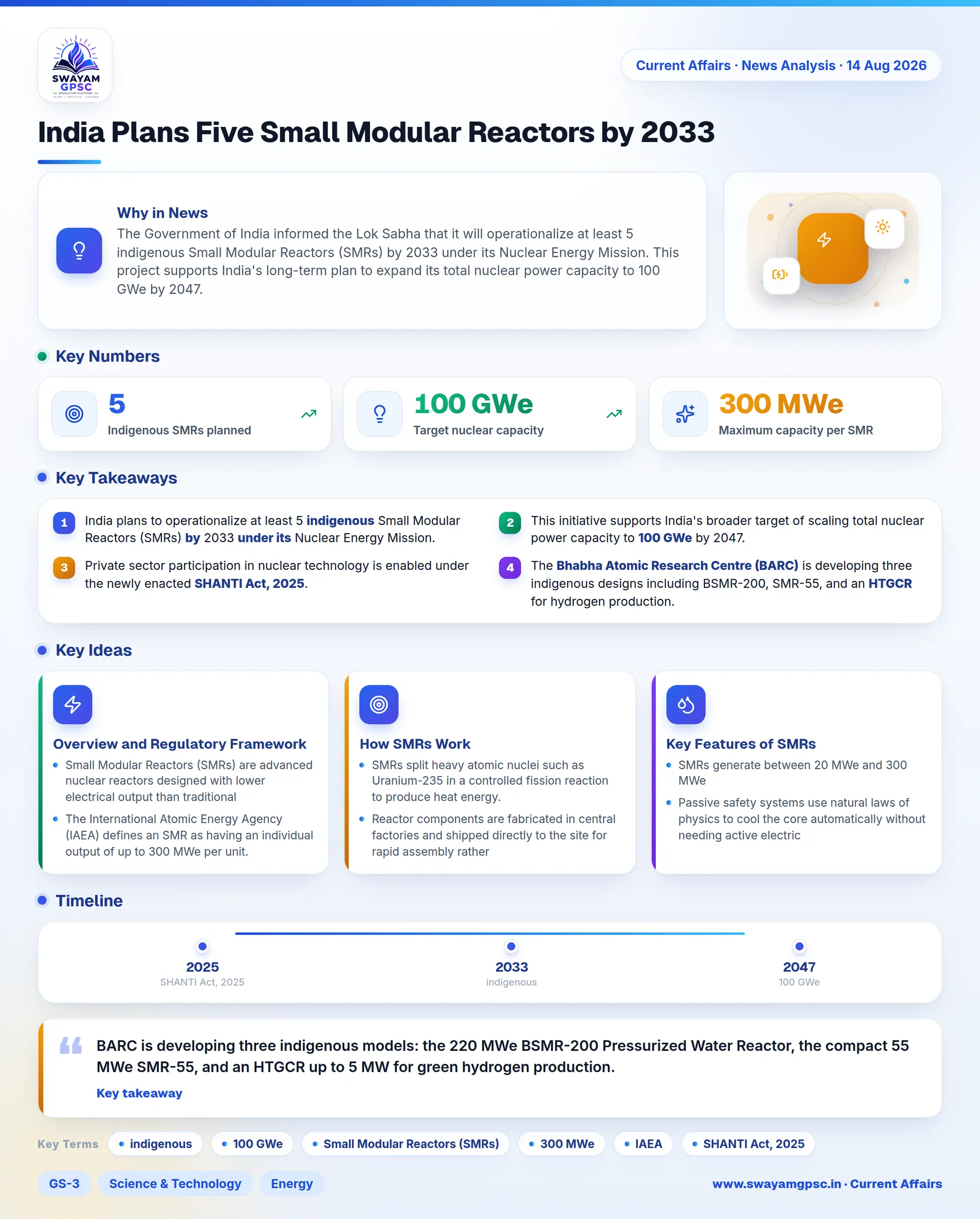
India Plans Five Small Modular Reactors by 2033
#GS-3 #Science & Technology #Energy #Current Events #National #Small Modular Reactors #SHANTI Act 2025 #BARC
Key takeaways
- India plans to operationalize at least 5 indigenous Small Modular Reactors (SMRs) by 2033 under its Nuclear Energy Mission.
- This initiative supports India's broader target of scaling total nuclear power capacity to 100 GWe by 2047.
- Private sector participation in nuclear technology is enabled under the newly enacted SHANTI Act, 2025.
- The Bhabha Atomic Research Centre (BARC) is developing three indigenous designs including BSMR-200, SMR-55, and an HTGCR for hydrogen production.
Why in News
- The Government of India informed the Lok Sabha that it will operationalize at least 5 indigenous Small Modular Reactors (SMRs) by 2033 under its Nuclear Energy Mission.
- This project supports India's long-term plan to expand its total nuclear power capacity to 100 GWe by 2047.
Overview and Regulatory Framework
- Small Modular Reactors (SMRs) are advanced nuclear reactors designed with lower electrical output than traditional gigawatt-scale plants.
- The International Atomic Energy Agency (IAEA) defines an SMR as having an individual output of up to 300 MWe per unit.
- Global SMR designs are monitored by the IAEA and the OECD Nuclear Energy Agency (NEA).
- In India, the Bhabha Atomic Research Centre (BARC) under the Department of Atomic Energy (DAE) serves as the lead developer.
- Private sector participation in nuclear technology manufacturing and deployment is enabled under the SHANTI Act, 2025.
- The main objective is to deliver clean baseload power and industrial heat with reduced upfront costs, faster timelines, and a smaller land footprint.
How SMRs Work
- SMRs split heavy atomic nuclei such as Uranium-235 in a controlled fission reaction to produce heat energy.
- Reactor components are fabricated in central factories and shipped directly to the site for rapid assembly rather than undergoing decade-long civil construction.
- The generated thermal heat creates steam to drive turbines for electricity or supplies high-temperature heat directly to industries.
Key Features of SMRs
- SMRs generate between 20 MWe and 300 MWe, requiring much less land area and lower cooling water volume than 1,000 MWe plants.
- Passive safety systems use natural laws of physics to cool the core automatically without needing active electric power or human intervention.
- Power companies can add reactor modules sequentially as regional demand grows over time.
- BARC is developing three indigenous models: the 220 MWe BSMR-200 Pressurized Water Reactor, the compact 55 MWe SMR-55, and an HTGCR up to 5 MW for green hydrogen production.
- Factory serial manufacturing cuts construction delays, lowers financing costs, and reduces site engineering risks.