India's Pharmaceutical Sector Growth and Future Path
#GS-3 #Economy #Infrastructure #Science & Technology #Health #Current Events #National
Key takeaways
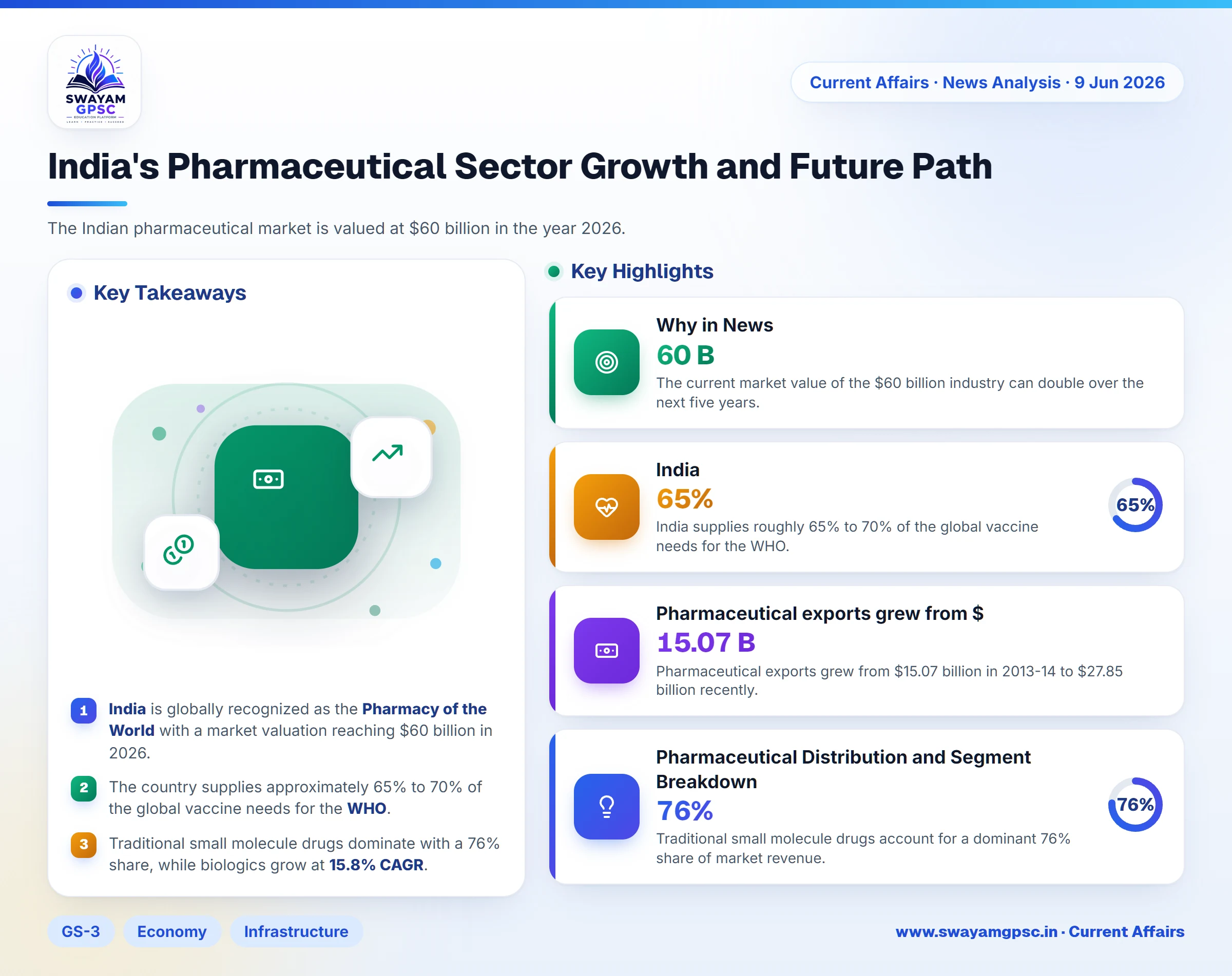
- India is globally recognized as the Pharmacy of the World with a market valuation reaching $60 billion in 2026.
- The country supplies approximately 65% to 70% of the global vaccine needs for the WHO.
- Traditional small molecule drugs dominate with a 76% share, while biologics grow at 15.8% CAGR.
- India imports roughly $4.35 billion in raw materials, with 73.7% coming from a single country.
- The Biopharma Shakti initiative and a $10 billion R&D fund aim to boost domestic drug discovery.
Why in News
- The Union Minister of Commerce and Industry invited international pharma firms to invest in the healthcare sector of India.
- The current market value of the $60 billion industry can double over the next five years.
About India's Pharmaceutical Sector
- The global community recognizes India as the Pharmacy of the World for public health support.
- The sector manufactures affordable generic drugs, vaccines, APIs, and complex biosimilars.
Key Data and Statistics
- The Indian pharmaceutical market is valued at $60 billion in the year 2026.
- India supplies roughly 65% to 70% of the global vaccine needs for the WHO.
- The country hosts 10 of the world's 25 largest generic drug makers.
- India holds the highest number of US FDA approved manufacturing plants outside the United States.
- Pharmaceutical exports grew from $15.07 billion in 2013-14 to $27.85 billion recently.
Pharmaceutical Distribution and Segment Breakdown
- Traditional small molecule drugs account for a dominant 76% share of market revenue.
- Biologics and biosimilars form the fastest-growing sector with an estimated 15.8% CAGR.
- Cardiovascular categories hold a 14.6% market share as chronic therapies expand rapidly.
- Brick-and-mortar retail pharmacies handle 64.57% of all domestic medicine sales.
- West India, featuring Gujarat and Maharashtra, retains a 32.24% share of total market output.
Challenges
- India imports roughly $4.35 billion worth of bulk drugs and intermediates annually.
- A single country accounts for 73.7% of these raw material imports.
- Indian firms invest only 7% to 8% of revenues into core R&D compared to global levels.
- Compliance upgrades and site cleaning cost $6 million to $18 million per facility.
- Strict domestic price controls and global competition create intense profit pressures.
Way Forward
- Public and private funding must coordinate to shift focus toward advanced specialty biologics.
- The bulk drug PLI Scheme should expand to reduce dependency on imported starting materials.
- The Biopharma Shakti initiative and a $10 billion R&D fund will provide high-risk capital.
- The revised Schedule M guidelines will align domestic factories with international GMP standards.
- Advanced artificial intelligence tools can automate digital audits and lower operational costs.